Home
Home

1.Identification
1.1 GHS Product identifier
| Product name | bisphenol A |
|---|
1.2 Other means of identification
| Product number | - |
|---|---|
| Other names | Bisphenol A |
1.3 Recommended use of the chemical and restrictions on use
| Identified uses | For industry use only. Adhesives and sealant chemicals,CBI,Flame retardants,Intermediates,Paint additives and coating additives not described by other categories |
|---|---|
| Uses advised against | no data available |
1.4 Supplier's details
| Company | MOLBASE (Shanghai) Biotechnology Co., Ltd. |
|---|---|
| Address | Floor 4 & 5, Building 12, No. 1001 North Qinzhou Road, Xuhui District, Shanghai, China |
| Telephone | +86(21)64956998 |
| Fax | +86(21)54365166 |
1.5 Emergency phone number
| Emergency phone number | +86-400-6021-666 |
|---|---|
| Service hours | Monday to Friday, 9am-5pm (Standard time zone: UTC/GMT +8 hours). |
2.Hazard identification
2.1 Classification of the substance or mixture
Serious eye damage, Category 1
Skin sensitization, Category 1
Specific target organ toxicity – single exposure, Category 3
Reproductive toxicity, Category 1B
2.2 GHS label elements, including precautionary statements
| Pictogram(s) | 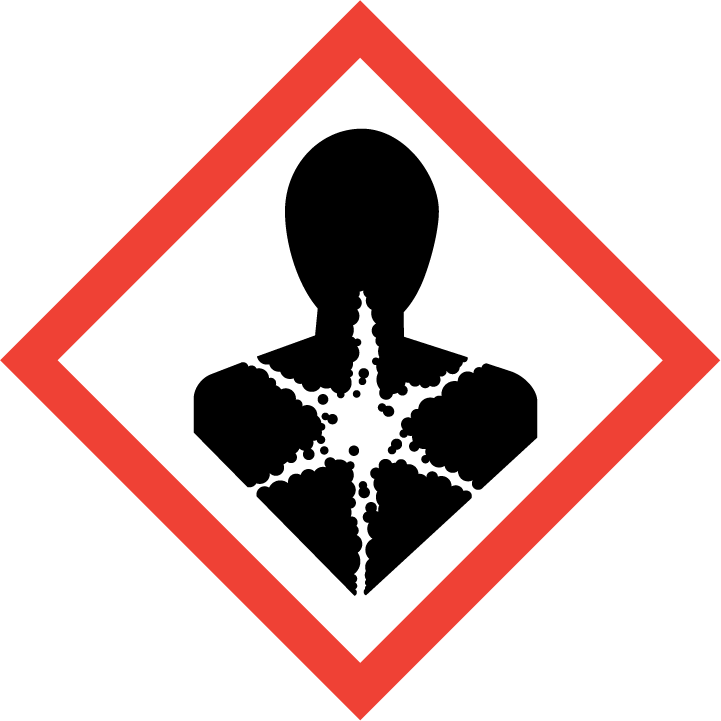 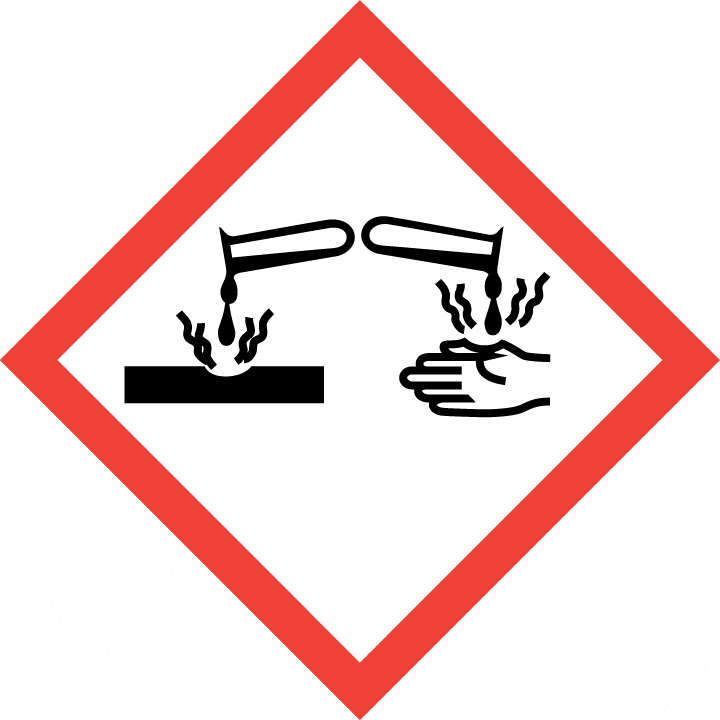  |
|---|---|
| Signal word | Danger |
| Hazard statement(s) | H318 Causes serious eye damage H317 May cause an allergic skin reaction H335 May cause respiratory irritation H360F |
| Precautionary statement(s) | |
| Prevention | P280 Wear protective gloves/protective clothing/eye protection/face protection. P261 Avoid breathing dust/fume/gas/mist/vapours/spray. P272 Contaminated work clothing should not be allowed out of the workplace. P271 Use only outdoors or in a well-ventilated area. P201 Obtain special instructions before use. P202 Do not handle until all safety precautions have been read and understood. |
| Response | P305+P351+P338 IF IN EYES: Rinse cautiously with water for several minutes. Remove contact lenses, if present and easy to do. Continue rinsing. P310 Immediately call a POISON CENTER/doctor/… P302+P352 IF ON SKIN: Wash with plenty of water/... P333+P313 If skin irritation or rash occurs: Get medical advice/attention. P321 Specific treatment (see ... on this label). P362+P364 Take off contaminated clothing and wash it before reuse. P304+P340 IF INHALED: Remove person to fresh air and keep comfortable for breathing. P312 Call a POISON CENTER/doctor/…if you feel unwell. P308+P313 IF exposed or concerned: Get medical advice/ attention. |
| Storage | P403+P233 Store in a well-ventilated place. Keep container tightly closed. P405 Store locked up. |
| Disposal | P501 Dispose of contents/container to ... |
2.3 Other hazards which do not result in classification
none
3.Composition/information on ingredients
3.1 Substances
| Chemical name | Common names and synonyms | CAS number | EC number | Concentration |
|---|---|---|---|---|
| bisphenol A | bisphenol A | 80-05-7 | none | 100% |
4.First-aid measures
4.1 Description of necessary first-aid measures
General advice
Consult a physician. Show this safety data sheet to the doctor in attendance.
If inhaled
Fresh air, rest. Seek medical attention if you feel unwell.
In case of skin contact
Remove contaminated clothes. Rinse and then wash skin with water and soap. Seek medical attention if you feel unwell.
In case of eye contact
First rinse with plenty of water for several minutes (remove contact lenses if easily possible), then refer for medical attention.
If swallowed
Rinse mouth. Give one or two glasses of water to drink. Refer for medical attention .
4.2 Most important symptoms/effects, acute and delayed
Dusts irritating to upper respiratory passages; may cause sneezing. (USCG, 1999)
4.3 Indication of immediate medical attention and special treatment needed, if necessary
/SRP:/ Immediate first aid: Ensure that adequate decontamination has been carried out. If patient is not breathing, start artificial respiration, preferably with a demand valve resuscitator, bag-valve-mask device, or pocket mask, as trained. Perform CPR if necessary. Immediately flush contaminated eyes with gently flowing water. Do not induce vomiting. If vomiting occurs, lean patient forward or place on the left side (head-down position, if possible) to maintain an open airway and prevent aspiration. Keep patient quiet and maintain normal body temperature. Obtain medical attention. /Poisons A and B/
5.Fire-fighting measures
5.1 Extinguishing media
Suitable extinguishing media
Use water spray, foam, powder, carbon dioxide.
5.2 Specific hazards arising from the chemical
This chemical is combustible. This compound may form explosive dust clouds. Static electricity can cause its dust to explode.
5.3 Special protective actions for fire-fighters
Wear self-contained breathing apparatus for firefighting if necessary.
6.Accidental release measures
6.1 Personal precautions, protective equipment and emergency procedures
Use personal protective equipment. Avoid dust formation. Avoid breathing vapours, mist or gas. Ensure adequate ventilation. Evacuate personnel to safe areas. Avoid breathing dust. For personal protection see section 8.
6.2 Environmental precautions
Personal protection: particulate filter respirator adapted to the airborne concentration of the substance. Do NOT let this chemical enter the environment. Sweep spilled substance into sealable containers. If appropriate, moisten first to prevent dusting. Carefully collect remainder. Then store and dispose of according to local regulations.
6.3 Methods and materials for containment and cleaning up
Evacuate and restrict persons not wearing protective equipment from area of spill or leak until cleanup is complete. Remove all ignition sources. Vacuum cleaning is preferable to sweeping to keep dust levels down. Use special HEPA vacuum; not a shop vacuum. Ventilate area of spill or leak after cleanup is complete. It may be necessary to contain and dispose of this chemical as a hazardous waste. If material or contaminated runoff enters waterways, notify downstream users of potentially contaminated waters. Contact your Department of Environmental Protection or your regional office of the federal EPA for specific recommendations. If employees are required to clean up spills, they must be properly trained and equipped. OSHA 1910.120(q) may be applicable.
7.Handling and storage
7.1 Precautions for safe handling
Avoid contact with skin and eyes. Avoid formation of dust and aerosols. Avoid exposure - obtain special instructions before use.Provide appropriate exhaust ventilation at places where dust is formed. For precautions see section 2.2.
7.2 Conditions for safe storage, including any incompatibilities
Separated from acid anhydrides, acid chlorides, strong oxidants, strong bases and food and feedstuffs. Store in an area without drain or sewer access.Safe Storage: Separated from acid anhydrides, acid chlorides, strong oxidants, strong bases and food and feedstuffs. Store in an area without drain or sewer access.
8.Exposure controls/personal protection
8.1 Control parameters
Occupational Exposure limit values
no data available
Biological limit values
no data available
8.2 Appropriate engineering controls
Handle in accordance with good industrial hygiene and safety practice. Wash hands before breaks and at the end of workday.
8.3 Individual protection measures, such as personal protective equipment (PPE)
Eye/face protection
Safety glasses with side-shields conforming to EN166. Use equipment for eye protection tested and approved under appropriate government standards such as NIOSH (US) or EN 166(EU).
Skin protection
Wear impervious clothing. The type of protective equipment must be selected according to the concentration and amount of the dangerous substance at the specific workplace. Handle with gloves. Gloves must be inspected prior to use. Use proper glove removal technique(without touching glove's outer surface) to avoid skin contact with this product. Dispose of contaminated gloves after use in accordance with applicable laws and good laboratory practices. Wash and dry hands. The selected protective gloves have to satisfy the specifications of EU Directive 89/686/EEC and the standard EN 374 derived from it.
Respiratory protection
Wear dust mask when handling large quantities.
Thermal hazards
no data available
9.Physical and chemical properties
| Physical state | White to light brown flakes or powder |
|---|---|
| Colour | Crystallizes as prisms from dil acetic acid and as needles from water |
| Odour | Mild phenolic odor |
| Melting point/ freezing point | 13°C(lit.) |
| Boiling point or initial boiling point and boiling range | 220°C/4mmHg(lit.) |
| Flammability | Combustible. |
| Lower and upper explosion limit / flammability limit | no data available |
| Flash point | 227°C |
| Auto-ignition temperature | 510-570 Deg C |
| Decomposition temperature | no data available |
| pH | no data available |
| Kinematic viscosity | no data available |
| Solubility | less than 1 mg/mL at 21.5°C |
| Partition coefficient n-octanol/water (log value) | log Kow = 3.32 |
| Vapour pressure | 0.2 mm Hg at 170°C ; 1 mm Hg at 193°C |
| Density and/or relative density | 1.195 |
| Relative vapour density | no data available |
| Particle characteristics | no data available |
10.Stability and reactivity
10.1 Reactivity
no data available
10.2 Chemical stability
Stable under recommended storage conditions.
10.3 Possibility of hazardous reactions
CombustibleDust explosion possible if in powder or granular form, mixed with air.4,4'-ISOPROPYLIDENEDIPHENOL is incompatible with strong oxidizers. It is also incompatible with strong bases, acid chlorides and acid anhydrides.
10.4 Conditions to avoid
no data available
10.5 Incompatible materials
Strong oxidizers, strong bases, acid chlorides, and acid anhydrides.
10.6 Hazardous decomposition products
When heated to decomposition it emits acrid and irritating fumes.
11.Toxicological information
Acute toxicity
- Oral: LD50 Rat (male, F344) oral 4100 mg/kg
- Inhalation: no data available
- Dermal: no data available
Skin corrosion/irritation
no data available
Serious eye damage/irritation
no data available
Respiratory or skin sensitization
no data available
Germ cell mutagenicity
no data available
Carcinogenicity
no data available
Reproductive toxicity
no data available
STOT-single exposure
no data available
STOT-repeated exposure
no data available
Aspiration hazard
no data available
12.Ecological information
12.1 Toxicity
- Toxicity to fish: LC50; Species: Menidia menidia (Atlantic silverside); Conditions: saltwater, flow through, 22°C, salinity 20 ppt; Concentration: 12000 ug/L for 24 hr (95% confidence interval: 9800-16000 ug/L) /polycarbonate grade, 99.93% purity
- Toxicity to daphnia and other aquatic invertebrates: EC50; Species: Daphnia magna (Water flea); Conditions: freshwater, static, 20°C; Concentration: 15500 ug/L for 24 hr (95% confidence interval: 14400-16700 ug/L); Effect: intoxication, immobilization /polycarbonate grade, 99.93% purity
- Toxicity to algae: EC50; Species: Selenastrum capricornutum (Algae); Concentration: 2.7-3.1 mg/L for 96hr; EC50 values are based on 50% inhibition of cell count (2.7 mg/L) and total cell volume (3.1 mg/L) compared to controls. /Conditions of bioassay not specified
- Toxicity to microorganisms: no data available
12.2 Persistence and degradability
AEROBIC: Bisphenol A, present at 3 mg/L, exhibited a half-life of 3 days when incubated using natural receiving waters from a bisphenol A plant discharge in Houston, TX; a half-life of 2.5 days was measured using Patricks Bayou water, obtained 200 yards downstream from the plant discharge, and a half-life of 4 days was measured using Houston Ship Channel water(1). Loss was attributed to biodegradation since 3 mg/L bisphenol A in a control sample (deionized water) underwent no observable change in concentration over the 8 day test period(1). Incubation of 105 mg/L bisphenol A in an acclimated activated sludge inocula from an industrial wastewater treatment plant resulted in 72% COD removal in 24 hours(2). Using the OECD biodegradation screening test with domestic sewage as seed, <1% degradation was observed in 28 days(1). Bisphenol A was not oxidized in either the Closed Bottle Test nor the Modified Sturm Test; these results indicate a possible lack of acclimation by a domestic sludge as the compound was degraded in biotreators of chemical plants where the compound was produced or used(1). Bisphenol A, present at 100 mg/L, reached 0% of its theoretical BOD in 2 weeks using an activated sludge inoculum at 30 mg/L and the Japanese MITI test(3). Of 40 Japanese river microcosms and 3 activated sludge samples tested, only 6 could completely mineralize this compound, resulting in 2 common metabolites: 2,3-bis(4-hydroxyphenyl)-1,2-propanediol and p-hydroxyphenacyl alcohol; 19 bacteria were isolated from these activated sludge and river water samples(4). Further testing with the pure cultures suggested that bisphenol A-degrading bacteria exist in aquatic environments but they are unable to completely degrade this compound, leading to accumulation of more recalcitrant metabolites(4). In 22-day aerobic river die-away tests using several river water samples in 24 microcosms, bisphenol A showed complete degradation in 19 microcosms (complete mineralization in two microcosms) and no degradation in 5 microcosms(5).
12.3 Bioaccumulative potential
BCF ranges of <20 to approximately 67.7 and 5.1 to 13.3 from starting concentrations of 15 and 150 mg/L, respectively, were measured for bisphenol A using carp (Cyprinus carpio) which were exposed over an 8-week period(1). The following experimentally-determined BCF values have also been reported(2): 38 in spotted halibut (Varaspar variegates), 73.4 in killfish (Oryzias latipes). According to a classification scheme(3), these BCF values suggest the potential for bioconcentration in aquatic organisms is low to moderate(SRC). The BCF in freshwater clams, Pisidium amninum, was 114, 128, 134, and 107 at and 1.8, 5.8, 8.4, and 11.6°C, respectively, suggesting the importance of temperature on the processes that control uptake and elimination by aquatic biota(4).
12.4 Mobility in soil
A mean Koc value of 796 for bisphenol A was measured in soil adsorption experiments using four different agricultural soils from North-Rhine Westphalia and Rhineland-Palatinate, Germany and a bisphenol A concentration range of 0.04 to 5.00 mg/L; Koc values ranged from 636-931(1). Leaching studies in turf grass fields having loamy sand and sandy loam soils determined respective Koc values of 1751 and 3886(3); bisphenol A did not leach below a 30 cm soil layer(3). Batch experiments using soil samples from South Australia found Koc values ranging from 251 to 1507 (mean of 962)(4). Batch experiments using two acid sandy soils determined bisphenol A Koc values ranging from 335 to 703 (average of 375)(5). According to a classification scheme(6), a Koc range of 115 to 3886 suggests that Bisphenol A may have high to slight mobility in soil. Most of the measured Koc values suggest that bisphenol A may have moderate to low mobility in soil(SRC). The pKa of bisphenol A is 9.6(7), indicating that this compound will exist partially in anion form in the environment and anions generally do not adsorb more strongly to soils containing organic carbon and clay than their neutral counterparts(8). The partial dissociation of Bisphenol A in environmental media may be one reason for the wide range of observed soil adsorptions(SRC). An average bisphenol A Koc of 115 was determined in sorption studies using sediments from five locations on the Xiangjiang River in China(2).
12.5 Other adverse effects
no data available
13.Disposal considerations
13.1 Disposal methods
Product
The material can be disposed of by removal to a licensed chemical destruction plant or by controlled incineration with flue gas scrubbing. Do not contaminate water, foodstuffs, feed or seed by storage or disposal. Do not discharge to sewer systems.
Contaminated packaging
Containers can be triply rinsed (or equivalent) and offered for recycling or reconditioning. Alternatively, the packaging can be punctured to make it unusable for other purposes and then be disposed of in a sanitary landfill. Controlled incineration with flue gas scrubbing is possible for combustible packaging materials.
14.Transport information
14.1 UN Number
| ADR/RID: UN3077 | IMDG: UN3077 | IATA: UN3077 |
14.2 UN Proper Shipping Name
| ADR/RID: ENVIRONMENTALLY HAZARDOUS SUBSTANCE, SOLID, N.O.S. |
| IMDG: ENVIRONMENTALLY HAZARDOUS SUBSTANCE, SOLID, N.O.S. |
| IATA: ENVIRONMENTALLY HAZARDOUS SUBSTANCE, SOLID, N.O.S. |
14.3 Transport hazard class(es)
| ADR/RID: 9 | IMDG: 9 | IATA: 9 |
14.4 Packing group, if applicable
| ADR/RID: III | IMDG: III | IATA: III |
14.5 Environmental hazards
| ADR/RID: no | IMDG: no | IATA: no |
14.6 Special precautions for user
no data available
14.7 Transport in bulk according to Annex II of MARPOL 73/78 and the IBC Code
no data available
15.Regulatory information
15.1 Safety, health and environmental regulations specific for the product in question
| Chemical name | Common names and synonyms | CAS number | EC number |
|---|---|---|---|
| bisphenol A | bisphenol A | 80-05-7 | none |
| European Inventory of Existing Commercial Chemical Substances (EINECS) | Listed. | ||
| EC Inventory | Listed. | ||
| United States Toxic Substances Control Act (TSCA) Inventory | Listed. | ||
| China Catalog of Hazardous chemicals 2015 | Not Listed. | ||
| New Zealand Inventory of Chemicals (NZIoC) | Listed. | ||
| Philippines Inventory of Chemicals and Chemical Substances (PICCS) | Listed. | ||
| Vietnam National Chemical Inventory | Listed. | ||
| Chinese Chemical Inventory of Existing Chemical Substances (China IECSC) | Listed. | ||
16.Other information
Information on revision
| Creation Date | Aug 12, 2017 |
|---|---|
| Revision Date | Aug 12, 2017 |
Abbreviations and acronyms
- CAS: Chemical Abstracts Service
- ADR: European Agreement concerning the International Carriage of Dangerous Goods by Road
- RID: Regulation concerning the International Carriage of Dangerous Goods by Rail
- IMDG: International Maritime Dangerous Goods
- IATA: International Air Transportation Association
- TWA: Time Weighted Average
- STEL: Short term exposure limit
- LC50: Lethal Concentration 50%
- LD50: Lethal Dose 50%
- EC50: Effective Concentration 50%
References
- IPCS - The International Chemical Safety Cards (ICSC), website: http://www.ilo.org/dyn/icsc/showcard.home
- HSDB - Hazardous Substances Data Bank, website: https://toxnet.nlm.nih.gov/newtoxnet/hsdb.htm
- IARC - International Agency for Research on Cancer, website: http://www.iarc.fr/
- eChemPortal - The Global Portal to Information on Chemical Substances by OECD, website: http://www.echemportal.org/echemportal/index?pageID=0&request_locale=en
- CAMEO Chemicals, website: http://cameochemicals.noaa.gov/search/simple
- ChemIDplus, website: http://chem.sis.nlm.nih.gov/chemidplus/chemidlite.jsp
- ERG - Emergency Response Guidebook by U.S. Department of Transportation, website: http://www.phmsa.dot.gov/hazmat/library/erg
- Germany GESTIS-database on hazard substance, website: http://www.dguv.de/ifa/gestis/gestis-stoffdatenbank/index-2.jsp
- ECHA - European Chemicals Agency, website: https://echa.europa.eu/