


 Home
Home
I’ve recently started a small DIY project using epoxy resin, and I’m a bit confused about the drying process. Some people say it can dry in just a few hours, while others talk about waiting a whole day or more. Does the drying time depend on the type of resin, the temperature, or even the thickness of the layer you pour? I’m wondering how I can tell when it’s actually dry enough to touch or handle without messing it up? Are there tricks to make it dry faster without ruining it?
How Long for Epoxy Resin to Dry?
Related Encyclopedia
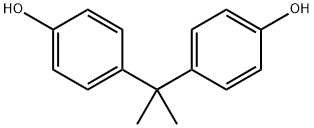
- 80-05-7
- C15H16O2
- 228.29
- All (98)
- China (5)
- (98)
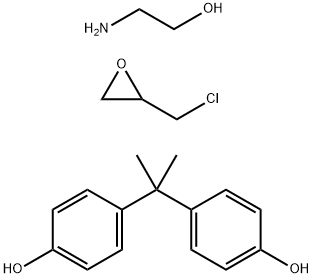
- 38891-59-7
- C20H28ClNO4
- 381.9
- All (2)
- China (0)
- (2)
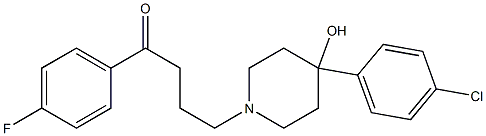
- 61788-97-4
- C21H23ClFNO2
- 375.8642232
- All (1)
- China (0)
- (1)
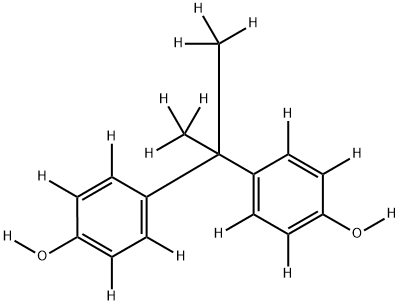
- 96210-87-6
- C15H16O2
- 228.29
- All (0)
- China (0)
- (0)
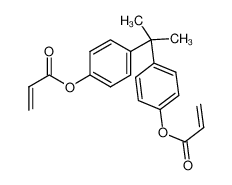
- 4491-03-6
- C21H20O4
- 336.38100
- All (0)
- China (0)
- (0)
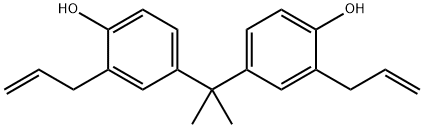
- 1745-89-7
- C21H24O2
- 308.41
- All (1)
- China (0)
- (1)

- 37353-75-6
- C21H28O4
- 344.44
- All (3)
- China (3)
- (3)
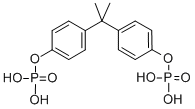
- 181028-79-5
- C15H18O8P2
- 388.25
- All (2)
- China (0)
- (2)
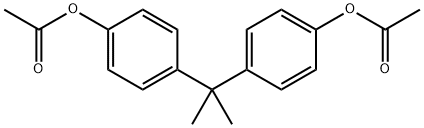
- 10192-62-8
- C19H20O4
- 312.36
- All (1)
- China (0)
- (1)
- 3253-39-2
- C23H24O4
- 364.43
- All (1)
- China (0)
- (1)
Related Products More >

- CNY Request For Quotation
- CNY Request For Quotation
- CNY Request For Quotation
- USD 340.0000
- 200kg
- 25085-99-8
- USD 490.0000
- 240kg
- 13732-62-2
- CNY 11500.0000
- 1ton
- 94334-64-2
- Request For Quotation


The timeframe for this process is governed by the resin's chemical formula and ambient conditions. A critical factor is the cure type: fast-setting formulations may become tack-free in as little as four to six hours, while deep, full curing often requires 24 to 72 hours. Environmental temperature plays a pivotal role; a warmer environment accelerates the molecular activity and reaction speed, whereas cooler temperatures significantly slow it down. The mixed ratio of resin to hardener is another fundamental variable, as an incorrect ratio can lead to an incomplete cure, leaving the material permanently soft or sticky.
In practical application, a woodworker creating a river table must first achieve a demold time, often around 24 hours, before carefully removing the casting. However, the piece cannot be subjected to heavy machining or sanding until it has reached a full cure, which might take another few days. Only then will the epoxy possess its ultimate durability and clarity. Similarly, a floor coating in a garage requires a specific window to become walk-on dry, but full cure and maximum resistance to automotive chemicals and weight develop over a longer period, sometimes up to a week.
Curing, which follows or overlaps with drying, is the critical chemical process where the resin and hardener undergo cross-linking, forming a three-dimensional polymer network. This is what gives epoxy its strength, durability, and chemical resistance. Unlike drying, curing is irreversible and temperature-dependent; most epoxies require a minimum temperature (often 15–20°C) for the cross-linking reaction to proceed efficiently. Even if the surface feels dry to the touch, incomplete curing means the material may remain soft, tacky, or lack structural integrity. This distinction is vital in fields like construction or manufacturing, where confusing drying with full curing can lead to premature loading of epoxy bonds, resulting in failure.
Several variables influence the total time from application to full curing, beyond just temperature. The resin-to-hardener ratio is precise—deviating from the recommended mix can either slow curing drastically or cause uneven cross-linking, leaving parts of the epoxy permanently uncured. Thickness of the application also plays a role; thicker layers generate more heat during curing (an exothermic reaction), which can speed up the process but may also lead to cracking if the heat builds too quickly. In professional settings, such as aerospace or marine engineering, where epoxy is used for structural bonding or coating, understanding these nuances is non-negotiable. For example, a marine coating that hasn’t fully cured might not resist saltwater penetration, compromising the integrity of the underlying material over time.
A common misunderstanding is assuming that a dry surface indicates full readiness for use. In reality, "dry to the touch" might only mean the surface layer has cured enough to not transfer to hands, while the bulk material is still undergoing cross-linking. Full curing can take anywhere from 24 hours to several days, depending on the formulation—some high-performance epoxies used in industrial molds may require post-curing at elevated temperatures for 8–12 hours to reach their maximum mechanical properties. This is why manufacturers provide specific cure schedules, including minimum curing times at different temperatures, which professionals must follow to ensure the epoxy performs as intended. Ignoring these guidelines can lead to costly errors, such as in electronics manufacturing, where an under-cured epoxy encapsulant might not protect components from moisture or vibration.
In practical applications, understanding the drying time is critical because it affects both the handling and the mechanical properties of the final product. For instance, in industrial coatings or laminates, insufficient curing can lead to softness, stickiness, or incomplete chemical bonding, which compromises durability. In contrast, allowing the resin to fully cure ensures optimal hardness, chemical resistance, and adhesion to substrates. The time needed can range from a few hours for thin coatings at elevated temperatures to several days for thicker casts or complex molds at room temperature. Adjusting environmental conditions, such as using controlled heat or ventilated spaces, can influence the speed and uniformity of curing without altering the material’s final performance.
From a cross-disciplinary perspective, the drying behavior of epoxy resin connects chemistry, materials science, and practical engineering. Its chemical mechanism demonstrates principles of polymerization and exothermic reactions, while its physical properties—like viscosity changes and thermal sensitivity—affect handling strategies in construction, art, and medical devices. In everyday life, knowing how long it takes for epoxy to dry helps hobbyists, craftsmen, and engineers plan their projects efficiently and avoid errors like smudging, warping, or adhesion failure. This interplay between molecular chemistry and practical use illustrates how theoretical knowledge directly informs real-world applications, making epoxy resin a widely versatile material.