


 Home
Home
Hello, I want to ask about ABS plastic safety: Does ABS plastic really not contain BPA? How safe is ABS compared to other plastics? Are there any health concerns with long-term use? What alternatives would you recommend for daily use items?
Is ABS plastic BPA free, and what implications does that have for consumer health and safety?
Related Encyclopedia
- 49603-39-6
- C14H18
- 186.29300
- All (0)
- China (0)
- (0)
- 80-05-7
- C15H16O2
- 228.29
- All (98)
- China (5)
- (98)
- 9003-55-8
- (C8H8.C4H6)x
- 158.24
- All (5)
- China (1)
- (5)
- 9003-18-3
- C7H9N
- 107.16
- All (0)
- China (0)
- (0)
- 122973-06-2
- C6H5NO+
- 108.11800
- All (38)
- China (36)
- (38)
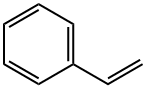
- 100-42-5
- C8H8
- 104.15
- All (38)
- China (36)
- (38)
- 79637-11-9
- C8H8
- 104.15000
- All (38)
- China (36)
- (38)
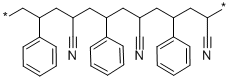
- 9003-54-7
- C33H33N3X2
- 471.64
- All (2)
- China (0)
- (2)
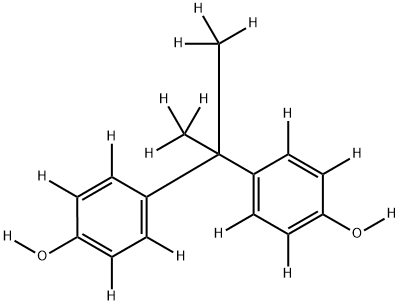
- 96210-87-6
- C15H16O2
- 228.29
- All (0)
- China (0)
- (0)
- 4491-03-6
- C21H20O4
- 336.38100
- All (0)
- China (0)
- (0)
Related Products More >

- CNY Request For Quotation
- CNY Request For Quotation
- CNY Request For Quotation
- CNY Request For Quotation
- CNY Request For Quotation


Since ABS plastic lacks BPA, it poses fewer risks related to BPA exposure. However, ABS itself can release other chemicals under certain conditions, such as high heat or prolonged exposure to solvents, which might cause irritation or toxicity depending on the situation. From a clinical perspective, patients with sensitivities to plastic additives should be cautious about prolonged contact or ingestion exposure.
For safer alternatives, consumers may opt for BPA-free labeled plastics or non-plastic materials such as glass or stainless steel, especially for food and drink storage. Additionally, avoiding heating plastics and using plastics designed for food safety reduces potential chemical leaching.
If managing concerns about chemical exposure from plastics, consulting with healthcare professionals and choosing products verified by regulatory agencies can be helpful steps to reduce risk.
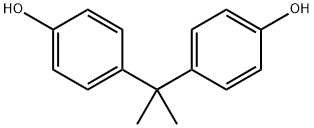
Importantly, ABS plastic does not contain bisphenol A (BPA), a chemical used mainly in polycarbonate plastics and epoxy resins. BPA has two phenol groups linked by a carbon bridge and is known for endocrine-disrupting effects in biological systems by mimicking estrogen, affecting hormone receptors and gene expression. Since ABS lacks this structure, it does not share BPA’s biological activity or related health risks.
From a stability perspective, ABS is chemically stable under normal use conditions, resistant to heat and many solvents, which makes it common in products like automotive parts, electronic housings, and kitchen utensils. However, under extreme heat or UV exposure, the polymer chains can degrade, leading to changes in mechanical properties and potential release of minor breakdown products.
In biological contexts, materials that do not leach harmful chemicals like BPA are preferable to avoid disrupting cellular signaling and endocrine balance. In industry and daily life, choosing ABS over BPA-containing plastics can reduce such risks.
A key question for you to ponder: How might the chemical structure of a polymer influence not only its physical properties but also its interaction with biological systems?
First, ABS plastic (Acrylonitrile Butadiene Styrene) is naturally BPA-free. Unlike polycarbonate plastics (often used in reusable water bottles or baby bottles), ABS doesn’t contain bisphenol A (BPA) or its common replacements (like BPS or BPF). This makes it a safer option for items that come into contact with food, drinks, or little mouths. However, that doesn’t mean all ABS products are created equal—factors like manufacturing quality, additives, and how you use them still matter.
Where the product comes from and how it’s made can affect safety. Some cheaper ABS items might use recycled plastics or additives (like colorants or stabilizers) that haven’t been tested for safety. For families with young kids, look for toys labeled “non-toxic” or “food-safe” ABS, especially if they’ll be chewed on. For kitchen tools (like spatulas or cutting boards), choose brands that explicitly state their ABS is FDA-approved for food contact.
A common误区 (Chinese for “misconception”) is assuming all hard plastics contain BPA. While polycarbonate and some epoxy resins do, ABS is a different material altogether—it’s more flexible, heat-resistant, and impact-resistant, which is why it’s used in LEGO bricks, phone cases, and even car parts. Another myth? That BPA-free means “completely safe.” Some ABS products might contain other chemicals (like phthalates or flame retardants) depending on the manufacturer, so checking labels is still important.
For family-friendly ABS use, keep it simple:
Check labels: Look for terms like “BPA-free,” “non-toxic,” or “FDA-compliant” on toys, kitchenware, or storage containers.
Avoid extreme heat: Don’t microwave ABS containers or leave them in hot cars—high temps can cause warping or release fumes (though not BPA, since it’s not present).
Replace scratched items: Deep scratches in plastic can harbor bacteria, so toss or recycle worn-out ABS kitchen tools or toys.
Teach kids to handle safely: Show them not to chew on non-food-grade plastics (like old phone cases or random ABS parts) to avoid ingesting additives.
By understanding what ABS plastic is—and isn’t—your family can use it confidently for everything from playtime to meal prep. After all, a little knowledge goes a long way toward keeping your home safe and functional!
Think of it like cookies: chocolate chip and sugar cookies are both cookies, but they use different ingredients. BPA is like chocolate chips—some plastics have it, but ABS is more like a sugar cookie, made without that specific ingredient.
If you’re using ABS items (like some toys or phone cases), no need to avoid them for BPA reasons. But if you’re picking food containers, check labels anyway—better safe than sorry, even if ABS itself is BPA-free. Easy enough!