


 Home
Home
I just bought some epoxy resin and I’m wondering how long it actually takes to set. I’ve seen different times mentioned online, and it seems to depend on a bunch of things like temperature, thickness, and the type of resin I’m using. Sometimes people say it’s a few hours, other times a full day. If I’m doing a small craft project versus coating a table, how do I know when it’s safe to touch or move it? How long does epoxy resin really take to set?
How Long Does It Take Epoxy Resin to Set?
Related Encyclopedia
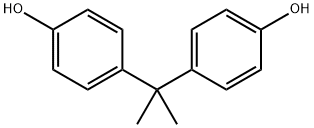
- 80-05-7
- C15H16O2
- 228.29
- All (98)
- China (5)
- (98)
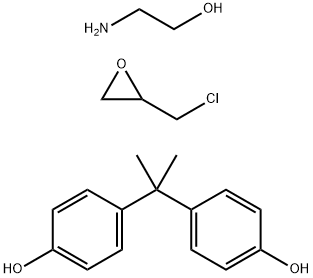
- 38891-59-7
- C20H28ClNO4
- 381.9
- All (2)
- China (0)
- (2)
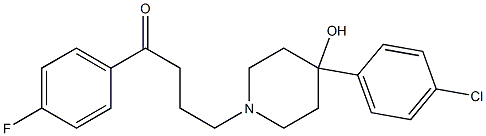
- 61788-97-4
- C21H23ClFNO2
- 375.8642232
- All (1)
- China (0)
- (1)
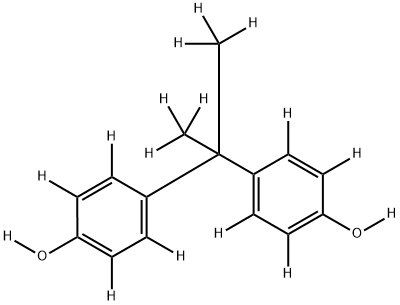
- 96210-87-6
- C15H16O2
- 228.29
- All (0)
- China (0)
- (0)
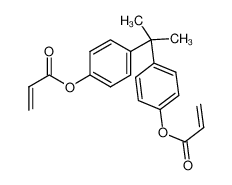
- 4491-03-6
- C21H20O4
- 336.38100
- All (0)
- China (0)
- (0)
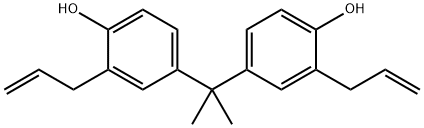
- 1745-89-7
- C21H24O2
- 308.41
- All (1)
- China (0)
- (1)

- 37353-75-6
- C21H28O4
- 344.44
- All (3)
- China (3)
- (3)
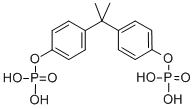
- 181028-79-5
- C15H18O8P2
- 388.25
- All (2)
- China (0)
- (2)
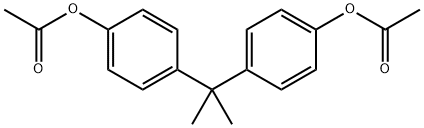
- 10192-62-8
- C19H20O4
- 312.36
- All (1)
- China (0)
- (1)
- 3253-39-2
- C23H24O4
- 364.43
- All (1)
- China (0)
- (1)
Related Products More >

- 9003-55-8
- CNY Request For Quotation
- CNY Request For Quotation
- CNY Request For Quotation
- CNY Request For Quotation


The setting time of epoxy resin is distinct from its curing time, a common point of confusion. Setting refers to the point at which the material is no longer fluid and can support light weight, while curing is the full development of mechanical properties like hardness and strength, which may continue for hours or even days after setting. Environmental factors also play a role: temperature accelerates the reaction, so a resin that sets in 30 minutes at 25°C might set in 15 minutes at 35°C, while cold conditions can delay setting to several hours.
In engineering and manufacturing, understanding setting time is critical for process control. For instance, in composite material layup, the resin must remain fluid long enough to wet out the reinforcement fibers but set quickly enough to maintain the desired shape during curing. In adhesive applications, setting time determines how long parts must be clamped together—too short a setting time may not allow proper alignment, while too long can slow production timelines. Even small variations in setting time, due to batch differences in resin or curing agent, can impact the quality of the final product, making precise control of this parameter essential.
The underlying chemistry involves the cross-linking of polymer chains, where molecules in the resin and hardener form covalent bonds. This network formation gradually increases the material’s viscosity and eventually leads to a solid, structurally stable state. From a physical perspective, the transition from liquid to solid can be observed as a progressive stiffening; initially the resin is pourable, then tacky, and finally fully rigid. Biologically and environmentally, epoxy is generally inert once cured, making it suitable for applications where non-reactivity is important, such as coatings on food-contact surfaces or medical devices.
In practical contexts, understanding the setting time of epoxy resin is essential for both domestic and industrial applications. In everyday scenarios, hobbyists using epoxy for crafts, jewelry, or tabletop coatings need to anticipate the time before the material can be safely touched or further processed. In industry, epoxy resins serve as adhesives, protective coatings, and composite materials, where precise timing influences workflow efficiency and structural integrity. In medical or scientific settings, cured epoxy is often used as a structural or insulating component, and its predictable setting behavior ensures reliability and safety.
Factors such as ambient temperature, resin-to-hardener ratio, and additives can be adjusted to modify the setting time to suit different purposes. Warmer conditions accelerate the cross-linking reaction, whereas cooler environments slow it down. Additives like fillers or pigments may also influence both viscosity and curing speed. Overall, the setting of epoxy resin is a complex interplay of chemical, physical, and environmental variables, and mastering these nuances allows for effective use across diverse disciplines.
The rate of this exothermic reaction is highly sensitive to ambient temperature and the mixed volume. A warmer environment significantly accelerates the cure, while a cooler one drastically slows it down. For instance, a common tabletop epoxy might have a pot life of 30-45 minutes at room temperature (around 23°C or 73°F), allowing ample time for pouring and spreading. It will then become tack-free within 6-8 hours, though it only reaches a soft solid state at that point.
Full curing, where the epoxy achieves its ultimate hardness, chemical resistance, and durability, is a much longer process. Even if an object feels solid to the touch after 24 hours, the internal cross-linking continues. For a deep-pour river table, it might be demolded after 72 hours but will require a full week or more to attain its maximum physical properties, ensuring it can be sanded and polished without softening. This extended timeline is critical for woodworkers and artists to plan their projects effectively, avoiding surface imperfections.