


 Home
Home
Have you ever wondered what happens when you mix epoxy resin and hardener? Why does this sticky liquid turn into a hard, glass-like surface after some time? What makes the curing process start, and what actually happens inside the mixture during this reaction? Does temperature or mixing ratio affect how fast epoxy cures and how strong it becomes? Why is it important to follow the instructions exactly when working with epoxy resin?
How Does Epoxy Resin Cure and Turn Solid?
Related Encyclopedia
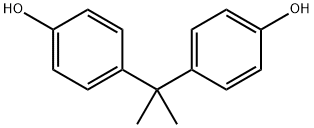
- 80-05-7
- C15H16O2
- 228.29
- All (98)
- China (5)
- (98)
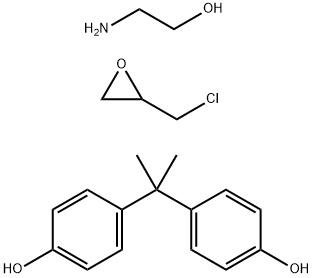
- 38891-59-7
- C20H28ClNO4
- 381.9
- All (2)
- China (0)
- (2)
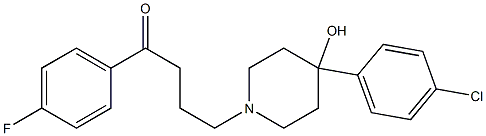
- 61788-97-4
- C21H23ClFNO2
- 375.8642232
- All (1)
- China (0)
- (1)
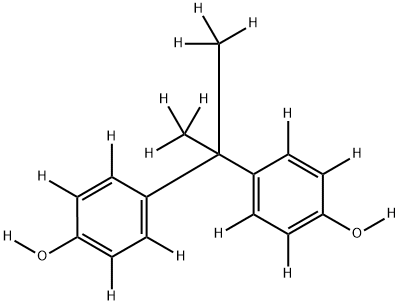
- 96210-87-6
- C15H16O2
- 228.29
- All (0)
- China (0)
- (0)
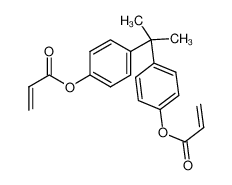
- 4491-03-6
- C21H20O4
- 336.38100
- All (0)
- China (0)
- (0)
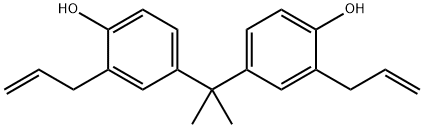
- 1745-89-7
- C21H24O2
- 308.41
- All (1)
- China (0)
- (1)

- 37353-75-6
- C21H28O4
- 344.44
- All (3)
- China (3)
- (3)
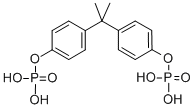
- 181028-79-5
- C15H18O8P2
- 388.25
- All (2)
- China (0)
- (2)
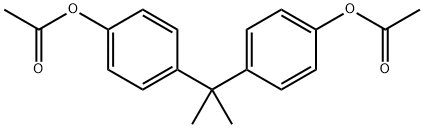
- 10192-62-8
- C19H20O4
- 312.36
- All (1)
- China (0)
- (1)
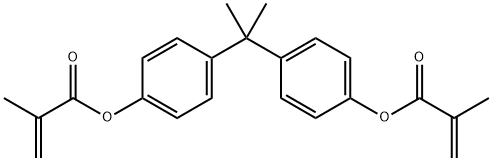
- 3253-39-2
- C23H24O4
- 364.43
- All (1)
- China (0)
- (1)
Related Products More >

- CNY Request For Quotation
- CNY Request For Quotation
- CNY Request For Quotation
- 25085-99-8
- USD 490.0000
- 240kg
- 94334-64-2
- Request For Quotation
- 94334-64-2
- Request For Quotation
- 90598-46-2
- Request For Quotation
- Drum


You don’t need heat from outside most of the time because the reaction itself creates a little heat, which helps it set. The mix will slowly get thicker, then harder, and in a few hours, it becomes solid and super strong. If you change the amount of hardener or the temperature, it can cure faster or slower, but getting the ratio wrong can make it sticky or weak.
That’s why people use it for tables, floors, jewelry, and repairs—once it cures, it’s tough, shiny, and water-resistant.
The kinetics of this process depend on factors such as temperature, stoichiometric balance, and the type of curing agent. Higher temperatures accelerate the reaction by providing energy for molecular motion, which is why controlled heat curing is often used in industrial applications. The degree of cross-linking determines the final mechanical properties, including hardness, adhesion, chemical resistance, and dimensional stability. Incomplete curing or improper ratios can lead to soft spots or brittleness, illustrating the critical importance of precision during formulation and processing.
Epoxy resin’s curing behavior has significant implications across disciplines. In engineering and construction, it creates coatings and adhesives with exceptional load-bearing capabilities. Electronics rely on cured epoxy for encapsulation and insulation because of its dielectric strength and thermal resistance. In aerospace and automotive manufacturing, the material enables lightweight composite structures with superior strength-to-weight ratios. Even in medical technology, epoxy systems are employed for prosthetics and dental materials, leveraging their biocompatibility and durability.
From a physical chemistry perspective, the process is exothermic, releasing heat as bonds form, which can sometimes cause localized thermal stress or even runaway curing if not managed properly. Understanding these chemical and physical mechanisms is essential for ensuring both safety and performance in applications where reliability is critical.
This curing process differs fundamentally from drying, a physical process where solvents evaporate from a material. Unlike drying, curing involves irreversible chemical bond formation, which is why cured epoxy resin cannot revert to a liquid state even if heated moderately. It also contrasts with thermoplastic melting, as thermoplastics soften with heat due to weakened intermolecular forces, while cured epoxy’s cross-linked structure remains stable at typical operating temperatures, maintaining its shape and properties.
The ability to control epoxy resin curing is critical in numerous professional fields. In aerospace engineering, precise curing ensures composite materials have consistent strength and resistance to extreme temperatures, as any incomplete cross-linking could lead to structural weaknesses. In electronics, controlled curing determines the resin’s electrical insulation properties; improper curing might create voids that compromise insulation, risking component failure. Even in construction, curing conditions affect the resin’s adhesion to substrates like concrete, directly impacting the durability of coatings or structural bonds.
A common misunderstanding is that epoxy resin cures solely through exposure to air, but this is incorrect. Most epoxy systems rely on the chemical interaction between the resin and a separate curing agent, not atmospheric oxygen. Some one-part epoxies do cure with moisture, but these are specialized formulations, and the core mechanism still involves chemical reactions with water molecules, not passive air exposure. Another misconception is that faster curing always yields better results; in reality, rapid curing due to excessive heat or high curing agent concentrations can cause internal stresses, leading to cracking or reduced adhesion, highlighting the need for controlled conditions.
In practical applications, the curing process can be tailored by adjusting the resin-to-hardener ratio, incorporating additives, or modifying temperature conditions. For example, in marine craftsmanship, a slow-curing epoxy might be chosen for coating wooden boats to allow sufficient working time and ensure deep penetration into the wood fibers. Conversely, rapid-cure formulations are preferred in manufacturing composite parts like bicycle frames, where controlled heat application accelerates production cycles without compromising the material’s durability or adhesion.
The versatility of epoxy curing enables its use across diverse fields, from art installations to aerospace engineering. Artists utilize UV-resistant, clear epoxy resins to encapsulate objects, relying on precise mixing to avoid bubbles or incomplete curing. In electronics, thermally conductive epoxy formulations protect sensitive components by curing into stable, insulating layers that withstand thermal cycling. Each application demonstrates how the curing chemistry is optimized to meet specific performance requirements, balancing factors like pot life, exotherm, and final hardness.