


 Home
Home
I’ve been thinking about using epoxy resin for a project, but I’m not sure how it handles heat. Can it withstand hot objects, sunlight, or even just a warm room without getting soft or damaged? I’ve heard some people use it on countertops or in craft projects that might see heat exposure. So, is epoxy resin actually heat resistant, or will it start to melt, warp, or discolor if it gets too warm? How much heat can it really take before it loses its shape or strength?
Is Epoxy Resin Heat Resistant? What You Should Know
Related Encyclopedia
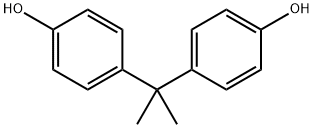
- 80-05-7
- C15H16O2
- 228.29
- All (98)
- China (5)
- (98)
- 38891-59-7
- C20H28ClNO4
- 381.9
- All (2)
- China (0)
- (2)
- 61788-97-4
- C21H23ClFNO2
- 375.8642232
- All (1)
- China (0)
- (1)
- 96210-87-6
- C15H16O2
- 228.29
- All (0)
- China (0)
- (0)
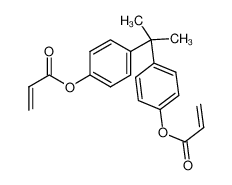
- 4491-03-6
- C21H20O4
- 336.38100
- All (0)
- China (0)
- (0)
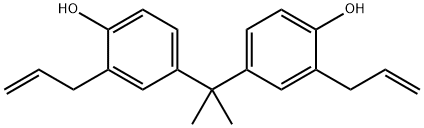
- 1745-89-7
- C21H24O2
- 308.41
- All (1)
- China (0)
- (1)

- 37353-75-6
- C21H28O4
- 344.44
- All (3)
- China (3)
- (3)
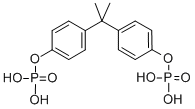
- 181028-79-5
- C15H18O8P2
- 388.25
- All (2)
- China (0)
- (2)
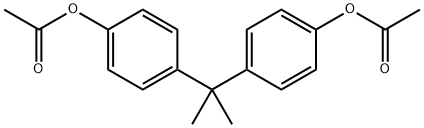
- 10192-62-8
- C19H20O4
- 312.36
- All (1)
- China (0)
- (1)
- 3253-39-2
- C23H24O4
- 364.43
- All (1)
- China (0)
- (1)
Related Products More >

- CNY Request For Quotation
- CNY Request For Quotation
- CNY Request For Quotation
- 25085-99-8
- USD 490.0000
- 240kg
- 94334-64-2
- Request For Quotation
- 94334-64-2
- Request For Quotation
- 90598-46-2
- Request For Quotation
- Drum


The key mechanism behind this behavior involves the strength of the covalent bonds within the crosslinked matrix. Highly crosslinked, aromatic epoxy systems possess strong molecular bonds that require substantial energy to break. This inherent stability allows them to maintain mechanical properties and dimensional integrity under continuous thermal stress, though prolonged exposure beyond their rated temperature will eventually lead to decomposition, discoloration, or loss of properties.
In practical terms, this translates to specialized applications. For instance, in electronics, epoxy resins encapsulate semiconductors and transformers, protecting components from heat generated during operation. Their electrical insulation properties remain stable even as temperatures rise. Another example is in aerospace composites, where epoxy matrices bind carbon fibers to create lightweight parts that must endure the extreme thermal cycles experienced during flight.
In engineering applications, distinguishing epoxy resin’s heat resistance from other polymers is critical for material selection. Unlike thermoplastics such as polyethylene, which soften and deform with heat due to weak intermolecular forces, cured epoxy resins maintain structural integrity up to their glass transition temperature (Tg), the point at which the material shifts from a rigid to a rubbery state. However, it is important to note that heat resistance here is not unlimited; prolonged exposure to temperatures above Tg can lead to gradual degradation, such as oxidation of the polymer chains, which weakens mechanical properties over time.
A common misconception is that all epoxy resins offer the same level of heat resistance, but this overlooks the role of formulation. Additives like ceramic fillers or flame retardants can enhance thermal performance, while the choice of hardener significantly alters Tg. For example, using a polyamide hardener might result in a lower Tg compared to an anhydride hardener when paired with the same epoxy base. This variability means that epoxy resin’s heat resistance must be evaluated based on the specific formulation and intended application, whether in electronics for encapsulating components or in aerospace for bonding structural parts.
In practical terms, epoxy resin is widely used in environments where moderate heat exposure is expected. For example, in electronics, it serves as an encapsulant or coating for components, providing thermal stability while protecting delicate circuits. In construction and manufacturing, epoxy coatings on floors, countertops, and machinery parts offer a balance of durability and resistance to moderate thermal stress. However, prolonged exposure to heat near or above its glass transition temperature can cause softening, deformation, or yellowing, limiting its use in high-heat applications without specialized formulations. This interplay between thermal stability and chemical structure is crucial in designing products that must endure both mechanical stress and temperature fluctuations.
From a cross-disciplinary perspective, the heat resistance of epoxy impacts its role in fields such as aerospace, automotive, and biomedical engineering. In aerospace, high-temperature epoxies are essential for components exposed to engine heat or friction, whereas in biomedical devices, epoxy adhesives must maintain stability under sterilization temperatures. Understanding how heat affects polymer chains allows engineers to tailor epoxy formulations for specific applications, enhancing reliability and performance. Beyond functionality, heat resistance also influences aesthetic and long-term durability considerations in everyday objects, highlighting the broad relevance of this material property across industries.