


 Home
Home
I’ve been wondering about epoxy resin and whether it can conduct electricity. People use it for so many things, from coating surfaces to making crafts, but I’m not sure if it allows electricity to pass through. Can you touch it safely around electronics? Could it be used in circuits, or would it block the current? I’m curious because I’ve seen it in DIY projects involving wires and gadgets, and I don’t want to risk anything. So, is epoxy resin actually conductive, or is it more like an insulator that stops electricity?
Is Epoxy Resin Conductive?
Related Encyclopedia
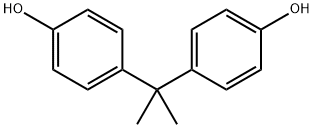
- 80-05-7
- C15H16O2
- 228.29
- All (98)
- China (5)
- (98)
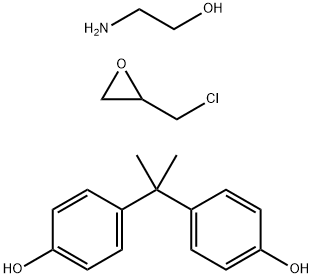
- 38891-59-7
- C20H28ClNO4
- 381.9
- All (2)
- China (0)
- (2)
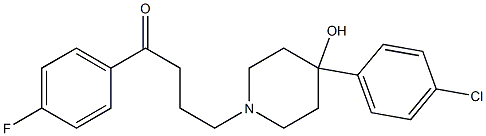
- 61788-97-4
- C21H23ClFNO2
- 375.8642232
- All (1)
- China (0)
- (1)
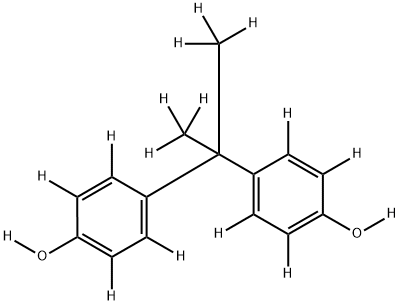
- 96210-87-6
- C15H16O2
- 228.29
- All (0)
- China (0)
- (0)
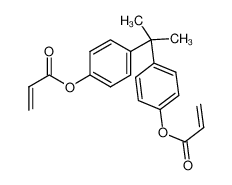
- 4491-03-6
- C21H20O4
- 336.38100
- All (0)
- China (0)
- (0)
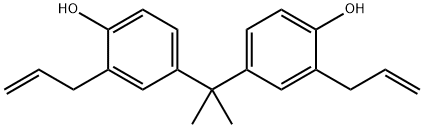
- 1745-89-7
- C21H24O2
- 308.41
- All (1)
- China (0)
- (1)

- 37353-75-6
- C21H28O4
- 344.44
- All (3)
- China (3)
- (3)
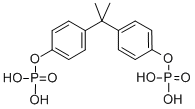
- 181028-79-5
- C15H18O8P2
- 388.25
- All (2)
- China (0)
- (2)
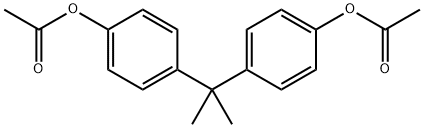
- 10192-62-8
- C19H20O4
- 312.36
- All (1)
- China (0)
- (1)
- 3253-39-2
- C23H24O4
- 364.43
- All (1)
- China (0)
- (1)
Related Products More >

- 9003-55-8
- CNY Request For Quotation
- CNY Request For Quotation
- CNY Request For Quotation
- CNY Request For Quotation


When considering conductivity, it is crucial to distinguish between pure epoxy resin and epoxy-based composites. Manufacturers often modify epoxy resins by incorporating conductive fillers such as carbon nanotubes, graphite, metal particles, or conductive polymers. These additions introduce pathways for electron flow; for example, metal particles in sufficient concentration can form a continuous network within the epoxy matrix, allowing electricity to pass through. This difference—between the inherently insulating pure resin and the potentially conductive composites—highlights why assumptions about epoxy’s conductivity without context can be misleading.
In professional fields like electronics and aerospace, this distinction matters significantly. Pure epoxy resins are valued as insulators for coating wires, encapsulating sensitive components, or isolating electrical circuits, where preventing current leakage is critical. Conversely, conductive epoxy composites find use in applications such as EMI shielding, where blocking electromagnetic interference requires a conductive barrier, or in bonding components that need both mechanical strength (a key trait of epoxy) and electrical connectivity. Understanding whether the epoxy in question is pure or modified thus directly impacts material selection and performance in these technical settings.
The mechanism of insulation is directly tied to the cured resin's extremely high volume resistivity, typically exceeding 10^12 Ω·cm. This prevents current flow between conductive components, thereby preventing short circuits and protecting sensitive devices from electrical interference. For instance, the green protective layer on a computer motherboard is a solder mask made from epoxy resin, which precisely prevents adjacent copper traces from accidentally contacting each other.
However, its insulating nature can be intentionally modified for specific applications. By incorporating conductive fillers like silver flakes, carbon black, or graphene, a composite material is created where the filler particles form a percolating network within the insulating epoxy matrix. This network provides a path for electrons to travel, rendering the material conductive. This principle is applied in electrically conductive adhesives used in solar panels and in shielding materials for aerospace electronics that require protection from electromagnetic waves without using metals.
In practical applications, this insulating property has broad significance. Epoxy is frequently used to coat and protect electrical components, circuit boards, and wiring systems because it prevents accidental short circuits and shields sensitive parts from moisture, dust, and chemical corrosion. In industries such as electronics manufacturing, aerospace, and automotive engineering, epoxy’s non-conductivity ensures both operational safety and long-term reliability. The material can also serve as a substrate in composite materials, where it provides mechanical strength while maintaining electrical isolation.
From a chemical and physical perspective, the inherent dielectric properties of epoxy allow it to withstand substantial voltages without breakdown. Its performance can be modified by adding fillers such as carbon black, metallic powders, or conductive nanoparticles, which can create a percolation network within the polymer and impart controlled conductivity. Such modifications are used in specialized applications, including sensors, electromagnetic shielding, and antistatic coatings.
The relevance of epoxy’s conductive or insulating behavior extends into cross-disciplinary contexts. In biomedical engineering, for instance, epoxy coatings are applied to protect electronic sensors in medical devices, ensuring that electric signals remain confined to intended pathways. In art and design, epoxy’s insulating nature allows for embedding LEDs or other electronics safely within resin-based projects. Overall, understanding the fundamental electrical characteristics of epoxy resin informs both its safe everyday use and its integration into complex industrial and technological systems.