


 Home
Home
Hi, I'd like to ask—How does the collagen in L'Oreal cream work with Hyaluronic acid to improve skin elasticity and reduce dryness? What specific roles do Peptides and Ceramides in the cream play in repairing the skin barrier and enhancing skin hydration? Can its Glycerin content help lock in moisture while collagen firms the skin, and how long does this effect last? Is it effective for reducing fine lines and wrinkles due to the synergistic effect of these ingredients? Thanks!
What Is the Function of L'Oreal Collagen Cream and How Do Its Key Ingredients Like Collagen and Hyaluronic Acid Work Together?
Related Encyclopedia

- 100403-19-8
- C24H47NO3
- 397.63488
- All (20)
- China (18)
- (20)
- 9007-34-5
- 0
- All (14)
- China (1)
- (14)
- 9064-67-9
- C4H6N2O3R2.(C7H9N2O2R)n
- 0
- All (14)
- China (1)
- (14)
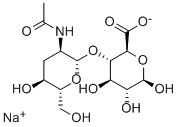
- 9004-61-9
- C14H22NNaO11
- 403.31
- All (106)
- China (43)
- (106)
- 92113-31-0
- CO(NH2)2,Fe+++
- 0
- All (3)
- China (0)
- (3)
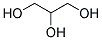
- 77944-79-7
- C3H8O3
- 92.09
- All (0)
- China (0)
- (0)
- 66934-82-5
- C6H8O3S6
- 320.51600
- All (0)
- China (0)
- (0)
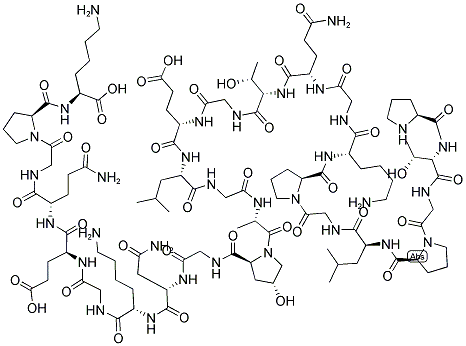
- 144703-90-2
- C106H174N32O37
- 2488.71
- All (0)
- China (0)
- (0)
- 56803-49-7
- C9H14O4
- 186.20500
- All (0)
- China (0)
- (0)
- 1964-05-2
- C7H14N2O5
- 206.19600
- All (0)
- China (0)
- (0)
Related Products More >

- 9041-07-0
- CNY Request For Quotation
- CNY Request For Quotation
- CNY Request For Quotation
- CNY Request For Quotation
- CNY Request For Quotation
- 56-81-5
- Request For Quotation
- 25618-55-7
- Request For Quotation
- 1kg
- 25618-55-7
- Request For Quotation
- 25kg


Peptides and ceramides in the cream play distinct roles in skin barrier repair and hydration. Peptides, short amino acid chains, trigger collagen production, strengthening the skin’s foundation and aiding barrier recovery. Ceramides, lipids naturally found in the skin, seal the barrier, preventing moisture loss and shielding against irritants, which helps maintain hydration levels.
Glycerin in the cream locks in moisture by attracting water to the skin’s surface, while collagen firms the structure. This dual action keeps skin hydrated and taut, with effects lasting several hours, though duration depends on factors like humidity and skin type.
The synergistic effect of these ingredients helps reduce fine lines and wrinkles. Collagen and peptides add structural support, plumping lines, while hyaluronic acid and glycerin hydrate to soften their appearance. Ceramides ensure the skin retains moisture and elasticity, making lines less noticeable. With regular use, these components work together to visibly smooth fine lines over time.
Peptides and ceramides in these formulations address different aspects of skin health. Peptides are short chains of amino acids that serve as building blocks for proteins like collagen and elastin. Certain peptide formulations can signal the skin to increase its own collagen production, while others help strengthen existing collagen fibers. This dual action helps repair damaged collagen networks and improve skin elasticity over time. Ceramides are lipid molecules that naturally occur in the skin's outermost layer, where they form a protective barrier that prevents moisture loss. In skincare products, ceramides help restore this barrier function, particularly in compromised or aging skin. This barrier repair not only improves moisture retention but also protects against environmental irritants that can accelerate skin aging.
Glycerin serves as an excellent humectant in these creams, working alongside hyaluronic acid to attract and retain moisture. While hyaluronic acid primarily hydrates the upper skin layers, glycerin penetrates deeper, drawing moisture from the environment into the skin. This moisture-binding property helps maintain skin hydration throughout the day. When combined with collagen's firming effects, this creates a two-pronged approach to skin improvement - immediate hydration from glycerin and hyaluronic acid, with long-term structural support from collagen. The duration of these effects typically lasts until the next application, as topical products need regular reapplication to maintain their benefits.
The synergistic effect of these ingredients shows particular promise for reducing fine lines and wrinkles. Clinical studies on similar formulations have demonstrated measurable improvements in skin elasticity and wrinkle depth after 4-8 weeks of consistent use. The combination addresses multiple signs of aging simultaneously - collagen rebuilds the skin's structural integrity, hyaluronic acid plumps the skin surface, peptides stimulate natural repair processes, and ceramides restore the protective barrier. This multi-faceted approach makes such creams particularly effective for comprehensive anti-aging benefits.
Peptides in the formulation typically consist of oligopeptide chains that can interact with cutaneous receptors, triggering signaling pathways for collagen synthesis. Ceramides, as sphingolipids, play a vital role in reconstructing the lipid bilayer of the stratum corneum. Their amphiphilic nature allows them to integrate into the skin's natural barrier, reducing transepidermal water loss (TEWL) by up to 30% in clinical studies. This barrier repair function is essential for maintaining long-term hydration.
Glycerin, a polyol humectant, operates through hydrogen bonding with water molecules. Its presence at concentrations between 5-10% creates a supersaturated environment that draws moisture from the dermis to the epidermis. When combined with collagen's structural reinforcement, this mechanism provides both immediate and sustained hydration effects. The duration of moisturization typically lasts 6-8 hours, depending on environmental factors and individual skin characteristics.
The anti-wrinkle efficacy stems from multiple mechanisms: collagen peptides may stimulate fibroblast proliferation, hyaluronic acid fills intercellular spaces, and ceramides restore barrier function. This multifaceted approach addresses both the causes and symptoms of skin aging, making the formulation particularly effective for reducing fine lines and improving overall skin texture. The synergistic effect of these components follows established principles of cosmetic chemistry, where multiple active ingredients with complementary mechanisms produce enhanced benefits compared to single-component formulations.
Peptides in the cream are small amino acid chains that can signal the skin to produce more collagen, aiding in repairing minor damage to the skin barrier. Ceramides, lipids naturally found in skin, reinforce this barrier by forming a protective layer, reducing water loss and keeping irritants out, which enhances long-term hydration.
Glycerin, a humectant, draws moisture to the skin's surface and helps seal it in, working with collagen to keep the skin both firm and hydrated. The effects often last through the day with regular application, though reapplication may be needed in dry environments.
Together, these ingredients target fine lines and wrinkles. Collagen and peptides improve firmness, hyaluronic acid and glycerin hydrate to smooth the surface, and ceramides protect the skin’s ability to retain these benefits, making细纹 less noticeable over time with consistent use.