


 Home
Home
Many people are curious if taking collagen can actually improve their sleep quality. Collagen supplements are widely promoted for skin, joints, and overall health, but can they also play a role in helping you fall asleep faster or stay asleep longer? How does the presence of amino acids like glycine in collagen influence the body’s sleep mechanisms, and are there specific types or doses of collagen that work best for promoting restful sleep?
Does Collagen Help You Sleep? Exploring the Connection
Related Encyclopedia
- 9007-34-5
- 0
- All (14)
- China (1)
- (14)
- 9064-67-9
- C4H6N2O3R2.(C7H9N2O2R)n
- 0
- All (14)
- China (1)
- (14)
- 92113-31-0
- CO(NH2)2,Fe+++
- 0
- All (3)
- China (0)
- (3)
- 66451-70-5
- C13H14N2O3
- 246.26200
- All (0)
- China (0)
- (0)
- 56-40-6
- C2H5NO2
- 75.07
- All (308)
- China (62)
- (308)
- 144703-90-2
- C106H174N32O37
- 2488.71
- All (0)
- China (0)
- (0)
- 51163-51-0
- C13H17N3O4
- 279.29200
- All (0)
- China (0)
- (0)
- 14313-00-9
- C2H7NO6S
- 173.14500
- All (0)
- China (0)
- (0)
- 1352614-79-9
- C4H8N4O2
- 144.13200
- All (0)
- China (0)
- (0)
- 19794-45-7
- C2H3NO2T2
- 79.08280
- All (0)
- China (0)
- (0)
Related Products More >

- CNY Request For Quotation
- CNY Request For Quotation
- CNY Request For Quotation
- 107-43-7
- CNY Request For Quotation
- 107-43-7
- CNY Request For Quotation
- 14281-83-5
- CNY 9.0000
- 25kg
- 56-40-6
- CNY 10.0000
- 25kg
- 999-29-1
- Request For Quotation
- 25kg/Drum


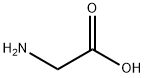
The interaction between glycine and sleep regulation is rooted in neurochemistry. Glycine works alongside other inhibitory molecules like GABA to balance excitatory signals in the central nervous system, promoting a state of relaxation that facilitates falling asleep and maintaining deeper sleep stages. Unlike sleep aids that target circadian rhythms (such as melatonin) or induce sedation (like some pharmaceuticals), glycine’s influence is more subtle, supporting the body’s natural sleep architecture without disrupting its inherent rhythms. This makes collagen, as a dietary source of glycine, relevant for individuals seeking gentle support for occasional sleep disturbances, particularly those whose diets lack glycine-rich foods like gelatin, meat, or dairy.
In practical terms, the effects of collagen on sleep vary based on individual physiology and diet. Those with low glycine intake may notice improved sleep quality—such as reduced time to fall asleep or fewer nighttime awakenings—when supplementing with collagen, as it replenishes the amino acid needed for neural calm. Conversely, individuals with adequate glycine levels are less likely to experience significant changes, underscoring that collagen is not a universal sleep solution but a nutrient that supports specific metabolic pathways. In wellness and nutritional contexts, this has led to collagen being included in nighttime formulations, often paired with other sleep-supporting ingredients like magnesium or chamomile, to enhance its subtle effects.
Beyond personal sleep health, this connection illustrates the interplay between nutrition and neurology, showing how a protein best known for physical structure also contributes to mental and emotional balance. In industrial and food science, this insight drives the development of functional foods and supplements that leverage collagen’s dual benefits, appealing to consumers seeking holistic approaches to health. Understanding that collagen’s role extends beyond structural support to include metabolic contributions to neural function enriches our grasp of how nutrients work synergistically, bridging seemingly disparate bodily systems in the pursuit of overall wellbeing.
Glycine serves as an inhibitory neurotransmitter. During the sleep process, the brain needs to shift from an active, wakeful state to a relaxed, sleep - ready state. The inhibitory effect of glycine helps to reduce neural excitability, making it easier to fall asleep and maintain a deep sleep. For instance, people with sleep disorders often have overactive neural circuits, and glycine from collagen can act as a natural modulator to calm these circuits.
It's crucial to differentiate collagen from other sleep aids like melatonin supplements. Melatonin is a hormone that directly regulates the body's internal clock, signaling when it's time to sleep and wake up. Collagen, on the other hand, works on the neural level through glycine. A common misunderstanding is that taking collagen will instantly cure all sleep problems. In fact, while glycine can support sleep, individual sleep issues can be complex, involving factors such as stress, lifestyle, and underlying medical conditions, so collagen should be seen as part of a broader approach to improving sleep.
In practical terms, supplemental collagen, often derived from bovine or marine sources, can provide a concentrated source of glycine. For example, ingesting collagen peptides in the evening may help prime the body’s natural sleep mechanisms by enhancing parasympathetic activity. This can be subtly observed in individuals who report improved sleep onset or a slightly deeper sleep cycle after consistent intake over several weeks. Collagen’s effect is indirect—it doesn’t act as a sedative but supports endogenous processes that facilitate restorative sleep.
Additionally, collagen supports the structural integrity of tissues involved in musculoskeletal comfort. By maintaining joint and connective tissue health, it can reduce discomfort that might otherwise disrupt sleep, especially in older adults or those engaging in regular physical activity. For instance, athletes or individuals with mild joint stiffness may find that nightly collagen supplementation contributes to more restful sleep simply by alleviating nocturnal discomfort. These combined biochemical and structural pathways illustrate how collagen interacts with physiological systems to influence sleep quality in real-world settings.