


 Home
Home
Have you ever wondered what rose essential oil is actually good for? People often hear about its lovely fragrance and natural qualities, but what makes it special beyond that? How can rose essential oil help in daily life? Is it useful for relaxing, skincare, or even mood boosting? And are there any simple ways to use it safely at home? What benefits does it really bring to your health and well-being?
What Is Rose Essential Oil Good For? Discover Its Benefits and Uses
Related Encyclopedia
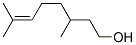
- 26489-01-0
- C10H20O
- 156.27
- All (23)
- China (7)
- (23)
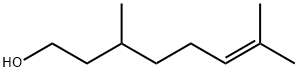
- 106-22-9
- C10H20O
- 156.27
- All (23)
- China (7)
- (23)
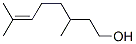
- 68916-43-8
- C10H20O
- 156.27
- All (23)
- China (7)
- (23)
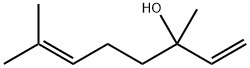
- 78-70-6
- C10H18O
- 154.25
- All (21)
- China (1)
- (21)
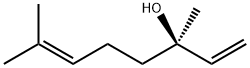
- 126-91-0
- C10H18O
- 154.25
- All (5)
- China (2)
- (5)
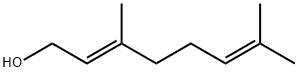
- 106-24-1
- C10H18O
- 154.25
- All (33)
- China (14)
- (33)
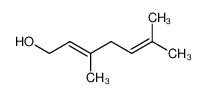
- 103606-17-3
- C9H16O
- 140.22300
- All (33)
- China (14)
- (33)
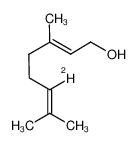
- 1203571-50-9
- C10H17DO
- 155.25500
- All (33)
- China (14)
- (33)
- 28673-23-6
- C12H19F3O2
- 252.27300
- All (0)
- China (0)
- (0)
- 1373284-85-5
- C10H17D3O
- 159.28400
- All (0)
- China (0)
- (0)
Related Products More >

- CNY Request For Quotation
- CNY Request For Quotation
- CNY Request For Quotation
- CNY Request For Quotation
- CNY Request For Quotation
- CNY Request For Quotation
- CNY Request For Quotation
- CNY Request For Quotation


From a physiological perspective, rose essential oil exhibits anti-inflammatory, antimicrobial, and antioxidant activities. These effects arise due to its ability to modulate cellular signaling pathways, reduce oxidative stress, and inhibit the growth of certain pathogens. This makes it valuable in topical applications for skin health, where it can soothe irritation, support wound healing, and improve skin hydration and elasticity. Its gentle nature allows for integration into cosmetic formulations, where it enhances both sensory appeal and functional efficacy.
In the broader context, rose essential oil influences multiple disciplines including perfumery, dermatology, and even food flavoring. In daily life, its pleasant scent elevates ambiance and emotional well-being, which can indirectly support mental health. Industrially, the oil is prized for its role in high-end fragrances and natural skincare products, offering a sustainable alternative to synthetic additives. Medically, while not a primary treatment, its adjunctive use in complementary therapies harnesses its calming and anti-inflammatory properties.
The physical mechanism behind its calming effect involves olfactory stimulation, where inhalation triggers neurotransmitter release such as serotonin and dopamine, promoting feelings of pleasure and reducing cortisol, a stress hormone. Additionally, topical absorption can affect peripheral tissues, providing localized benefits without systemic side effects. The multidisciplinary nature of rose essential oil's impact underscores its significance beyond just a fragrance, highlighting its intersection of chemistry, biology, and human experience.
In dermatology, rose essential oil’s relevance is tied to its lipophilic nature, enabling it to penetrate the stratum corneum and modulate skin barrier function. Geraniol and citronellol exhibit anti-inflammatory properties by inhibiting cyclooxygenase-2 (COX-2) and lipoxygenase (LOX) pathways, reducing prostaglandin and leukotriene synthesis. This mechanism is distinct from corticosteroids, which suppress inflammation via genomic pathways, but shares similarities with non-steroidal anti-inflammatory drugs (NSAIDs). Additionally, its antioxidant activity, attributed to phenylpropanoids like eugenol, neutralizes reactive oxygen species (ROS), mitigating oxidative stress-induced skin aging. Unlike vitamin C derivatives, which rely on proton donation for antioxidant action, rose essential oil’s components scavenge free radicals through electron transfer, offering complementary protection.
Aromatherapy applications leverage rose essential oil’s ability to interact with the olfactory system and limbic brain regions. Inhalation of its vaporized constituents stimulates olfactory receptors, triggering neural signals that modulate the hypothalamic-pituitary-adrenal (HPA) axis. This process influences cortisol secretion, explaining its anxiolytic effects. Contrary to popular belief, these effects are not solely psychogenic; pharmacological evidence shows that geraniol binds to gamma-aminobutyric acid (GABA) receptors, enhancing inhibitory neurotransmission. This dual mechanism—psychological and pharmacological—differentiates rose essential oil from synthetic sedatives, which act primarily on central nervous system (CNS) receptors without olfactory engagement.
In food and flavor industries, rose essential oil’s role as a natural preservative is often underestimated. Its phenylpropanoids, particularly eugenol, exhibit antimicrobial activity against Staphylococcus aureus and Escherichia coli by disrupting bacterial cell membranes and inhibiting biofilm formation. This mode of action contrasts with chemical preservatives like sodium benzoate, which target microbial metabolic enzymes. However, rose essential oil’s volatility limits its shelf-life efficacy compared to non-volatile preservatives, necessitating encapsulation technologies to enhance stability—a challenge not faced by synthetic alternatives.
A common misconception is that rose essential oil’s benefits are interchangeable with those of rose hydrosol or absolute. Hydrosols, the aqueous byproducts of distillation, contain water-soluble compounds like flavonoids but lack the lipophilic terpenes central to the oil’s bioactivity. Absolutes, extracted using solvents like hexane, retain more non-volatile constituents but may carry residual solvents, altering their safety profile. Thus, rose essential oil’s unique extraction method and chemical composition underpin its distinct applications across industries.
Another overlooked aspect is its potential in transdermal drug delivery systems. The oil’s composition enhances skin permeation of hydrophobic drugs by disrupting lipid bilayers in the stratum corneum. This property, exploited in pharmaceutical formulations, is absent in synthetic penetration enhancers like azone, which rely on altering keratin conformation. However, rose essential oil’s variability in composition due to botanical origin and extraction conditions poses challenges for standardized drug delivery outcomes, a limitation not inherent to synthetic enhancers.
Beyond its impact on mood, the oil’s anti-inflammatory and antimicrobial properties make it useful in skincare. When diluted with a carrier oil like jojoba, it can be applied topically to soothe irritated skin, such as mild redness from environmental exposure. Its astringent qualities also help balance excess oil production, making it a gentle addition to routines for those with combination skin, where occasional breakouts or shine are common concerns.
Physiologically, rose essential oil may support relaxation by influencing the body’s production of stress hormones. Massaging a diluted blend into the shoulders before bed, for example, can promote a sense of calm that eases the transition into sleep, particularly for individuals who struggle with restlessness due to mild anxiety. This effect stems from how its compounds interact with neurotransmitters, encouraging a shift from a state of alertness to one of relaxation, without the drowsiness associated with some sedatives.