


 Home
Home
Hi, I'd like to ask—what color is polyethylene in its natural state? Can it be dyed into different colors, and how? What factors during manufacturing affect its color (like additives or processing temperature)? Do high-density polyethylene (HDPE) and low-density polyethylene (LDPE) have different colors? Are there any color-related quality standards for polyethylene products? Thanks!
What Is the Natural Color of Polyethylene and Can It Be Dyed?
Related Encyclopedia
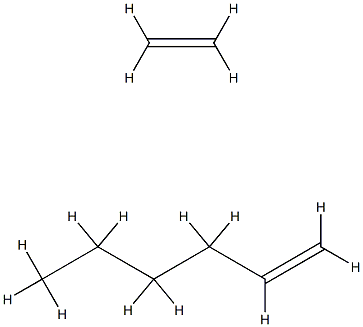
- 25213-02-9
- C8H16
- 112.21264
- All (24)
- China (2)
- (24)
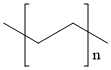
- 9002-88-4
- (C2H4)n
- 28.05316
- All (24)
- China (2)
- (24)
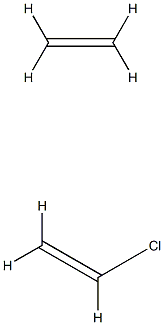
- 63231-66-3
- C4H7Cl
- 90.55138
- All (3)
- China (3)
- (3)
- 68131-73-7
- C12H5N7O12
- 0
- All (2)
- China (0)
- (2)
- 68441-17-8
- C51H102O21Si2
- 0
- All (29)
- China (28)
- (29)
- 64754-90-1
- 0
- All (3)
- China (3)
- (3)
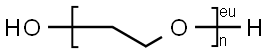
- 25322-68-3
- (C2H4O)nH2O
- 0
- All (65)
- China (33)
- (65)
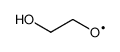
- 28287-76-5
- C2H5O2
- 61.05990
- All (65)
- China (33)
- (65)
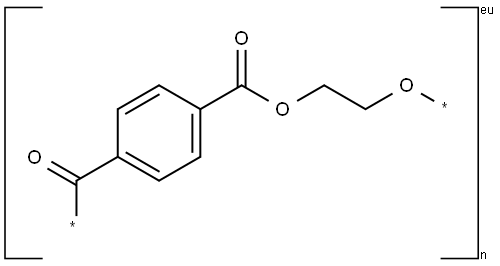
- 25038-59-9
- C10H12O6
- 228.19868
- All (3)
- China (0)
- (3)

- 1192130-70-3
- C20H40O4
- 344.52900
- All (0)
- China (0)
- (0)
Related Products More >

- 63231-66-3
- CNY Request For Quotation
- 9002-88-4
- Request For Quotation
- 25322-68-3
- Request For Quotation
- USD 20.0000
- 25kg
- USD 15.0000
- 25kg
- 9004-96-0
- Request For Quotation
- 50


Yes, polyethylene can be dyed into various colors. This is commonly achieved by adding color masterbatches—concentrated mixtures of pigments or dyes—during the manufacturing process. These masterbatches are blended with the PE resin before extrusion or molding, ensuring uniform color distribution. Solvent-based dyes or organic pigments can also be used, but masterbatches are preferred for consistency and ease of use.
Manufacturing factors affecting PE color include additives like stabilizers, antioxidants, or fillers, which may introduce slight tinting. Processing temperature is critical: excessive heat can degrade the polymer, causing yellowing or browning. Catalyst residues from polymerization and exposure to oxygen during processing can also alter color. Additionally, the cooling rate and duration of heat exposure influence the final shade.
High-density polyethylene (HDPE) and low-density polyethylene (LDPE) generally have similar natural colors, but their structural differences affect transparency. HDPE, with higher crystallinity, tends to be more opaque and slightly whiter, while LDPE’s lower crystallinity makes it more translucent. Color variations between them are usually due to additive choices rather than inherent structural differences.
For PE products, color-related quality standards focus on consistency and durability. Organizations like ASTM and ISO set guidelines for color fastness, resistance to UV fading, and uniformity across batches. Manufacturers often use color matching systems (e.g., Pantone) to ensure products meet specific hue requirements, while regulatory bodies may specify limits on pigment migration to ensure safety in food contact applications.
Manufacturing factors play a key role in color. Processing temperature is crucial—too high, and it might yellow from thermal degradation. Additives like stabilizers or fillers also impact color; some can alter hues or prevent fading. HDPE and LDPE don’t differ much in natural color, but HDPE’s higher crystallinity might make it look slightly more opaque. For quality standards, they vary by use. Food-grade products need safe colorants, while industrial ones focus on consistency and durability. Understanding this connects chemistry to real-world uses.
Several factors during the manufacturing process can influence the color of polyethylene. Additives play a significant role. For instance, UV stabilizers and antioxidants are commonly added to protect the material from degradation. These additives can sometimes impart a slight tint to the polyethylene. Processing temperature is another critical factor. Polyethylene is sensitive to thermal degradation. If the processing temperature is too high, it can cause the polymer to degrade, leading to discoloration. This is particularly important in applications where the aesthetic appearance of the product is crucial.
High-density polyethylene (HDPE) and low-density polyethylene (LDPE) have distinct characteristics that can affect their color. HDPE is generally more opaque and has a natural milky white appearance. LDPE, on the other hand, is more translucent and also has a natural milky white color. The differences in density and molecular structure between HDPE and LDPE contribute to these variations in appearance.
Color-related quality standards are important in the production of polyethylene products. In the context of international trade, compliance with specific color standards is often necessary. For example, in the packaging industry, color consistency is crucial for branding and consumer recognition. Standards such as the ISO color standards provide guidelines for color accuracy and consistency. These standards ensure that polyethylene products meet the required specifications for color, which can be critical for applications in food packaging, consumer goods, and industrial components. Adherence to these standards helps maintain product quality and consumer trust.
The ability to dye polyethylene into various colors is one of its key advantages in industrial and consumer applications. This is achieved by incorporating pigments or color masterbatches during the extrusion or molding process. Masterbatches are concentrated mixtures of pigments and additives dispersed in a carrier resin, which are then blended with the base polyethylene. The choice of coloring method depends on factors such as the desired color intensity, UV resistance, and the final product's application. For instance, outdoor products require UV-stable pigments to prevent fading, while food packaging may need FDA-approved colorants for safety.
Several manufacturing factors influence polyethylene's color. Additives such as clarifiers can enhance transparency, making the material appear lighter or more glass-like. Conversely, fillers or reinforcing agents may darken the plastic or introduce speckles. Processing temperature is another critical variable; if the temperature is too high, pigments can degrade or burn, leading to uneven coloring or discoloration. Conversely, insufficient heat may result in poor pigment dispersion, creating a mottled appearance. The mixing efficiency during compounding also plays a role, as inconsistent blending can lead to streaks or color variations in the final product.
High-density polyethylene (HDPE) and low-density polyethylene (LDPE) differ slightly in their natural appearance due to their molecular structures. HDPE tends to be more opaque and has a slightly whiter or more matte finish, while LDPE is more translucent and flexible, often appearing glossier even when uncolored. These differences stem from HDPE's tighter molecular packing, which reduces light transmission, whereas LDPE's looser structure allows more light to pass through.
Color-related quality standards for polyethylene are typically industry-specific rather than universal. For example, the automotive sector may require precise color matching for interior components, while construction materials might prioritize durability over exact shades. Organizations like ASTM or ISO provide guidelines for polyethylene properties, but color consistency is usually addressed only when it directly impacts performance or aesthetic requirements. In cases where color accuracy is critical, manufacturers often implement rigorous quality control measures, including spectrophotometric testing, to ensure compliance with client specifications.