


 Home
Home
Stretch marks can happen to almost anyone, whether from pregnancy, weight changes, or rapid growth. People often look for ways to reduce their appearance and improve skin texture. Collagen is a protein found naturally in the body that helps keep skin firm and elastic, but can it really make a difference for stretch marks? Is taking collagen supplements or using collagen creams enough to fade them? Could collagen help prevent new stretch marks from forming in the first place?
Can Collagen Help Stretch Marks Go Away?
Related Encyclopedia
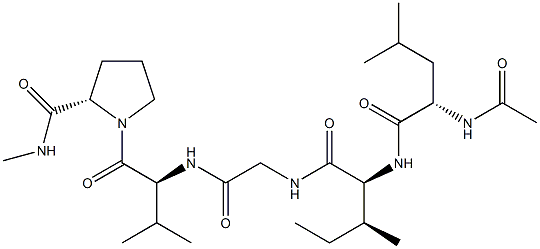
- 9007-58-3
- C27H48N6O6
- 552.70662
- All (0)
- China (0)
- (0)
- 9007-34-5
- 0
- All (14)
- China (1)
- (14)
- 9064-67-9
- C4H6N2O3R2.(C7H9N2O2R)n
- 0
- All (14)
- China (1)
- (14)
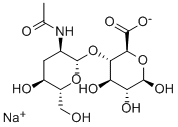
- 9004-61-9
- C14H22NNaO11
- 403.31
- All (106)
- China (43)
- (106)
- 92113-31-0
- CO(NH2)2,Fe+++
- 0
- All (3)
- China (0)
- (3)
- 138250-06-3
- C91H139N27O22
- 1963.25000
- All (0)
- China (0)
- (0)
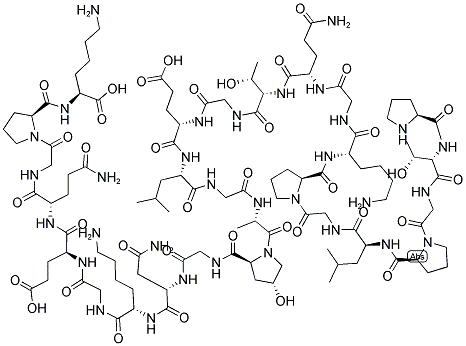
- 144703-90-2
- C106H174N32O37
- 2488.71
- All (0)
- China (0)
- (0)
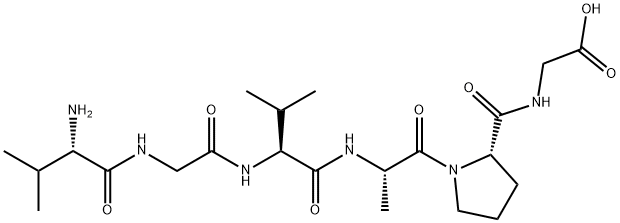
- 92899-39-3
- C22H38N6O7
- 498.57
- All (0)
- China (0)
- (0)
Related Products More >

- CNY Request For Quotation
- CNY Request For Quotation
- 72-18-4
- USD 45.0000
- 25kg
- 74-79-3
- USD 92.0000
- 25kg
- 95507-66-7
- Request For Quotation
- 25kg/Drum
- 92113-31-0
- Request For Quotation
- 25kg/Cardboard Drum
- 92113-31-0
- Request For Quotation
- 1g,50g,100g,1000g
- 92113-31-0
- Request For Quotation


The tricky part is that creams don’t always get deep enough to really rebuild damaged skin from the inside. Supplements, on the other hand, may help your body make more collagen overall, which could slowly improve skin texture. But it’s not magic—you won’t wake up with perfectly smooth skin.
For most people, a mix of good skincare habits, staying hydrated, and maybe adding collagen to your routine can help the skin look a bit better over time. It’s more about softening the look of stretch marks than erasing them completely.
The role of collagen in addressing stretch marks lies in its potential to support the skin’s regenerative processes. Unlike elastin, which primarily contributes to the skin’s ability to recoil, collagen focuses on maintaining structural integrity. When collagen synthesis is enhanced, either through topical application or dietary supplementation, it may aid in rebuilding the damaged dermis by promoting the formation of new, more organized collagen fibers. This differs from hyaluronic acid, which primarily hydrates the skin and supports its moisture barrier, rather than directly contributing to the structural repair of connective tissue.
A common misconception is that collagen alone can fully eliminate stretch marks; in reality, stretch marks involve changes in multiple skin layers, including the epidermis, and are influenced by factors like genetics and hormonal fluctuations. Collagen can support improvement in the appearance of stretch marks by enhancing skin elasticity and promoting structural repair, but its effectiveness is often maximized when combined with other approaches, such as maintaining skin hydration and protecting against further stretching. Additionally, the form of collagen matters—topical collagen may penetrate the upper layers of the skin to provide localized support, while oral collagen peptides are broken down during digestion and used by the body to support overall collagen synthesis, including in the skin.
Understanding how collagen interacts with the skin’s structure helps set realistic expectations about its role in addressing stretch marks. It is not a standalone solution but a valuable component in a broader strategy aimed at supporting skin health and repair. By contributing to the formation of strong, organized connective tissue, collagen can help reduce the visibility of stretch marks over time, particularly when used consistently and in conjunction with practices that support overall skin integrity.
From a mechanistic angle, helping stretch marks means nudging fibroblasts back into productive remodeling. Oral collagen peptides—rich in glycine, proline, and hydroxyproline—are digested to di- and tripeptides that can be absorbed and act as substrates and messengers for matrix rebuilding. Vitamin C, iron, and oxygen support prolyl/lysyl hydroxylases for proper helix stabilization, while adequate protein intake prevents negative nitrogen balance that would otherwise limit repair. Topically, retinoids can upregulate collagen I/III and normalize epidermal turnover in early lesions, and hyaluronic acid improves turgor and microenvironment hydration that favors fibroblast activity.
Devices leverage controlled injury to drive neocollagenesis. Microneedling, fractional lasers (non-ablative and ablative), and radiofrequency create microthermal zones that trigger TGF-β pathways, temporarily increase MMP activity, and then shift toward net collagen deposition with better fiber alignment. Platelet-rich plasma and bioactive peptides sometimes accompany these procedures to enhance signaling. None of these erase scars, yet they can reduce width, depth, and color contrast, improving the way light reflects off the surface and the way the skin feels to the touch. Timing matters: vascular, early striae respond more readily than long-standing, atrophic ones.
Outside the clinic, the implications are broad. In daily life, gradual training plans, steady weight trajectories, moisturization to reduce friction, and attention to nutrition can ease mechanical stress and support resilience, though no cream can “proof” skin against large, rapid stretching. In the cosmetics and nutraceutical industries, collagen drives a sizable category of ingestibles and topicals, while in regenerative medicine, collagen scaffolds and matrices inform wound dressings and engineered skin substitutes. Even textiles and biomechanics draw on these insights to design maternity supports that distribute load more evenly. The practical takeaway is nuanced: collagen—whether encouraged by diet, signaled by topicals, or induced by procedures—can help stretch marks look and feel better by improving dermal architecture, but biology sets limits, and results hinge on lesion stage, genetics, hormones (including corticosteroid exposure), and adherence to a thoughtful, multi-modal plan.
Topical collagen creams, however, face limitations due to the molecule’s size, which hinders penetration into the dermis where stretch marks form. Instead, formulations with retinoids or peptides that stimulate endogenous collagen production may be more effective. Anecdotal evidence suggests that consistent use of collagen-rich diets or supplements, combined with microneedling—a procedure that creates micro-injuries to trigger collagen remodeling—can improve skin texture. Yet, individual results vary widely based on genetics, age, and the severity of stretch marks.
In practice, collagen’s efficacy for stretch marks remains nuanced. While it isn’t a standalone cure, integrating collagen support with other treatments like hydration, massage, or laser therapy may yield better outcomes. The interplay between collagen degradation and synthesis underscores the importance of a holistic approach to skin health, where external and internal factors converge to influence outcomes.