


 Home
Home
Have you ever wondered what makes the soles of your shoes so durable or why car tires don’t just fall apart after a few drives? Chances are, Buna rubber is part of the answer. But what exactly is Buna rubber, and how is it different from other types of rubber? Is it natural or synthetic? What materials is it made from, and why is it so widely used in everyday products?
What Is Buna Rubber and Why Is It Commonly Used?
Related Encyclopedia
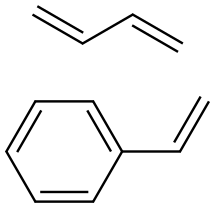
- 9003-55-8
- (C8H8.C4H6)x
- 158.24
- All (5)
- China (1)
- (5)
- 122973-06-2
- C6H5NO+
- 108.11800
- All (38)
- China (36)
- (38)
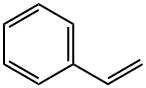
- 100-42-5
- C8H8
- 104.15
- All (38)
- China (36)
- (38)
- 79637-11-9
- C8H8
- 104.15000
- All (38)
- China (36)
- (38)
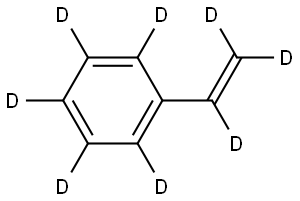
- 19361-62-7
- C8D8
- 112.2
- All (0)
- China (0)
- (0)
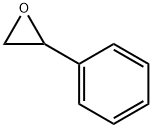
- 96-09-3
- C8H8O
- 120.15
- All (0)
- China (0)
- (0)
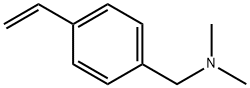
- 2245-52-5
- C11H15N
- 161.24
- All (0)
- China (0)
- (0)
- 145964-63-2
- C8H8Ar
- 144.09700
- All (0)
- China (0)
- (0)
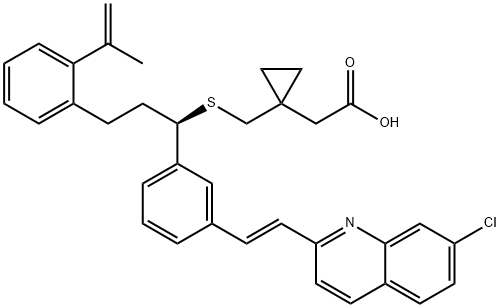
- 918972-54-0
- C35H34ClNO2S
- 568.17
- All (0)
- China (0)
- (0)
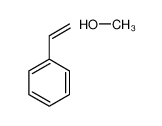
- 444843-35-0
- C9H12O
- 136.19100
- All (0)
- China (0)
- (0)
Related Products More >

- CNY Request For Quotation
- CNY Request For Quotation
- CNY Request For Quotation
- CNY Request For Quotation
- CNY Request For Quotation


You’ll find Buna rubber in car tires, shoe soles, belts, hoses, and even some sports gear. It’s especially good because it doesn’t easily break down when it comes into contact with oils or fuels. That’s why it’s often used in cars and machines.
Basically, Buna rubber is a strong, reliable rubber made by people, not plants. It lasts a long time, handles rough use, and keeps working even when it gets oily or hot. Pretty cool for something you might never think about, right?
Key attributes of buna rubber stem from its cross-linked polymer structure, which allows it to return to its original shape after deformation—a trait critical for sealing and cushioning. Buna-S, known for its high resilience and low cost, excels in dynamic applications like tire treads, where repeated compression and expansion demand flexibility without permanent distortion. Buna-N, by contrast, owes its oil and fuel resistance to acrylonitrile’s polar groups, making it ideal for fuel hoses and O-rings in automotive systems.
In practice, buna rubber’s versatility bridges industrial gaps: its resistance to abrasion suits conveyor belts, while its elasticity enhances gaskets in plumbing. Compared to natural rubber, it offers greater consistency in performance, unaffected by seasonal variations in latex quality, ensuring reliability in manufacturing. Whether in household appliances or heavy machinery, buna rubber’s engineered properties make it a staple in modern materials science, proving indispensable where natural rubber falls short.
At the molecular level, Buna rubber consists of long chains of repeating hydrocarbon units, giving it elasticity, resilience, and resistance to wear. Unlike natural rubber, which is derived from the latex of rubber trees, Buna is produced through controlled chemical processes, allowing its properties to be tailored to specific industrial needs. Buna-S (butadiene-styrene) and Buna-N (butadiene-acrylonitrile) are two major variants, each with distinct characteristics. For example, Buna-S is valued for abrasion resistance and is widely used in tires, while Buna-N offers superior resistance to oil and fuel, making it crucial in automotive and aerospace applications.
Physically, Buna rubber performs well under mechanical stress and maintains stability over a wide range of temperatures. Chemically, its resistance to aging, oxidation, and certain solvents makes it highly durable in demanding environments. The ability to vulcanize Buna rubber—introducing sulfur bridges between polymer chains—further enhances its strength and elasticity, making it suitable for repeated deformation without cracking.
Its relevance extends far beyond industrial settings. In medicine, Buna-based materials are used in seals, tubing, and gloves where flexibility and chemical resistance are essential. In consumer products, it's present in footwear, sporting goods, and household tools. From an interdisciplinary standpoint, Buna rubber intersects with materials science, chemistry, mechanical engineering, and even environmental studies, as its production and disposal raise questions about sustainability and long-term ecological impact.
Understanding Buna rubber is not merely a study of material properties—it reveals how synthetic innovations can shape global supply chains, support technological progress, and replace limited natural resources. As our world continues to rely on adaptable, high-performance materials, Buna rubber remains a cornerstone in both practical applications and scientific development.
A key attribute of buna rubber is its compatibility with other polymers, such as styrene or acrylonitrile, leading to copolymers like SBR (styrene-butadiene rubber) or NBR (nitrile-butadiene rubber). These variants enhance specific properties—for example, NBR exhibits superior oil resistance, while SBR offers better traction, explaining its widespread use in tire manufacturing. The vulcanization process further improves buna rubber's thermal stability and tensile strength by cross-linking polymer chains with sulfur, a critical step in tailoring its performance for industrial use.
In practice, buna rubber's impact is evident in everyday products. Tire treads, conveyor belts, and industrial hoses rely on its wear-resistant qualities, while shoe soles leverage its cushioning effect. The automotive industry particularly benefits from its vibration-damping properties, integrating it into engine mounts and suspension components. Beyond machinery, buna rubber's versatility extends to consumer goods like gloves or seals, where elasticity and chemical resistance are paramount. Its adaptability across sectors underscores its role as a foundational material in modern manufacturing.