


 Home
Home
Imagine you’re flipping through a food packet and spot stearic acid in the ingredients. You might wonder: does this waxy substance actually add flavour?
Is Stearic Acid Associated with Flavor?
Related Encyclopedia
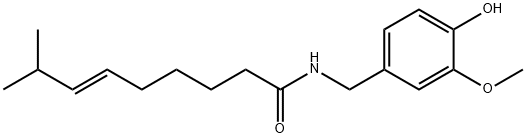
- 404-86-4
- C18H27NO3
- 305.41
- All (64)
- China (19)
- (64)
- 27641-21-0
- C12H22O11
- 342.29600
- All (17)
- China (10)
- (17)
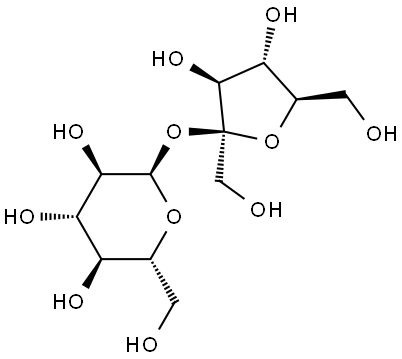
- 57-50-1
- C12H22O11
- 342.3
- All (17)
- China (10)
- (17)
- 95152-84-4
- C11H20O10
- 312.27100
- All (17)
- China (10)
- (17)

- 57-11-4
- C18H36O2
- 284.48
- All (393)
- China (51)
- (393)

- 85404-83-7
- C18H36O2
- 568.95000
- All (393)
- China (51)
- (393)
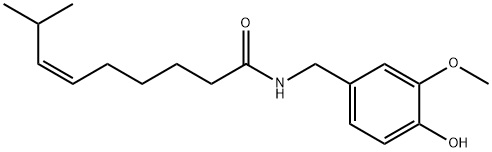
- 25775-90-0
- C18H27NO3
- 305.41
- All (0)
- China (0)
- (0)
- 1454765-38-8
- C19H27F2NO3
- 355.41900
- All (0)
- China (0)
- (0)
- 1217899-52-9
- C18H24D3NO3
- 308.43000
- All (0)
- China (0)
- (0)
- 123727-15-1
- C18H35DO2
- 285.48300
- All (0)
- China (0)
- (0)
Related Products More >

- 56038-13-2
- CNY 20.0000
- 25kg
- CAS 57-11-4
- USD 800.0000
- 25kg
- 57-11-4
- USD 12.0000
- 25kg
- 34482-63-8
- Request For Quotation
- 1ton
- 34482-63-8
- Request For Quotation
- 25kg
- 25168-73-4
- Request For Quotation
- 25kg
- 25168-73-4
- Request For Quotation
- 500g
- 25168-73-4
- Request For Quotation
- 1kg


When it comes to human health, stearic acid is generally safe. Unlike some other saturated fats, research suggests it has a neutral impact on cholesterol levels. So in moderate amounts, it’s not a concern. It's also used in cosmetics and pharmaceuticals to stabilize formulations.
In the chemical industry, stearic acid is huge. It’s used in making soaps, detergents, candles, lubricants, and even plastic additives. Because it’s biodegradable and plant-based (often from palm or soybean oil), it’s a relatively eco-friendly ingredient, though sustainability concerns still exist, especially with palm oil sourcing.
In some cases, highly refined stearic acid may be used in food additives (e.g., emulsifiers like glycerol monostearate), where its role is purely structural, not flavor-related. However, if stearic acid is degraded or oxidized (e.g., in rancid fats), it might indirectly contribute to off-flavors, but this is due to degradation products, not stearic acid itself. Overall, stearic acid’s primary associations are with texture, stability, and nutrition, not taste or aroma.
Why No Flavor Role? Chemistry Decoded!
Molecular "Boringness": With 18-carbon chains, it’s too bulky to bind taste receptors (sweet/salty/sour). Only short-chain acids (e.g., butyric acid in rancid butter) stink!
Hydrophobic Hogging: Repels water like a Chennai auto in monsoon rain. Prevents flavor compounds from dissolving or evaporating easily.
Texture Duty: Forms crystals that give foods "mouthfeel":
Chocolate’s melt-in-mouth snap
Chewing gum’s elasticity
Ice cream’s anti-ice armor
Indirect Flavor Impact? Texture is Key!
While stearic acid itself adds no taste, it amplifies flavors by:
✅ Slow Release: Traps aromatic molecules (e.g., vanillin), delaying their escape so taste lasts longer.
✅ Fatty Blanket: Emulsifies oils to carry lipophilic flavor compounds (e.g., turmeric’s curcumin).
⚠️ Caution: Impure stearic acid (>0.5% oleic acid) gives soapy aftertaste—like washing down paan with detergent!
Industrial Roles: Beyond the Kitchen
Field Use Case
Food Chocolate (6-8%), margarine emulsifier
Cosmetics Creams/soaps (hardener + pearlescent effect)
Pharma Tablet coatings (time-release pills)
Candles Wax stabilizer (reduces dripping)
Fun Fact: Your birthday cake candles likely contain stearic acid—burning it releases water + CO₂, adding no smoke flavor!
Safety Check: Food vs. Industry Grade
Food Grade (E570): Safe in chocolates/gums (<3% of fat).
Industry Grade: May contain heavy metals—never use in cooking!
Irritation Alert: Pure powder can cause nasal/eye burns—handle like you’re cutting onions!
Final Verdict: Stearic acid is a ghost actor in flavor science—working invisibly backstage. Without it, ice cream crystallizes, chocolate crumbles, and flavors fade faster than Delhi’s winter!