


 Home
Home
When seeking to know if hydrogen chloride (HCl) is a strong acid considering its properties, several questions arise. First, how does HCl dissociate in water? Strong acids dissociate completely, so does HCl follow this pattern? Second, what about its pH - related properties? How low of a pH can an HCl solution achieve? Also, does the concentration of HCl affect its acid - strength manifestation? Additionally, how does HCl interact with different substances? For example, in reactions with metals or bases, does it exhibit the typical behavior of a strong acid? Understanding these aspects helps in determining if HCl is a strong acid based on its properties.
Seeking to Know: Is Hydrogen Chloride (HCl) a Strong Acid Considering Its Properties?
Related Encyclopedia
- 13760-18-4
- ClH
- 37.97380
- All (1)
- China (1)
- (1)
- 13779-43-6
- ClH
- 35.97680
- All (1)
- China (1)
- (1)
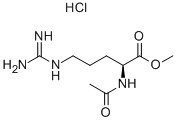
- 1784-05-0
- C9H19ClN4O3
- 266.73
- All (0)
- China (0)
- (0)
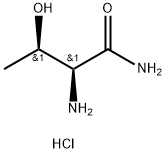
- 33209-01-7
- C4H11ClN2O2
- 154.59
- All (0)
- China (0)
- (0)
- 1355478-15-7
- C16H8BrCl2N3
- 393.06500
- All (0)
- China (0)
- (0)
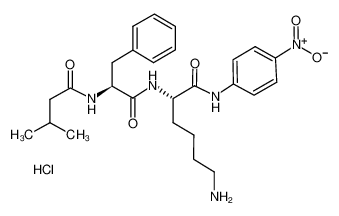
- 178894-43-4
- C26H36ClN5O5
- 534.05000
- All (0)
- China (0)
- (0)
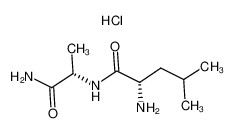
- 87831-94-5
- C9H20ClN3O2
- 237.73000
- All (0)
- China (0)
- (0)
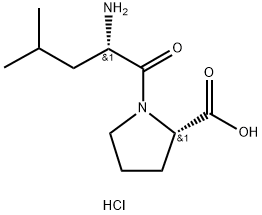
- 87178-63-0
- C11H21ClN2O3
- 264.75
- All (0)
- China (0)
- (0)
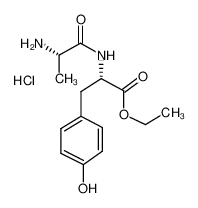
- 13260-91-8
- C14H21ClN2O4
- 316.78100
- All (0)
- China (0)
- (0)
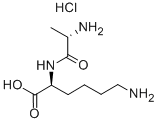
- 68973-27-3
- C9H20ClN3O3
- 253.73
- All (0)
- China (0)
- (0)
Related Products More >

- 657-27-2
- USD 1050.0000
- 25kg
- 14252-80-3
- 1.0000
- GlassBottlekg
- 99300-78-4
- Request For Quotation
- 99300-78-4
- Request For Quotation
- 99300-78-4
- Request For Quotation
- 99300-78-4
- Request For Quotation
- 99300-78-4
- Request For Quotation
- 99300-78-4
- Request For Quotation


Now, let's think about pH. The pH scale measures how acidic or basic a solution is. The lower the pH, the more acidic the solution. Since HCl dissociates completely into hydrogen ions, it can make the pH of a solution really low. Just how low depends on the concentration of the HCl. But generally speaking, even a relatively dilute solution of HCl can have a pH well below 7. For example, a 0.1 M (molar) solution of HCl has a pH of about 1. And if you increase the concentration, the pH will drop even further. So, its pH - related properties also point to HCl being a strong acid.
Concentration does play a role in how HCl shows its acid strength. The more HCl you have in a given volume of water, the more hydrogen ions are released into the solution. This means that as the concentration of HCl goes up, the solution becomes more acidic. But no matter the concentration, HCl always dissociates completely, which is a key characteristic of a strong acid. A weak acid, on the other hand, only dissociates partially, and changing the concentration doesn't have the same kind of impact on the degree of dissociation.
When it comes to interacting with different substances, HCl really shows its strong - acid colors. Take metals, for example. When HCl reacts with a metal like zinc or iron, it causes a chemical reaction. The hydrogen ions in the HCl solution react with the metal atoms. The metal gives up electrons to the hydrogen ions, which then turn into hydrogen gas. This is a classic reaction that strong acids do. With bases, it's a similar story. When HCl reacts with a base like sodium hydroxide, the hydrogen ions from the HCl combine with the hydroxide ions from the base to form water. The remaining ions, chloride and sodium in this case, form a salt. This kind of neutralization reaction is exactly what you'd expect from a strong acid. So, considering all these aspects of its properties - dissociation in water, pH - related behavior, the effect of concentration, and its reactions with other substances - it's clear that hydrogen chloride is indeed a strong acid.
Now, let's dive into its pH properties. pH is a measure of how acidic or basic something is. Strong acids can push the pH scale way down, towards zero. HCl solutions can get really, really low on the pH scale, meaning they're super acidic.
Concentration matters too. The more HCl you have in a solution, the stronger its acidity shows up. It's like adding more spice to your food – the more you add, the hotter it gets.
And how does HCl play with other stuff? Well, with metals, it's like acid meets metal and it's not a pretty sight. HCl can react with metals to produce hydrogen gas and metal chlorides. Same goes for bases – HCl neutralizes them, giving off water and the salt of the base and HCl. This is classic strong acid behavior.
So, putting it all together, HCl ticks all the boxes for being a strong acid. It breaks down completely in water, pushes the pH way down, its acidity scales with concentration, and it reacts with metals and bases just like you'd expect a strong acid to. HCl, it's definitely in the strong acid club.
Moving on to its pH - related properties. HCl solutions can achieve very low pH values. For example, a 1 molar solution of HCl will have a pH of around 0. The more concentrated the HCl solution, the lower the pH it can reach. This is because a higher concentration of HCl means more hydrogen ions are present in the solution, which makes the solution more acidic and thus lowers the pH.
The concentration of HCl does affect how its acid - strength is manifested. A more concentrated HCl solution will not only have a lower pH but also react more vigorously with other substances. For instance, in reactions with metals, a concentrated HCl solution will produce hydrogen gas more quickly compared to a dilute solution.
When it comes to its interaction with different substances, HCl shows the typical behavior of a strong acid. In reactions with metals, it displaces the hydrogen from the metal, forming a salt and releasing hydrogen gas. For example, when it reacts with zinc (Zn), the reaction is Zn + 2HCl → ZnCl₂ + H₂↑. With bases, it undergoes a neutralization reaction. It reacts with bases like sodium hydroxide (NaOH) to form a salt (sodium chloride in this case) and water. The reaction is HCl + NaOH → NaCl + H₂O.
All these properties, like complete dissociation in water, ability to achieve very low pH values, the influence of concentration on its reactivity, and its typical reactions with metals and bases, indicate that HCl is indeed a strong acid.