


 Home
Home
People often hear that collagen can improve joint health, but how exactly does it work? Can taking collagen supplements actually support the cartilage and connective tissues in your knees, elbows, or other joints? Is it more effective than regular diet or exercise alone? And how long does it usually take to notice any difference in joint comfort or flexibility? Are there specific types of collagen that are better for joints, or can any collagen supplement make a difference?
Does Collagen Help with Joints? Understanding Its Role in Joint Health
Related Encyclopedia
- 9007-34-5
- 0
- All (14)
- China (1)
- (14)
- 9064-67-9
- C4H6N2O3R2.(C7H9N2O2R)n
- 0
- All (14)
- China (1)
- (14)
- 92113-31-0
- CO(NH2)2,Fe+++
- 0
- All (3)
- China (0)
- (3)
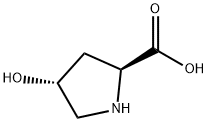
- 51-35-4
- C5H9NO3
- 131.13
- All (84)
- China (23)
- (84)
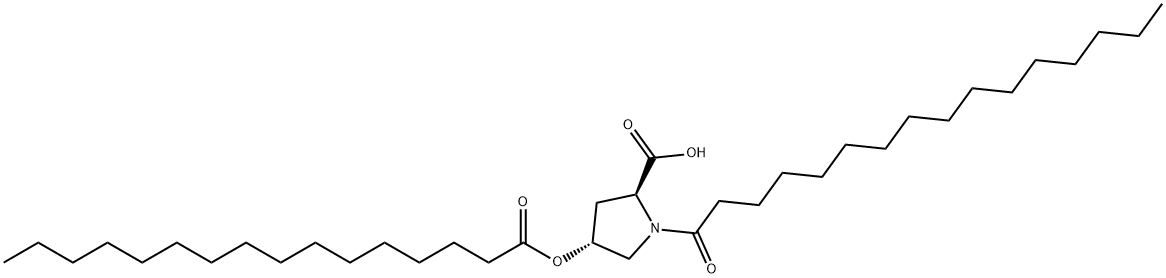
- 41672-81-5
- C37H69NO5
- 607.95
- All (1)
- China (0)
- (1)
- 147028-80-6
- C5H9NO3
- 131.13000
- All (84)
- China (23)
- (84)
- 104111-00-4
- C5H9NO3
- 131.13000
- All (0)
- China (0)
- (0)
- 286375-02-8
- C53H78N12O16S4
- 1267.52000
- All (0)
- China (0)
- (0)
- 264146-55-6
- C58H92N16O16S4
- 1397.71000
- All (0)
- China (0)
- (0)
- 286375-00-6
- C57H89N17O17S4
- 1412.68000
- All (0)
- China (0)
- (0)
Related Products More >

- 92113-31-0
- Request For Quotation
- 25kg/Cardboard Drum
- 92113-31-0
- Request For Quotation
- 1g,50g,100g,1000g
- 92113-31-0
- Request For Quotation
- 92113-31-0
- Request For Quotation
- 25kg/drum
- 92113-31-0
- Request For Quotation
- 92113-31-0
- Request For Quotation
- 92113-31-0
- Request For Quotation
- 92113-31-0
- Request For Quotation
- 100g;1kg;25g


In joints, collagen forms the framework of cartilage, which acts as a cushion between bones, reducing friction and absorbing shock during movement. As we age or due to excessive physical stress, the collagen in cartilage can degrade, leading to joint pain, stiffness, and conditions like osteoarthritis. Supplementing with collagen may help replenish the lost collagen in the joint matrix, potentially improving joint function and reducing discomfort.
It's important to distinguish collagen from other joint - health supplements like glucosamine and chondroitin. While glucosamine and chondroitin are components of cartilage and may support its repair, collagen provides the structural scaffold. A common misunderstanding is that collagen supplements will instantly restore joint health. In reality, the benefits are gradual and depend on factors such as the severity of joint damage, overall health, and consistency of supplementation. Additionally, collagen's effectiveness can vary based on its source and bioavailability, highlighting the need for informed choices when selecting supplements.
Supplemental collagen, typically hydrolyzed into smaller peptides for better absorption, may support joint health by providing the amino acids—glycine, proline, and hydroxyproline—needed for the body to produce new collagen. These peptides are transported to joint tissues, where they can stimulate chondrocytes, the cells responsible for synthesizing cartilage components. This mechanism differs from anti-inflammatory drugs, which alleviate pain but do not address the underlying structural damage, making collagen a candidate for supporting long-term joint integrity rather than just symptom relief.
In practical terms, the effects of collagen supplementation on joints vary by individual and context. Athletes or individuals with early-stage joint discomfort often report reduced pain and improved mobility, as the additional collagen may help replenish cartilage matrix components. For those with advanced osteoarthritis, benefits may be more modest, as significant cartilage loss is harder to reverse. This aligns with the understanding that collagen works best as a preventive or supportive measure, maintaining existing cartilage health rather than regenerating large amounts of lost tissue.
Beyond individual wellness, collagen’s role in joint health has implications for public health, particularly as populations age and osteoarthritis prevalence rises. By supporting cartilage maintenance, collagen supplementation can reduce reliance on pain medications and improve quality of life, underscoring its value in integrative approaches to musculoskeletal care. In industrial contexts, collagen-derived products are also used in medical devices like cartilage grafts, leveraging its structural properties to aid in surgical repair. This intersection of nutrition, physiology, and medicine highlights how a single protein can influence both daily mobility and long-term joint function, making it a focal point in efforts to support healthy aging.
In practical applications, athletes or individuals with osteoarthritis often incorporate collagen peptides into their routines to support joint function and reduce wear-related degradation. For example, studies on collagen supplementation show improved joint comfort and mobility when taken consistently, particularly in weight-bearing joints such as knees and hips. Collagen intake alone is not sufficient; it is synergistic with mechanical loading—regular exercise or physical therapy stimulates cartilage turnover and optimizes tissue adaptation. Additionally, not all collagen forms are equally bioavailable, so hydrolyzed or enzymatically processed collagen is preferred for systemic absorption.
In a real-world context, consistent collagen supplementation may help mitigate age-related collagen loss in joints, contributing to sustained mobility and reduced stiffness. For instance, older adults engaging in low-impact exercises while supplementing with collagen may experience improved joint range of motion compared to exercise alone. Understanding these mechanisms helps clarify why collagen can be a valuable adjunct in joint health management strategies, particularly when combined with lifestyle measures that support musculoskeletal integrity.