


 Home
Home
Many people wonder if simple actions like gently pinching or massaging the skin can actually boost collagen production. Can these minor mechanical stimulations encourage the skin’s natural repair processes and increase firmness over time? Are there any real benefits to this approach compared to topical creams or supplements, or is it mostly a myth? How much pressure or frequency would be needed to see noticeable results, and is it safe for sensitive skin areas like the face or under the eyes? Could pinching really help maintain youthful skin?
Does Pinching Skin Stimulate Collagen?
Related Encyclopedia
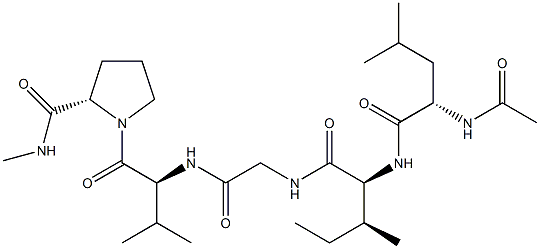
- 9007-58-3
- C27H48N6O6
- 552.70662
- All (0)
- China (0)
- (0)
- 9007-34-5
- 0
- All (14)
- China (1)
- (14)
- 9064-67-9
- C4H6N2O3R2.(C7H9N2O2R)n
- 0
- All (14)
- China (1)
- (14)
- 92113-31-0
- CO(NH2)2,Fe+++
- 0
- All (3)
- China (0)
- (3)
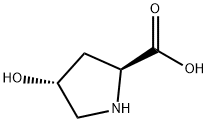
- 51-35-4
- C5H9NO3
- 131.13
- All (84)
- China (23)
- (84)
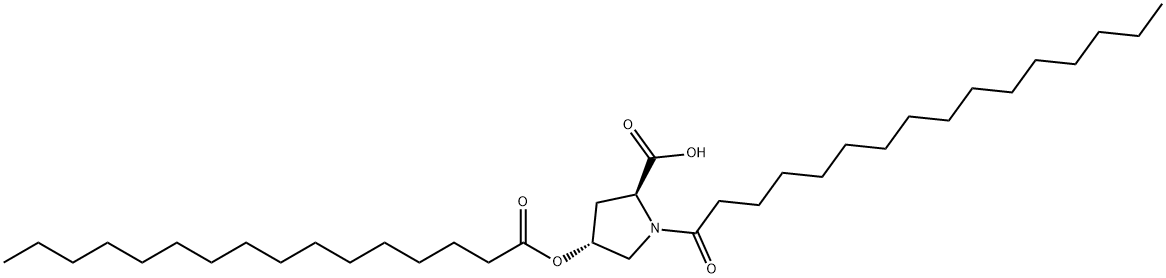
- 41672-81-5
- C37H69NO5
- 607.95
- All (1)
- China (0)
- (1)
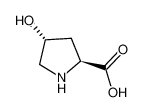
- 147028-80-6
- C5H9NO3
- 131.13000
- All (84)
- China (23)
- (84)
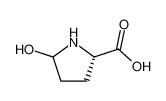
- 104111-00-4
- C5H9NO3
- 131.13000
- All (0)
- China (0)
- (0)
- 286375-02-8
- C53H78N12O16S4
- 1267.52000
- All (0)
- China (0)
- (0)
- 264146-55-6
- C58H92N16O16S4
- 1397.71000
- All (0)
- China (0)
- (0)
Related Products More >

- 96702-03-3
- Request For Quotation
- 92113-31-0
- Request For Quotation
- 25kg/Cardboard Drum
- 92113-31-0
- Request For Quotation
- 1g,50g,100g,1000g
- 92113-31-0
- Request For Quotation
- 92113-31-0
- Request For Quotation
- 25kg/drum
- 92113-31-0
- Request For Quotation
- 92113-31-0
- Request For Quotation
- 92113-31-0
- Request For Quotation


For instance, in microneedling, tiny punctures create a controlled wound response, prompting fibroblasts to generate collagen and elastin, which improves skin texture and firmness over time. Pinching is much milder but operates on the same concept of mechanical signaling. Additionally, combining these actions with adequate nutrition—such as amino acids from proteins—and topical factors that support collagen production, like vitamin C, can enhance the overall effect. In everyday practice, gentle massage or pinching may complement other skincare routines rather than serve as a standalone solution.
In summary, pinching skin can provide subtle mechanical cues that potentially engage fibroblasts, but the magnitude of collagen production is limited without additional interventions. Understanding the underlying biology clarifies why this approach may have a modest effect and highlights the importance of integrating it with comprehensive strategies like nutrition, sun protection, and clinically established procedures for tangible results.
Pinching the skin is a mechanical stimulus. While mechanical forces can influence tissue behavior, simply pinching the skin does not directly and effectively stimulate collagen production. In contrast, procedures like micro - needling, which create controlled micro - injuries in the skin, trigger a wound - healing response. This response involves a cascade of events, including the activation of fibroblasts and the release of cytokines and growth factors that promote collagen synthesis.
A common misunderstanding is that any form of skin manipulation, such as pinching, can have the same collagen - boosting effect as specialized treatments. However, pinching lacks the precision and intensity needed to initiate the biological pathways for significant collagen production. Moreover, excessive or improper pinching can even damage the skin's surface, leading to inflammation and potentially disrupting the normal collagen structure. For those seeking to enhance collagen levels, medical - grade treatments or a well - balanced diet rich in collagen - building nutrients are more reliable options.
The physiological mechanism behind this lies in the skin’s ability to adapt to mechanical stimuli. Collagen fibers provide structural support, and when they are stretched or compressed—even gently—fibroblasts interpret this as a signal to strengthen the network. However, pinching often affects only the outermost layers, limiting the depth of the stimulus and thus the extent of collagen production. Unlike deeper mechanical or thermal treatments, which penetrate the dermis more effectively, casual pinching rarely generates enough stress to trigger significant collagen synthesis, making any resulting effect subtle at best.
In practical terms, relying on pinching to boost collagen is unlikely to yield noticeable results. The skin’s repair response to such mild trauma is short-lived and overshadowed by other factors like age, nutrition, and sun exposure, which have far greater impacts on collagen levels. Excessive or aggressive pinching can even damage skin cells, leading to bruising or irritation without meaningful collagen benefits, highlighting the importance of balancing mechanical stimulation with tissue safety. This contrasts with clinical procedures that use calibrated stress to induce collagen production, ensuring controlled, effective results without harm.
Beyond individual skincare, this relationship underscores the skin’s role as a dynamic organ that responds to environmental cues, including mechanical stress. In dermatology, this principle informs treatments like radiofrequency therapy or laser resurfacing, which use precise energy to stimulate collagen without excessive damage. Understanding that casual pinching has limited effect reinforces the idea that meaningful collagen synthesis requires targeted, controlled stimuli, guiding individuals toward evidence-based practices rather than anecdotal methods. This also highlights the complexity of skin biology, where repair mechanisms are finely tuned to respond appropriately to different types and intensities of stress.