


 Home
Home
Phosphorus is one of the main nutrients plants need, but how much of it is actually used in fertilizers for growing crops? Is there a standard amount farmers apply, or does it depend on the type of crop and soil? How important is phosphorus compared to other nutrients like nitrogen and potassium? And what happens if crops don’t get enough phosphorus during their growth?
How Much Phosphorus Is Used in Fertilizers for Crops and Why Does It Matter?
Related Encyclopedia
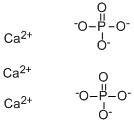
- 7758-87-4
- Ca3O8P2
- 310.18
- All (75)
- China (0)
- (75)

- 7757-93-9
- CaHO4P
- 136.06
- All (0)
- China (0)
- (0)
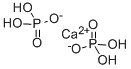
- 7758-23-8
- CaH4O8P2
- 234.05
- All (41)
- China (19)
- (41)
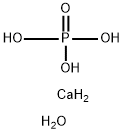
- 10031-30-8
- CaH7O5P
- 158.1
- All (41)
- China (19)
- (41)
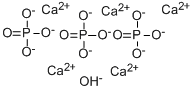
- 12167-74-7
- 5Ca.3O4P.HO
- 502.31
- All (3)
- China (1)
- (3)
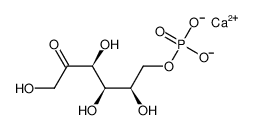
- 6035-93-4
- C6H11CaO9P
- 298.19800
- All (0)
- China (0)
- (0)
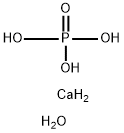
- 7789-77-7
- CaH7O5P
- 158.1
- All (1)
- China (0)
- (1)
- 141249-01-6
- H4P6
- 189.87400
- All (2)
- China (2)
- (2)
- 145491-55-0
- P8
- 247.79000
- All (2)
- China (2)
- (2)
- 141248-98-8
- P6
- 185.84300
- All (2)
- China (2)
- (2)
Related Products More >

- 10124-56-8
- CNY Request For Quotation
- 7722-88-7
- CNY Request For Quotation
- 7722-88-6
- CNY Request For Quotation
- 7722-88-5
- CNY Request For Quotation
- 7758-16-11
- CNY Request For Quotation
- 7758-16-10
- CNY Request For Quotation
- 7758-16-9
- CNY Request For Quotation
- 7757-93-11
- CNY Request For Quotation


The amount used varies quite a bit. For example, heavy feeders like corn or wheat might get more phosphorus because they need strong root systems to support fast growth. Other plants need less, so farmers often test the soil first to figure out how much phosphorus to add. If plants don’t get enough phosphorus, they may grow slowly, have weak roots, or produce fewer fruits and seeds.
Phosphorus doesn’t move easily in the soil, so it stays near the roots where plants can use it. This means applying the right amount is important—not too little to avoid poor growth, and not too much to prevent waste or environmental harm. Getting phosphorus right helps farmers grow healthy crops and good harvests year after year.
Phosphorus in soil exists mostly in forms that are not immediately available to plants, often bound to minerals or organic matter. Fertilizers provide soluble phosphate ions that roots can absorb directly. However, phosphorus mobility in soil is limited, so placement and timing of fertilizer application are critical to maximize uptake efficiency and minimize environmental losses. For example, banding phosphorus fertilizer near seed rows can improve early root access compared to broadcasting it uniformly across a field.
Crop-specific phosphorus application rates vary widely. Cereals like wheat or maize commonly receive between 30 to 60 kilograms of phosphorus pentoxide (P2O5) per hectare depending on soil test results, while legumes might require less due to their symbiotic nitrogen fixation which demands different nutrient balances. Over-application can lead to phosphorus accumulation in soils, increasing risks of runoff and eutrophication in nearby water bodies.
In real-world farming, precision agriculture techniques use soil testing and GPS-guided equipment to tailor phosphorus applications, ensuring crops receive adequate nutrition without excess. This targeted management not only enhances crop performance but also supports sustainable practices by preserving soil health and protecting ecosystems. The nuanced understanding of phosphorus dynamics remains fundamental to efficient and responsible fertilizer use in modern agriculture.
Chemically, phosphorus in fertilizers is often supplied as phosphate ions, derived from minerals like apatite or processed into forms such as monoammonium phosphate (MAP) or diammonium phosphate (DAP). These compounds dissolve in soil moisture, releasing phosphate ions that plants absorb through their roots. Physically, phosphorus mobility in soil is limited; it binds tightly to clay particles and organic matter, making it prone to fixation and reducing its availability over time. This necessitates strategic application, such as banding near roots or incorporating it into the soil during tillage, to enhance uptake efficiency.
In daily farming, precise phosphorus management ensures cost-effective resource use and minimizes environmental risks like eutrophication, where excess phosphorus runoff fuels algal blooms in water bodies. Industrially, phosphorus recovery from waste streams—such as sewage sludge or animal manure—is gaining traction to reduce reliance on finite phosphate rock reserves. Although not directly used in medicine, phosphorus’s role in crop nutrition indirectly supports food security and human health by enabling the production of nutrient-dense staples. From an interdisciplinary lens, phosphorus use in fertilizers highlights the intersection of agronomy, environmental science, and resource economics, underscoring the need for sustainable practices to balance agricultural productivity with long-term ecological resilience.
Phosphorus in fertilizers is primarily supplied as phosphate salts, such as monoammonium phosphate (MAP) or diammonium phosphate (DAP), where phosphorus is present as orthophosphate ions (PO₄³⁻)—the form most readily absorbed by plant roots. These ions participate in critical physiological processes, including ATP synthesis, DNA replication, and cell membrane formation, making phosphorus essential for energy transfer and growth regulation. Unlike nitrogen, which is mobile in plants, phosphorus is relatively immobile, meaning deficiencies manifest first in younger tissues, highlighting the need for timely availability.
A key distinction exists between total phosphorus content and plant-available phosphorus. Fertilizer labels often list total phosphorus as P₂O₅ (phosphorus pentoxide), a convention to standardize measurements, but only the water-soluble or citrate-soluble fractions are accessible to plants. This differs from soil phosphorus, much of which is bound to minerals or organic matter, requiring microbial activity or acidification to release free ions.
A common misconception is that applying excess phosphorus guarantees better yields. In reality, overapplication can lead to phosphorus accumulation in soil, increasing the risk of runoff into waterways, where it contributes to eutrophication. Another misunderstanding is equating phosphorus needs across soils; alkaline soils may bind phosphorus into insoluble calcium phosphates, while acidic soils form iron or aluminum phosphates, both reducing availability and necessitating adjusted application rates.
Precise phosphorus management, guided by soil testing, ensures crops receive adequate amounts without environmental harm. This balance is critical for sustainable agriculture, as phosphorus is a finite resource derived from phosphate rock, making efficient use essential for long-term food security.