


 Home
Home
Many people wonder about the oils they use every day, especially olive oil. Is it hydrogenated like some other cooking oils, or does it stay in its natural form? How does hydrogenation affect the oil’s taste, texture, and health benefits? Are there any risks if olive oil were hydrogenated? Can we easily find hydrogenated olive oil on the market, or is it mostly sold as regular olive oil? Why do manufacturers choose hydrogenation for certain oils but not for olive oil?
Is Olive Oil Hydrogenated? What You Need to Know
Related Encyclopedia
- 8001-25-0
- N/A
- 0
- All (19)
- China (6)
- (19)

- 67701-08-0
- C18H34O2
- 282.46100
- All (0)
- China (0)
- (0)

- 67701-03-5
- C34H68O4
- 540.90132
- All (0)
- China (0)
- (0)

- 61788-66-7
- 0.00000
- All (0)
- China (0)
- (0)
- 67784-82-1
- (C3H8O3
- 0
- All (2)
- China (2)
- (2)
- 61789-31-9
- 0
- All (6)
- China (6)
- (6)
- 86403-32-9
- 0
- All (1)
- China (1)
- (1)
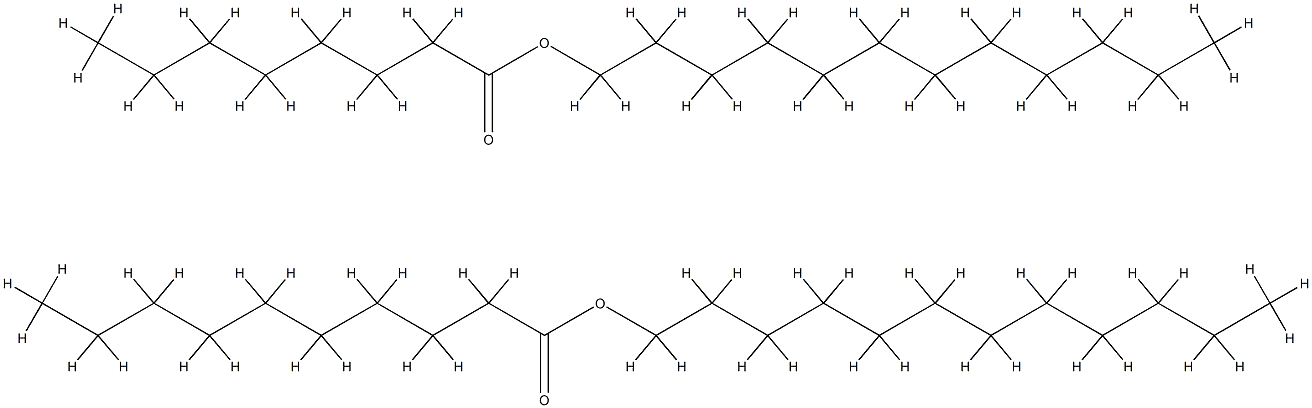
- 95912-86-0
- C42H84O4
- 653.11396
- All (1)
- China (1)
- (1)
- 68410-23-1
- 0
- All (2)
- China (0)
- (2)
- 91995-81-2
- 0
- All (8)
- China (7)
- (8)
Related Products More >

- 95912-86-0
- Request For Quotation
- 220L/drum
- 93348-22-2
- Request For Quotation
- 25KG/50KG/1000KG
- 93348-22-2
- Request For Quotation
- 25kg/Cardboard Drum
- 92044-87-6
- Request For Quotation
- 91995-81-2
- Request For Quotation
- 25
- 91995-81-2
- Request For Quotation
- 190kg/drum
- 91995-81-2
- Request For Quotation
- Bottle,barrel,cargo,container,etc.
- 91995-81-2
- Request For Quotation
- 200kgs net plastic drum.


From a chemical and physical perspective, hydrogenation alters melting points and oxidative stability. In industrial applications, this is useful for oils like soybean or canola, which benefit from longer shelf life and a solid texture for products such as margarine or processed foods. Olive oil, however, already maintains stability at room temperature and has a unique composition of oleic acid and polyphenols that contribute to both its flavor and health properties. Subjecting olive oil to hydrogenation could degrade these beneficial compounds, reduce its antioxidant capacity, and potentially produce unwanted trans fats, which have different biological effects compared to naturally occurring monounsaturated fats.
In daily life, olive oil is widely used in cooking, baking, and as a condiment, appreciated for its sensory qualities and cardiovascular benefits. The absence of hydrogenation allows it to retain its liquid form, golden color, and distinct aroma. From a cross-disciplinary view, its stability and nutritional profile make it valuable not only in culinary settings but also in nutrition, dermatology, and even pharmaceutical formulations. While hydrogenation has industrial advantages, for olive oil, the natural form provides optimal balance between functionality, health impact, and sensory experience.
Understanding olive oil’s composition and why it is not hydrogenated offers insights into broader food science principles, including fat chemistry, shelf life considerations, and nutritional optimization. Its natural state exemplifies how certain oils are best consumed with minimal processing to preserve both chemical integrity and health benefits.
The absence of hydrogenation in olive oil distinguishes it from many processed vegetable oils, such as partially hydrogenated soybean or cottonseed oils, which contain trans fats linked to cardiovascular risks. Olive oil’s unaltered chemical structure preserves its anti-inflammatory properties and ability to support heart health. For example, Mediterranean diets, rich in non-hydrogenated olive oil, correlate with lower rates of chronic diseases, partly due to its favorable impact on cholesterol levels and endothelial function.
In practice, the choice between hydrogenated and non-hydrogenated oils often hinges on intended use. While hydrogenated oils withstand high-temperature frying better, olive oil’s lower smoke point makes it ideal for sautéing or dressings. Food manufacturers avoid hydrogenating olive oil because it would degrade its flavor and nutritional value, undermining the very qualities consumers seek. The preference for minimally processed oils reflects a broader shift toward whole-food ingredients, where olive oil’s natural state aligns with both culinary and health priorities.
The resistance of olive oil to hydrogenation in its natural state stems from both its fatty acid composition and the typical contexts of its use. Unlike polyunsaturated fats, which have multiple double bonds and are more reactive, the single double bond in oleic acid makes it less prone to undergoing hydrogenation without intentional industrial intervention. Additionally, olive oil is often valued for its unprocessed or minimally processed form, where preserving its natural fatty acid profile and associated health benefits—such as its role in supporting cardiovascular health through reducing low-density lipoprotein cholesterol—is a priority. Hydrogenation would alter these properties, diminishing the qualities that make olive oil distinct in culinary and nutritional applications.
A common misconception is that all vegetable oils, including olive oil, undergo hydrogenation as a standard processing step. This is incorrect. While some vegetable oils are routinely hydrogenated, olive oil’s processing usually involves only pressing and filtering to extract the oil, avoiding chemical modifications like hydrogenation. The presence of trans fats, a byproduct of partial hydrogenation, is therefore not a typical concern with pure olive oil, unlike with many hydrogenated oils. This distinction is crucial for consumers and professionals in nutrition and food science, as it affects dietary recommendations and product formulations centered on health and functionality.