


 Home
Home
Many people wonder how different liquids mix with each other, especially when it comes to chemicals we hear about in science or medicine. Chloroform is a substance that was once used as an anesthetic, and water is everywhere in daily life. Can these two liquids blend together easily, or do they stay separate when combined? How does chloroform behave if you pour it into water, and what does that mean for using or handling it safely? Is chloroform miscible in water, or does it act differently?
Is Chloroform Miscible in Water?
Related Encyclopedia
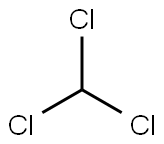
- 67-66-3
- CHCl3
- 119.38
- All (0)
- China (0)
- (0)
- 32119-90-7
- DOT
- 22.02930
- All (50)
- China (13)
- (50)
- 20272-95-1
- DOT
- 21.02960
- All (50)
- China (13)
- (50)

- 358616-29-2
- H3O2
- 35.02260
- All (50)
- China (13)
- (50)
- 61468-85-7
- OT2
- 23.03120
- All (50)
- China (13)
- (50)
- 53774-37-1
- OT2
- 24.03130
- All (50)
- China (13)
- (50)
- 32113-92-1
- HOT
- 22.02320
- All (50)
- China (13)
- (50)
- 32119-89-4
- HOT
- 21.02310
- All (50)
- China (13)
- (50)
- 32113-93-2
- DOT
- 23.02930
- All (50)
- China (13)
- (50)
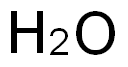
- 7732-18-5
- H2O
- 18.01
- All (50)
- China (13)
- (50)
Related Products More >

- 9003-05-8
- USD 30.0000
- 25kg
- 9003-05-8
- USD 30.0000
- 25kg
- 1336-21-6
- CNY 500.0000
- 1ton


The partial miscibility of chloroform in water is further influenced by the balance between cohesive forces within each liquid and adhesive forces between them. Cohesive forces in water are strong due to extensive hydrogen bonding, while chloroform’s cohesive forces are dominated by weaker dipole-dipole interactions and London dispersion forces. The adhesive forces between chloroform and water are not strong enough to overcome the cohesive forces in either liquid to a large extent, resulting in only limited solubility—approximately 0.8 g of chloroform dissolves in 100 mL of water at room temperature.
This property distinguishes chloroform from fully miscible organic solvents like ethanol, which can form hydrogen bonds with water through their hydroxyl groups, allowing them to mix in all proportions. Unlike ethanol, chloroform’s inability to form such strong interactions restricts its solubility, making it more suitable for extracting non-polar or moderately polar compounds from aqueous solutions, a common application in organic chemistry laboratories.
A common misconception is that all organic compounds are immiscible in water, but this is not the case. Chloroform’s limited solubility, as opposed to complete immiscibility, shows that polarity gradients exist, and even less polar substances can dissolve to a small degree in highly polar solvents like water, depending on their specific molecular interactions. This nuance is important in fields such as environmental science, where understanding chloroform’s behavior in aqueous systems helps assess its transport and fate in natural water bodies.
From a chemical mechanism perspective, the inability of chloroform to fully dissolve in water arises from its molecular structure: the three chlorine atoms contribute to significant electron density around the central carbon, reducing the molecule’s affinity for hydrogen bonding. As a result, the energetics of mixing chloroform with water are unfavorable beyond a very small concentration. In practical terms, this characteristic has implications in both laboratory and industrial settings. Chloroform is commonly used as a solvent for nonpolar substances, and its immiscibility with water allows for efficient separation of compounds during extraction processes. In medicinal history, chloroform’s density and poor water solubility influenced its use in anesthesia, as it could be administered in controlled formulations without dissolving in bodily fluids in a manner that would dilute its effect unpredictably.
In environmental and safety contexts, chloroform’s behavior with water also matters. Its separation from aqueous systems means it can accumulate at the bottom of containers or sediments in natural bodies of water, affecting disposal and remediation strategies. In chemical manufacturing, understanding its immiscibility guides handling protocols, storage, and containment measures to prevent unintended mixing with water or aqueous solutions. Beyond practical applications, this property highlights broader lessons about molecular interactions: polarity, hydrogen bonding, and density differences collectively determine how chemicals behave when they encounter each other. It demonstrates that even simple mixing experiments reveal deep insights into chemical structure, solvent behavior, and the principles underlying solution chemistry in both academic and real-world settings.
The interaction between chloroform and water illustrates the "like dissolves like" principle, where polar solvents preferentially dissolve polar solutes. Chloroform’s partial miscibility arises because its weak polarity allows some interaction with water molecules, but not enough to overcome the energy penalty of disrupting water’s hydrogen-bonded network. This behavior is critical in applications like liquid-liquid extraction, where chloroform’s ability to separate from water is exploited to isolate organic compounds. For instance, in pharmaceutical labs, chloroform is used to extract nonpolar active ingredients from aqueous solutions.
In practical settings, chloroform’s water miscibility has implications for environmental and safety protocols. Spills of chloroform in water systems create localized contamination due to its limited solubility and higher density, which causes it to sink. This property necessitates careful handling in industrial processes to prevent groundwater pollution. The interplay between chloroform and water also influences its use as an anesthetic, where its solubility affects absorption rates in biological tissues. Despite its declining medical use, understanding its behavior in water remains relevant for chemical waste management and laboratory practices.