


 Home
Home
People often hear that chloroform can be made from simple household items like acetone and bleach, but is that really true? What kind of chemical process is involved, and why do these two substances react this way? Is it legal or safe to even try such an experiment at home? What could happen if someone mixes these two ingredients without understanding the reaction? Could this lead to dangerous fumes, poisoning, or other serious problems? How exactly does chloroform form from acetone and bleach in this situation?
How to Make Chloroform from Acetone and Bleach?
Related Encyclopedia
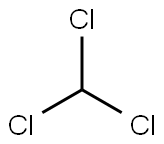
- 67-66-3
- CHCl3
- 119.38
- All (0)
- China (0)
- (0)
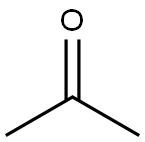
- 67-64-1
- C3H6O
- 58.08
- All (22)
- China (16)
- (22)
![[14C]-Chloroform](https://chemcloud-1304660855.cos.ap-shanghai.myqcloud.com/compound/efb0eeb1f4fe47ee81daf5f97d57302d.png?imageMogr2/format/webp)
- 10307-69-4
- CHCl3
- 121.37000
- All (0)
- China (0)
- (0)
- 133733-29-6
- C5H9Cl3
- 175.48400
- All (0)
- China (0)
- (0)
- 18675-83-7
- C6H6Cl3N
- 198.47800
- All (0)
- China (0)
- (0)
- 18675-92-8
- C7H7Cl3
- 197.48900
- All (0)
- China (0)
- (0)
- 61414-06-0
- CH37Cl3O18
- 443.65300
- All (0)
- China (0)
- (0)
![[3H]chloroform](https://chemcloud-1304660855.cos.ap-shanghai.myqcloud.com/compound/b5c04ab84ae34a36a282ea79d69e10fb.png?imageMogr2/format/webp)
- 38024-32-7
- CCl3T
- 121.38600
- All (0)
- China (0)
- (0)
- 73506-42-0
- CCl4O4
- 217.82000
- All (0)
- China (0)
- (0)
- 32955-16-1
- C3H4Cl3N
- 160.43000
- All (0)
- China (0)
- (0)
Related Products More >

- 96-26-4
- CNY Request For Quotation
- 96-26-4
- CNY Request For Quotation
- CNY Request For Quotation
- CNY Request For Quotation
- 67-64-1
- CNY 2000.0000
- 1ton
- 7778-54-3
- USD 50.0000
- 45kg
- 51364-51-3
- Request For Quotation
- 100g
- 51364-51-3
- Request For Quotation
- 10g


Most people don’t realize that chloroform was once used in hospitals as an anesthetic, but it got banned because it was too harmful and unpredictable. Making it in your kitchen or garage is nothing like a safe science experiment—it’s basically a toxic gas factory. Even a small mistake in the amounts or exposure time can land you in the hospital.
So while the idea might sound like simple chemistry, in reality, it’s a recipe for real danger. It’s better to leave this stuff to professionals in controlled labs, not your home sink or a random mixing bowl.
The haloform reaction, of which this is a specific example, is significant in organic chemistry as a method for functional group transformation and synthesis. It allows for the conversion of methyl ketones (like acetone) into haloforms (such as chloroform) and carboxylic acids (or their salts), providing a route to valuable compounds. Chloroform itself has historical importance as an anesthetic, though its use in this context has declined due to toxicity and safety concerns; it is now more commonly used as a solvent in organic synthesis and in some industrial processes. Distinguishing this reaction from other halogenation processes is key: unlike simple electrophilic aromatic substitution, which introduces halogens onto aromatic rings, or free radical halogenation of alkanes, which is initiated by light and proceeds via radical intermediates, the haloform reaction is a nucleophilic substitution occurring at the α-carbon of a ketone, driven by the stability of the carbonyl group and the reactivity of enolates.
A common misconception is that this reaction proceeds spontaneously or safely under standard conditions, but in reality, it requires careful control of pH (typically basic), temperature, and reactant ratios to avoid side reactions. For instance, excess hypochlorite can lead to further oxidation of the products, and acidic conditions can reverse the enolate formation, halting the reaction. Additionally, chloroform is a volatile and potentially toxic compound, with exposure risks including central nervous system depression and liver damage, making proper handling and ventilation essential. Another misunderstanding is equating this reaction to the formation of other haloforms (like bromoform or iodoform) using different halides, but while the general mechanism is similar, the reactivity of the halide ions and the stability of the intermediate products vary, affecting reaction rates and yields. Recognizing these nuances is crucial for both educational purposes and practical applications in chemical synthesis.
The properties of chloroform make it an interesting compound scientifically yet highly hazardous in practical terms. It is a dense, colorless liquid with a sweet odor, relatively volatile at room temperature, and highly lipophilic, meaning it dissolves easily in fats. Its volatility and ability to depress the central nervous system made it historically useful as an anesthetic during the 19th century. However, its application was abandoned due to severe hepatotoxicity, cardiotoxicity, and the potential to induce sudden death. In addition, chloroform acts as a potential carcinogen, particularly linked to liver and kidney damage.
From an interdisciplinary perspective, this reaction illustrates important concepts in organic chemistry, industrial safety, and toxicology. Although the chemical equation appears straightforward, the uncontrolled setting of household environments introduces unpredictable variables that dramatically increase risks. The industrial production of chloroform today is tightly regulated, primarily for use as a precursor in manufacturing refrigerants, pesticides, and fluoropolymers. In medical and environmental contexts, chloroform contamination is monitored because of its persistence in water sources and its ability to bioaccumulate. The broader implications of this chemistry extend to discussions on public health, chemical regulation, and the necessity of proper scientific oversight when dealing with hazardous compounds.
The mechanism hinges on the hypochlorite ion’s ability to act as both an oxidizing and chlorinating agent. In the first stage, acetone’s alpha-hydrogens are replaced by chlorine atoms, forming trichloroacetone. Under continued exposure to hypochlorite, the carbon-carbon bond breaks, releasing chloroform and sodium acetate. This reaction is highly sensitive to pH and concentration—excess bleach or improper conditions can lead to over-oxidation or incomplete conversion.
In practical settings, this method has historical significance in organic synthesis, though its use is now limited due to chloroform’s toxicity and controlled status. For example, early anesthetic preparations relied on similar processes, but modern applications prioritize safer alternatives. The reaction also illustrates broader principles in organic chemistry, such as alpha-halogenation and nucleophilic substitution. Despite its theoretical interest, attempting this synthesis outside controlled laboratories is strongly discouraged due to the risks of chlorine gas release and chloroform’s carcinogenic properties.