


 Home
Home
Hello, I’m curious about what exactly a fiber textile is.
What kinds of fibers are used in making textiles?
Are some better or safer for sensitive skin?
Can textiles cause allergies or breathing problems?
What should I look for to avoid skin irritation?
What Is a Fiber Textile and How Does It Affect Skin and Respiratory Health?
Related Encyclopedia
- 25038-59-9
- C10H12O6
- 228.19868
- All (3)
- China (0)
- (3)
- 68238-35-7
- 0
- All (3)
- China (1)
- (3)
- 63428-84-2
- 0
- All (16)
- China (1)
- (16)

- 69430-36-0
- C2H2BrClO2
- 173.39308
- All (0)
- China (0)
- (0)
- 1160375-91-6
- C41H68N14O11S3
- 1029.26000
- All (0)
- China (0)
- (0)
- 663933-94-6
- C35H60N12O13S2
- 921.05300
- All (0)
- China (0)
- (0)

- 9004-64-2
- C3H7O*
- 59.08708
- All (22)
- China (9)
- (22)
- 9004-62-0
- C29H52O21
- 0
- All (59)
- China (31)
- (59)
- 9004-57-3
- C23H24N6O4
- 448.47446
- All (21)
- China (2)
- (21)
- 9013-34-7
- C20H23NO5
- 0
- All (4)
- China (4)
- (4)
Related Products More >

- CNY Request For Quotation
- CNY Request For Quotation
- CNY Request For Quotation
- 9004-62-0
- Request For Quotation
- 9004-62-0
- Request For Quotation
- 9004-65-3
- Request For Quotation
- 9004-65-3
- USD 361.6000
- 25kg
- 9004-57-3
- USD 580.0000
- 25kg


From a medical perspective, fiber textiles can impact skin health and respiratory systems depending on their chemical composition and physical properties. Natural fibers like cotton or wool tend to be breathable and hypoallergenic for most people, reducing skin irritation. However, synthetic fibers such as polyester or nylon may sometimes cause allergic reactions or skin sensitivities because of additives or chemical residues used in manufacturing.
The fibers in textiles are composed of long-chain polymers or protein-based molecules, each with distinct chemical bonds and structures. For example, natural fibers like cotton primarily contain cellulose, a polysaccharide made of glucose units linked by β-1,4-glycosidic bonds. This gives cotton fibers hydrophilic (water-attracting) properties and good breathability. Wool, on the other hand, is mostly keratin, a protein with disulfide (S-S) bonds, which provide elasticity and some water resistance.
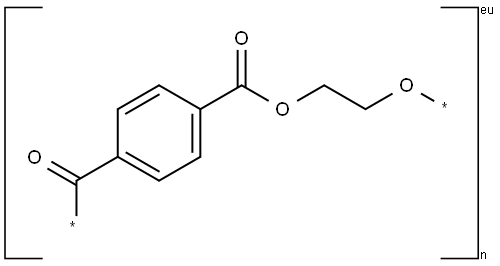
Synthetic fibers involve polymers like polyethylene terephthalate (PET) or polyamide, featuring covalent bonds in long hydrocarbon chains. These fibers are generally hydrophobic (water-repelling) and less breathable, which can lead to moisture accumulation on the skin, increasing the risk of irritation or fungal infections.
Clinically, patients with eczema or sensitive skin should consider wearing natural fiber textiles to minimize skin flare-ups. Those exposed to industrial textile dust or microfibers may develop respiratory symptoms if inhaled over time, emphasizing the importance of proper ventilation and protective equipment in work environments.
For daily management, choosing textiles labeled as “hypoallergenic” and washing new clothes before use can reduce chemical irritants. When dealing with skin sensitivities, moisturizing and limiting exposure to synthetic fabrics helps prevent complications.
Here’s the breakdown:
Fibers are the building blocks of textiles. They can be:
Natural: From plants (cotton, linen) or animals (wool, silk).
Synthetic: Man-made (polyester, nylon, spandex) using chemistry tricks.
These fibers get twisted or woven into threads, then knitted or stitched into fabrics. Think of it like spaghetti turned into a lasagna sheet—single fibers (noodles) → threads (bundled noodles) → fabric (the whole dish)! ??️
Real-world example: Your athletic leggings are a fiber textile superhero! They’re made of synthetic fibers like polyester (durable) and spandex (stretchy), woven together to wick sweat, resist odors, and move with you. Natural fibers like cotton would get soggy and saggy during a workout—no bueno! ??
Pro tip: Check fabric labels before buying clothes! If you want breathable, go for cotton/linen. For workout gear, look for polyester blends. And always avoid 100% synthetic jackets near campfires—they’ll melt like plastic (yikes!). ??
P.S. Fun fact: Silk (from silkworms) is the strongest natural fiber, while Kevlar (used in bulletproof vests) is a synthetic fiber 5x stronger than steel! ??
Fibers can come from nature (like cotton from plants, wool from sheep) or be man-made (like polyester or nylon). That’s the big split: natural vs. synthetic fiber textiles. Natural ones breathe better—great for summer clothes—while synthetic ones are often stretchier or more water-resistant, good for raincoats or activewear.
What affects how they feel or work? The fiber type, for starters. Cotton is soft but wrinkles; wool is warm but can itch. How they’re woven matters too—tight weaves (like denim) are durable, while loose weaves (like linen) are breezy.
Common myths? “Natural is always better.” Not necessarily—wool might bother sensitive skin, while synthetic blends (like cotton-polyester) can be softer and easier to wash. Another myth: “All textiles last the same.” Nope—delicate fibers like silk need gentle washing, while polyester can handle rough-and-tumble kids’ play.
Who cares? Families! Picking the right fiber textiles makes daily life easier—like choosing cotton pajamas for kids (breathable, so they sleep better) or a polyester couch cover (resists stains from spills).
Family-friendly tips:
Check labels for fiber content. “100% cotton” is great for t-shirts; “cotton-poly blend” is better for school uniforms (fewer wrinkles).
For baby clothes, stick to natural fibers like organic cotton—softer on sensitive skin.
Treat stains fast on natural fibers (they absorb liquids more). Synthetic ones? A little soap and water usually work later.
Rotate textiles: Use wool blankets in winter, cotton sheets in summer—your family will stay comfy year-round.
Fiber textiles are just fabrics, but knowing their basics helps you pick what works for your crew. No need to overthink—just match the fiber to the job, and life gets a little cozier.
Most natural fiber textiles, like cotton or wool, are made from polymers—large molecules made of repeating units. For example, cotton fibers mainly consist of cellulose, a polysaccharide polymer formed by glucose units linked through β-1,4-glycosidic bonds. These bonds are covalent, meaning atoms share electrons, creating strong connections. Cellulose chains are highly polar due to abundant hydroxyl (-OH) groups, which allow hydrogen bonding between chains. This hydrogen bonding increases the fiber’s strength and water absorbency, explaining cotton’s comfort and breathability.
Wool and silk, in contrast, are protein-based fibers composed of amino acid chains linked by peptide bonds. These peptides fold into complex structures stabilized by hydrogen bonds, disulfide bonds (S-S), and ionic interactions, which provide elasticity and durability. The presence of nonpolar side chains also affects the overall polarity and water interaction, influencing wool’s ability to resist moisture.
Synthetic fiber textiles, such as polyester or nylon, are made from petrochemical-derived polymers like polyethylene terephthalate (PET) or polyamide. These fibers have strong covalent bonds but generally less polarity compared to natural fibers, resulting in hydrophobic properties. The lack of polar groups means they repel water, making them less breathable but often more resistant to environmental degradation and stains.
The chemical stability of fiber textiles depends on these bonds and molecular interactions. Natural fibers are biodegradable due to enzymes breaking down glycosidic or peptide bonds, while synthetic fibers resist degradation because of stable carbon-carbon bonds and aromatic rings in their structures.
In industrial settings, understanding these chemical features is crucial for textile processing—such as dyeing, finishing, and durability testing—since chemical reactivity influences how fibers interact with chemicals and environmental factors.