


 Home
Home
Hello, I’d like to ask: Are shea butter and cocoa butter interchangeable for skin care? What are their main differences in composition and effects? Can they cause allergic reactions? Which is better for sensitive skin?
Is Shea Butter the Same as Cocoa Butter? Key Differences and Skin Benefits
Related Encyclopedia

- 194043-92-0
- 0.00000
- All (0)
- China (0)
- (0)
- 8002-31-1
- 0
- All (10)
- China (6)
- (10)
- 90498-90-1
- C43H64O10
- 740.98
- All (0)
- China (0)
- (0)

- 110675-26-8
- C33H60OS2
- 536.96
- All (0)
- China (0)
- (0)
- 29598-76-3
- C65H124O8S4
- 1161.94
- All (0)
- China (0)
- (0)
- 1709-70-2
- C54H78O3
- 775.2
- All (1)
- China (0)
- (1)

- 23128-74-7
- C40H64N2O4
- 636.95
- All (27)
- China (7)
- (27)
- 2082-79-3
- C35H62O3
- 530.86
- All (29)
- China (11)
- (29)
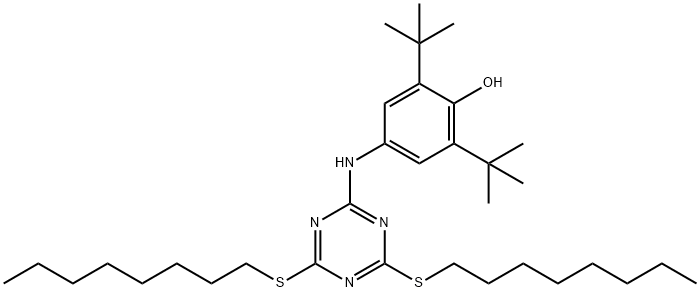
- 991-84-4
- C33H56N4OS2
- 588.95
- All (2)
- China (0)
- (2)
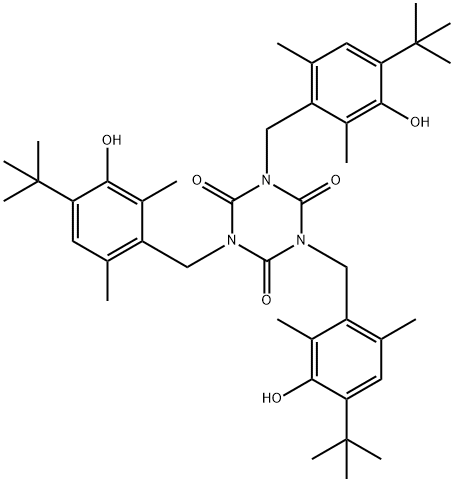
- 40601-76-1
- C42H57N3O6
- 699.92
- All (1)
- China (0)
- (1)
Related Products More >

- CNY Request For Quotation
- CNY Request For Quotation
- CNY Request For Quotation
- CNY Request For Quotation
- CNY Request For Quotation
- CNY Request For Quotation
- CNY Request For Quotation
- CNY Request For Quotation


Shea butter is extracted from the nuts of the shea tree (Vitellaria paradoxa) and is rich in unsaturated fatty acids such as oleic and linoleic acid, along with vitamins A and E, which provide antioxidant and anti-inflammatory properties. Cocoa butter, derived from cocoa beans (Theobroma cacao), contains higher amounts of saturated fatty acids like stearic and palmitic acids, giving it a firmer texture and excellent moisturizing and barrier-forming capabilities.
From a pharmacological standpoint, shea butter’s unsaturated fats help improve skin elasticity and reduce inflammation, making it beneficial for sensitive or irritated skin. Cocoa butter’s saturated fats excel at creating a protective occlusive layer that retains moisture, which is particularly useful for dry or cracked skin. However, both butters are generally well tolerated, though some individuals may experience allergic reactions or pore clogging depending on skin type and product formulation.
Clinically, choosing between shea butter and cocoa butter depends on skin needs: shea butter may be preferred for soothing and repairing, while cocoa butter is favored for intense hydration and protection. For patients with sensitive or acne-prone skin, non-comedogenic alternatives or patch testing is advised. Incorporating both butters in a skincare routine can also be beneficial, leveraging their complementary properties.
First, their sources set them apart. Shea butter comes from the nuts of the African shea tree, with a mild, nutty scent. Cocoa butter is extracted from cocoa beans (used in chocolate), boasting a rich, chocolatey aroma. Texture matters too: Shea butter is softer, melting quickly on skin, while cocoa butter is firmer and thicker, taking longer to absorb.
How you use them varies. Shea butter works well for daily moisturizing—its lightness suits all skin types, even sensitive or acne-prone areas. Cocoa butter’s thickness makes it ideal for very dry spots (like elbows or heels) or as a protective barrier in cold weather. People with oily skin might find cocoa butter too heavy, while those with dry skin may love its deep hydration.
Common myths? Myth 1: “They’re interchangeable.” Shea butter’s lighter feel is better for faces, while cocoa butter’s richness can clog facial pores. Myth 2: “All versions are the same.” Refined shea butter is milder (great for sensitive skin), while unrefined has more nutrients but a stronger scent. Cocoa butter’s refinement affects its firmness—unrefined is softer than highly processed kinds.
Family-friendly tips:
For daily use: Keep a jar of shea butter by the sink to moisturize hands after washing—its quick absorption won’t leave a greasy mess.
For rough spots: Rub a small chunk of cocoa butter between palms (it melts fast!) and massage into heels or knees before bed.
For kids: Opt for unscented, refined versions—they’re less likely to irritate sensitive skin or clash with their favorite fruity lotions.
Think of them as two types of nut butters, but from different plants: Shea comes from shea nuts (a tree in Africa), cocoa from cocoa beans (yes, the same as chocolate). Shea’s softer, melts easily on skin, and is great for deep hydration. Cocoa’s firmer, has a rich chocolatey scent, and is thicker—more like a solid balm.
Pro tip: Use shea butter for dry, sensitive areas (like elbows) since it’s lighter. Save cocoa butter for extra rough spots (like heels) where that thick texture works better. Both are good, but knowing which to grab makes a difference!
1. Chemical Structure & Fatty Acid Composition
Both are triglycerides (three fatty acids + glycerol), but their "building blocks" vary:
Cocoa butter: Dominated by saturated fats (65%):
Stearic acid (C18:0, ~35%): Long, straight hydrocarbon chain (nonpolar, hydrophobic).
Palmitic acid (C16:0, ~25%): Shorter saturated chain.
Oleic acid (C18:1, ~35%): Monounsaturated (one double bond, kinked chain).
This mix creates a symmetric 1,3-distearoyl-2-oleoyl triglyceride, which gives cocoa butter its sharp melting point (~34–38°C).
Shea butter: Contains unsaturated fats (~50%):
Oleic acid (C18:1, ~40–60%): Dominant, making it softer.
Linoleic acid (C18:2, ~3–11%): Polyunsaturated (two double bonds, more reactive).
Stearic acid (C18:0, ~30–50%): Balances hardness.
Its asymmetric triglycerides lead to a broader melting range (~32–45°C), ideal for creams.
2. Bond Types & Reactivity
Saturated fats (cocoa butter): Only C-C single bonds and C-H bonds. Stable, resistant to oxidation (long shelf life).
Unsaturated fats (shea butter): C=C double bonds in oleic/linoleic acids. More reactive—can undergo hydrogenation (to make margarine) or autooxidation (rancidity if stored poorly).
3. Polarity & Solubility
Both are nonpolar (hydrophobic) due to long hydrocarbon chains, but shea butter’s unsaturated bonds create slight polar regions near double bonds. This explains why shea butter:
Absorbs into skin slightly faster (mixes with sebum).
Emulsifies better in water-based formulas (e.g., lotions).
4. Stability & Industrial Applications
Cocoa butter: High thermal stability (melts cleanly at body temp). Used in:
Chocolate: Symmetric structure prevents bloom (fat crystallization).
Suppositories: Melts at 37°C for drug delivery.
Shea butter: More prone to oxidation (store in cool, dark places!). Used in:
Cosmetics: Unsaturated fats mimic skin lipids, boosting hydration.
Biofuel: Can be transesterified (like in the 2025 study on clay-doped catalysts!) to make biodiesel.