


 Home
Home
Hello, I’d like to ask: Can I use veg oil instead of olive oil when cooking? Does it affect the taste? Are there any differences in how they work for frying versus salad dressing? Is one better than the other in terms of health?
an I use veg oil instead of olive oil in cooking and other daily uses?
Related Encyclopedia

- 61788-66-7
- 0.00000
- All (0)
- China (0)
- (0)
- 8001-25-0
- N/A
- 0
- All (19)
- China (6)
- (19)

- 67701-08-0
- C18H34O2
- 282.46100
- All (0)
- China (0)
- (0)

- 67701-03-5
- C34H68O4
- 540.90132
- All (0)
- China (0)
- (0)
- 67784-82-1
- (C3H8O3
- 0
- All (2)
- China (2)
- (2)
- 61789-31-9
- 0
- All (6)
- China (6)
- (6)
- 86403-32-9
- 0
- All (1)
- China (1)
- (1)
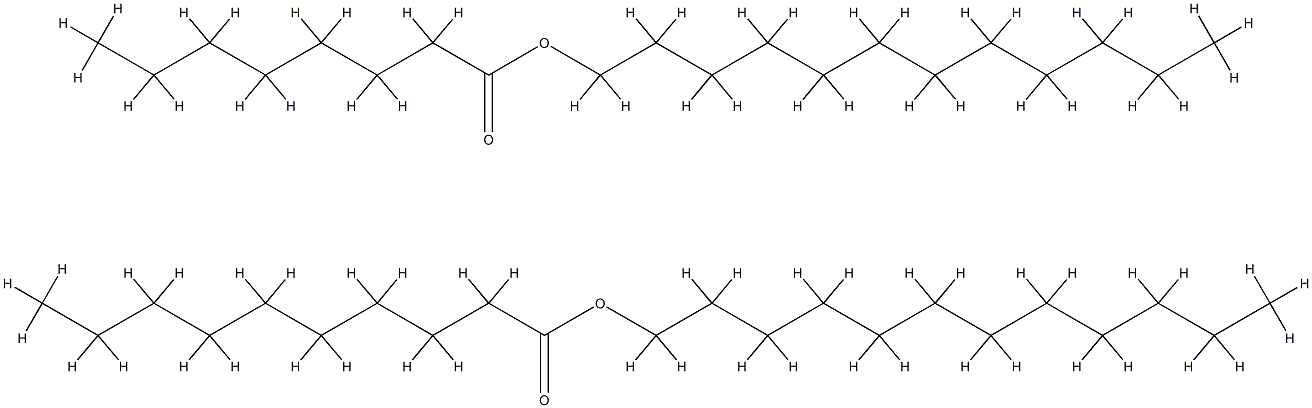
- 95912-86-0
- C42H84O4
- 653.11396
- All (1)
- China (1)
- (1)
- 68410-23-1
- 0
- All (2)
- China (0)
- (2)
- 91995-81-2
- 0
- All (8)
- China (7)
- (8)
Related Products More >

- 95912-86-0
- Request For Quotation
- 220L/drum
- 93348-22-2
- Request For Quotation
- 25KG/50KG/1000KG
- 93348-22-2
- Request For Quotation
- 25kg/Cardboard Drum
- 92044-87-6
- Request For Quotation
- 91995-81-2
- Request For Quotation
- 25
- 91995-81-2
- Request For Quotation
- 190kg/drum
- 91995-81-2
- Request For Quotation
- Bottle,barrel,cargo,container,etc.
- 91995-81-2
- Request For Quotation
- 200kgs net plastic drum.


If you’re making a salad dressing and want that olive oil taste, veg oil might change things a bit. But for frying, veg oil can be better because it usually has a higher smoke point, meaning it can get hotter without burning. Health-wise, both are fine in moderation—just pick what fits the flavor you want. It’s not a strict rule; just go with what you have on hand.
Physicochemically, the substitutability hinges on key properties: fatty acid composition, smoke point, and oxidative stability. The smoke point—temperature at which a lipid undergoes thermal degradation—varies: olive oil (especially extra virgin) typically has a smoke point of 190–210°C, while many vegetable oils (e.g., refined sunflower oil) reach 220–230°C. This makes vegetable oils more suitable for high-heat applications like deep-frying, where olive oil may degrade prematurely, releasing harmful aldehydes and losing nutritional value.
Chemically, the fatty acid profile drives functional differences. Olive oil’s high oleic acid (a MUFA) confers greater oxidative stability than vegetable oils rich in PUFAs (e.g., linoleic acid in corn oil), which are more prone to lipid peroxidation during storage or heating. This peroxidation generates reactive oxygen species (ROS), linked to cellular damage in vivo—a critical consideration for nutritional physiology. Conversely, vegetable oils with balanced PUFA/MUFA ratios (e.g., canola oil) offer comparable stability in moderate-heat cooking.
Physiologically, both oils contribute to dietary fat intake, but their bioactive components diverge. Olive oil’s phenolics (e.g., hydroxytyrosol) exhibit anti-inflammatory and antioxidant effects, studied in cardiovascular medicine for potential roles in reducing LDL oxidation. Vegetable oils, particularly those fortified with α-linolenic acid (an omega-3 PUFA, e.g., flaxseed oil), support omega-3/omega-6 balance, relevant to neurodevelopment and immune function.
One key difference lies in their fatty acid composition. Olive oil is rich in monounsaturated fats (like oleic acid), which are linked to heart health, while many vegetable oils contain higher levels of polyunsaturated fats (like omega-6), which can be less stable at high heat. For frying or high-heat cooking, vegetable oil’s higher smoke point makes it a safer choice to avoid burning and off-flavors. However, for dressings, dips, or sautéing, olive oil’s flavor and health benefits often make it the superior option.
In practical terms, you can substitute vegetable oil for olive oil in recipes where the oil’s flavor isn’t central—such as in baked goods or stir-fries. For example, muffins made with vegetable oil will taste neutral, while using olive oil might add a subtle fruitiness. Conversely, in dishes like a Mediterranean salad, swapping olive oil for vegetable oil would result in a noticeable loss of depth. Cost and availability also play a role; vegetable oil is generally cheaper, making it a practical choice for bulk cooking.
At the molecular level, the key distinction between vegetable oil (typically soybean, canola, sunflower, or corn oil) and olive oil lies in their fatty acid profiles and degree of refinement. Olive oil—especially extra virgin—is predominantly composed of monounsaturated fats (about 70–75% oleic acid), whereas most vegetable oils have a higher proportion of polyunsaturated fats, such as linoleic acid. This chemical difference affects both the oxidative stability and health impacts of the oils. Olive oil’s high monounsaturated content makes it more resistant to oxidation and rancidity, particularly under moderate heat conditions, whereas polyunsaturated-rich vegetable oils degrade more rapidly when exposed to high temperatures and oxygen, forming potentially harmful oxidation products like aldehydes.
The refining process also plays a critical role. Most vegetable oils are highly refined through chemical and physical means, stripping away flavor compounds and antioxidants to yield a neutral product with a high smoke point. Olive oil, in contrast, especially in its virgin or extra virgin forms, is minimally processed and retains a wide range of phenolic compounds, tocopherols (Vitamin E), and phytosterols. These bioactive compounds not only contribute to the oil’s distinctive flavor but also offer anti-inflammatory and antioxidant benefits, making olive oil more valuable from a nutritional and medicinal perspective, particularly in cardioprotective dietary patterns like the Mediterranean diet.
In professional culinary arts and food engineering, the decision to substitute olive oil with vegetable oil is context-dependent. For example, in baking, where a neutral flavor is desired, vegetable oil may be a suitable alternative, although the lack of antioxidants means shorter shelf life for products. In contrast, in cold applications like dressings or finishing dishes, substituting olive oil with vegetable oil compromises not only the taste profile but also the nutritional value. In high-heat cooking, refined olive oil or high-oleic vegetable oils (engineered to mimic olive oil's fatty acid structure) may offer more stability and a similar mouthfeel, but again, without the same flavor complexity or health benefits.
A common misconception is that all cooking oils are functionally interchangeable as long as the smoke point is appropriate. While smoke point is relevant in terms of thermal degradation, it does not capture the entire oxidative stability or nutritional profile of the oil. For instance, extra virgin olive oil, despite a lower smoke point compared to refined oils, remains chemically more stable due to its antioxidant load, which delays the onset of harmful degradation products during cooking.