


 Home
Home
Hi, I’ve been thinking about getting solar panels, but I don’t fully understand how they actually produce electricity. I know sunlight is involved, but what happens first, and what steps does the energy go through before it powers my home? How does it get stored, and how do the panels work with batteries or the grid? Basically, I want to know: how does solar energy work step by step in a way that’s easy to understand?
How Does Solar Energy Work Step by Step: A Simple Guide for Everyone
Related Encyclopedia

- 68848-64-6
- H5LiSi
- 40.07
- All (0)
- China (0)
- (0)

- 15092-72-5
- H4Si
- 36.00590
- All (0)
- China (0)
- (0)
- 14885-65-5
- FLi
- 25.01350
- All (0)
- China (0)
- (0)
- 878045-87-5
- H6LiOSiSn
- 175.77500
- All (0)
- China (0)
- (0)
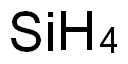
- 7440-21-3
- H4Si
- 32.12
- All (5)
- China (5)
- (5)

- 90337-93-2
- H4Si
- 32.11730
- All (5)
- China (5)
- (5)
- 12596-44-0
- Li2
- 13.03110
- All (2)
- China (2)
- (2)
- 12596-45-1
- Li2
- 14.03200
- All (2)
- China (2)
- (2)

- 17341-24-1
- Li+
- 6.94
- All (2)
- China (2)
- (2)
- 12596-43-9
- Li2
- 12.03020
- All (2)
- China (2)
- (2)
Related Products More >

- 9016-00-6
- CNY Request For Quotation
- 9016-00-6
- CNY Request For Quotation
- 112945-52-5
- Request For Quotation
- 112945-52-5
- Request For Quotation
- 112945-52-5
- Request For Quotation
- 112945-52-5
- Request For Quotation
- 112945-52-5
- Request For Quotation
- 112945-52-5
- Request For Quotation


Next, the electricity flows through a device called an inverter, which changes it from the type the panels make into the kind your home appliances can use. After that, the power goes to your home to run things like lights, computers, or the fridge. If you have batteries, extra electricity can be stored for later, like at night or on cloudy days.
Finally, any electricity you don’t use might go back to the grid if your system is connected. That way, nothing is wasted, and you get credit for the energy you produce. It’s like catching sunlight and turning it into electricity in a few easy steps.
When photons with sufficient energy hit the silicon, they transfer their energy to electrons, knocking them free from their atomic bonds. This creates electron-hole pairs: negatively charged electrons and positively charged “holes” left behind. The solar cell is engineered with a p-n junction, a boundary between two silicon layers—one doped with impurities to create excess holes (p-type) and the other with excess electrons (n-type). This junction generates an electric field that drives the free electrons toward the n-type layer and holes toward the p-type layer, preventing recombination.
The separated charges are collected by metal contacts on the cell’s surface, creating a flow of electrons through an external circuit—direct current (DC) electricity. An inverter then converts this DC power to alternating current (AC), which is compatible with most electrical grids and appliances.
This process differs from solar thermal systems, which absorb sunlight as heat to warm fluids, rather than directly generating electricity. A common misconception is that solar panels store energy; in reality, they produce it in real time, requiring batteries for storage.
Understanding these steps is critical in renewable energy engineering, as it highlights how material properties (semiconductor behavior) and design (p-n junctions) enable clean energy production. This direct conversion mechanism, with no moving parts, ensures reliability and scalability, making solar a cornerstone of sustainable energy transitions.
From a materials science perspective, the efficiency of this process depends on the semiconductor’s bandgap—the energy difference between valence and conduction bands. Silicon’s bandgap (1.1 eV) aligns well with the solar spectrum, enabling it to absorb visible and near-infrared light. Innovations like multi-junction cells stack layers of different semiconductors, each tuned to capture specific wavelengths, thereby boosting efficiency beyond silicon’s limits. Chemical engineering advancements have also reduced defects in silicon crystals, minimizing electron recombination and maximizing current output. These refinements reflect interdisciplinary collaboration, merging solid-state physics with industrial manufacturing to optimize performance.
In daily life, PV systems convert this direct current (DC) into alternating current (AC) via inverters, powering homes and appliances. Industrial applications include solar farms that feed electricity into grids, reducing reliance on fossil fuels. In medicine, solar-powered refrigerators maintain vaccine temperatures in off-grid clinics, leveraging the same principles to save lives. Beyond practical uses, solar energy’s broader significance lies in its scalability and sustainability. Unlike finite resources, sunlight is inexhaustible on human timescales, offering a decentralized energy solution that mitigates climate change and enhances energy security. This step-by-step transformation of photons into usable electricity exemplifies how fundamental scientific principles, when harnessed through engineering, can redefine humanity’s relationship with energy and the environment.
Once the DC electricity is produced, it typically flows into an inverter, which converts it into alternating current (AC), the standard form of electricity used in homes and businesses. This step ensures that the energy can power everyday appliances efficiently. Some systems also incorporate battery storage, often using lithium-ion technology, to store excess electricity for use when sunlight is not available. This allows for continuous power supply even at night or during cloudy weather.
Practical applications illustrate these steps clearly. A residential rooftop system captures sunlight during the day, converts it through the inverter, and supplies electricity to household devices. Any surplus energy can be stored in batteries or fed back to the grid for credit. Large-scale solar farms operate on the same principles, supplying power to thousands of homes while maintaining reliability and efficiency. This stepwise process shows how the principles first observed in early photovoltaic experiments directly translate into modern, everyday solar energy use.