


 Home
Home
Hi, I’m curious about solar energy and want to understand more. I keep hearing that there are different types, but I’m not sure what the differences are or how each one works. Can they both be used at home, or are some meant only for big projects? How do they capture sunlight, and what kind of energy do they provide? Basically, I want to know: are there different types of solar energy and what makes each type unique?
Are There Different Types of Solar Energy and How Do They Work?
Related Encyclopedia

- 68848-64-6
- H5LiSi
- 40.07
- All (0)
- China (0)
- (0)

- 15092-72-5
- H4Si
- 36.00590
- All (0)
- China (0)
- (0)
- 14885-65-5
- FLi
- 25.01350
- All (0)
- China (0)
- (0)
- 878045-87-5
- H6LiOSiSn
- 175.77500
- All (0)
- China (0)
- (0)
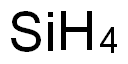
- 7440-21-3
- H4Si
- 32.12
- All (5)
- China (5)
- (5)

- 90337-93-2
- H4Si
- 32.11730
- All (5)
- China (5)
- (5)
- 12596-44-0
- Li2
- 13.03110
- All (2)
- China (2)
- (2)
- 12596-45-1
- Li2
- 14.03200
- All (2)
- China (2)
- (2)
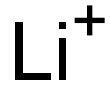
- 17341-24-1
- Li+
- 6.94
- All (2)
- China (2)
- (2)
- 12596-43-9
- Li2
- 12.03020
- All (2)
- China (2)
- (2)
Related Products More >

- 9016-00-6
- CNY Request For Quotation
- 9016-00-6
- CNY Request For Quotation
- 112945-52-5
- Request For Quotation
- 112945-52-5
- Request For Quotation
- 112945-52-5
- Request For Quotation
- 112945-52-5
- Request For Quotation
- 112945-52-5
- Request For Quotation
- 112945-52-5
- Request For Quotation


Solar thermal energy, on the other hand, captures sunlight to produce heat instead of electricity. This heat can warm water, heat buildings, or even generate electricity indirectly in larger systems. Solar thermal panels or collectors are used for this purpose. Many homes use PV panels for electricity while also using solar thermal systems for hot water, making both types useful depending on your energy needs.
Solar thermal energy, in contrast, captures sunlight as heat rather than electricity. This is achieved through solar collectors or concentrators, which absorb and transfer heat to a fluid, such as water or oil. The heated fluid can then be used for domestic hot water, space heating, or in concentrated solar power plants, to generate steam that drives turbines and produces electricity. The efficiency of solar thermal systems depends on the collector design, the properties of the working fluid, and environmental factors like sunlight intensity and ambient temperature.
Practical applications illustrate these differences clearly. A household may use PV panels to power lights, appliances, and small electronics, while employing a solar thermal system to heat water for showers or underfloor heating. Large-scale solar farms may integrate concentrated solar thermal technology to generate electricity on a commercial scale. By understanding the mechanisms and applications of both types, it becomes clear how the principles of converting sunlight into electricity or heat are applied in real-world energy solutions that meet diverse needs.
Photovoltaic systems directly convert sunlight into electricity through the photovoltaic effect. This process relies on semiconductor materials—most commonly silicon—where photons from sunlight excite electrons, creating an electric current. Within PV, there are variations based on material and design: monocrystalline silicon cells, with a uniform crystal structure for higher efficiency; polycrystalline cells, made from multiple silicon fragments, balancing cost and performance; and thin-film cells, using lightweight materials like cadmium telluride, suitable for flexible or low-weight applications. These differ in efficiency, durability, and cost, but all share the core principle of electron excitation to generate electricity.
Solar thermal systems, by contrast, capture sunlight as heat. Passive solar thermal design uses building materials and orientation to trap heat, such as south-facing windows and thermal mass (concrete, stone) that stores warmth. Active solar thermal systems use pumps or fans to circulate heat-absorbing fluids (water or antifreeze) through collectors, heating water for homes or industrial processes. Concentrated solar power (CSP) is a subset that uses mirrors to focus sunlight onto a receiver, generating high temperatures to produce steam and drive turbines for electricity—distinct from PV as it converts light to heat first, then to power.
A common misconception is treating all solar technologies as interchangeable. In reality, PV is optimized for electricity production, while solar thermal excels at heating tasks. For example, a rooftop PV panel powers a home’s lights and appliances, while a solar thermal collector heats the shower water.
Understanding these types is critical in renewable energy planning, as it allows tailored solutions: PV for grid integration, passive thermal for building efficiency, and CSP for utility-scale power. This diversity ensures solar energy can address varied energy needs, from residential use to industrial-scale electricity generation, enhancing its role in global decarbonization.
Solar thermal energy, by contrast, converts sunlight into heat, which can be used directly or converted to electricity. Low-temperature systems, like solar water heaters, employ collectors to absorb sunlight and transfer heat to fluids, providing domestic hot water or space heating. High-temperature concentrating solar power (CSP) plants use mirrors or lenses to focus sunlight onto receivers, heating fluids to temperatures exceeding 500°C. This thermal energy drives turbines, producing electricity akin to conventional power plants. The physics here involves thermodynamics and optics: maximizing light concentration while minimizing heat loss through advanced insulation and heat-transfer fluids. CSP’s ability to store thermal energy in molten salts enables electricity generation after sunset, addressing solar intermittency—a challenge PV systems face without battery storage.
In daily life, PV panels power homes and portable devices, while solar thermal systems heat water for bathing or cooking, reducing reliance on fossil fuels. Industrial applications include PV farms supplying grid electricity and CSP plants providing baseload power in sunny regions. In medicine, solar-powered refrigerators maintain vaccine temperatures in remote clinics, leveraging both PV and thermal principles. Beyond practicality, these technologies symbolize humanity’s shift toward sustainable energy. PV’s scalability suits decentralized urban and rural electrification, whereas CSP’s storage capability complements grid stability. Together, they illustrate how harnessing solar energy through diverse mechanisms can mitigate climate change, enhance energy security, and foster equitable access to clean power across global contexts.