


 Home
Home
Hi, I’m curious about Advil and its uses. I’ve seen people take it for headaches, muscle pain, and sometimes swelling. I want to understand whether Advil actually reduces inflammation or if it mainly helps with pain relief. How does it interact with the body to produce its effects, and is it considered an anti inflammatory drug like other medications in that category? Could it be effective for everyday aches or more serious inflammation issues?
Is Advil an Anti Inflammatory Drug and How Does It Work?
Related Encyclopedia
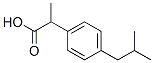
- 58560-75-1
- C13H18O2
- 206.28
- All (102)
- China (12)
- (102)
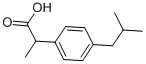
- 15687-27-1
- C13H18O2
- 206.28
- All (102)
- China (12)
- (102)
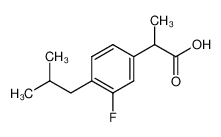
- 62741-78-0
- C13H17FO2
- 224.27100
- All (102)
- China (12)
- (102)
- 1289675-16-6
- C21H32N2O2
- 344.49100
- All (0)
- China (0)
- (0)
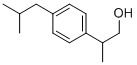
- 36039-36-8
- C13H20O
- 192.3
- All (0)
- China (0)
- (0)
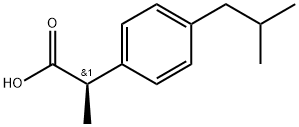
- 51146-57-7
- C13H18O2
- 206.29
- All (0)
- China (0)
- (0)
- 951381-63-8
- C19H24N2O3
- 328.40500
- All (0)
- China (0)
- (0)
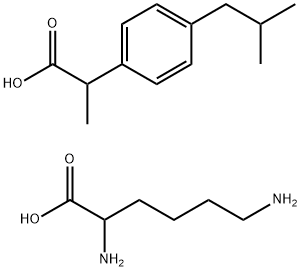
- 57469-76-8
- C19H32N2O4
- 352.48
- All (1)
- China (0)
- (1)
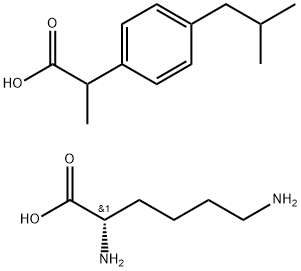
- 57469-77-9
- C19H32N2O4
- 352.48
- All (3)
- China (0)
- (3)
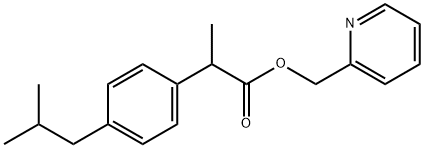
- 64622-45-3
- C19H23NO2
- 297.4
- All (3)
- China (3)
- (3)
Related Products More >

- 69-72-7
- Request For Quotation
- 64622-45-3
- Request For Quotation
- 25kg Drum
- 64622-45-3
- Request For Quotation
- 1kg/bottle
- 64622-45-3
- Request For Quotation
- 25kg drum
- 58560-75-1
- Request For Quotation
- 58560-75-1
- Request For Quotation
- 58560-75-1
- Request For Quotation
- 57469-77-9
- Request For Quotation


From a pharmacological standpoint, the key attributes of Advil include its rapid absorption, moderate half life, and dose dependent effects. In practical terms, this means that after oral administration, patients typically experience symptom relief within 30 to 60 minutes, and the anti inflammatory effect persists for several hours. Its versatility in addressing pain and inflammation simultaneously makes it a staple in both over the counter and professional healthcare use.
In real world applications, Advil is commonly recommended for short term management of conditions like sprains, strains, post dental procedures, or general musculoskeletal pain. For instance, someone with a swollen ankle after a sports activity can use Advil to decrease both swelling and tenderness. Clinicians also consider its safety profile, balancing effective anti inflammatory action with potential gastrointestinal or cardiovascular risks in long term use. Understanding these mechanisms allows healthcare providers to advise patients on appropriate dosing and situational use.
In daily life, Advil’s versatility is evident in its use for managing acute injuries or chronic inflammatory conditions. For instance, a person with a sports injury might take Advil to reduce joint swelling and ease movement, while someone with a tension headache may use it to alleviate pain without addressing underlying inflammation. Its over-the-counter availability empowers individuals to address mild to moderate symptoms promptly, though caution is advised regarding dosing frequency to avoid gastrointestinal side effects linked to COX-1 inhibition, such as ulcers or bleeding. In industrial settings, workers exposed to repetitive strain injuries often rely on Advil for short-term relief, enabling them to continue tasks without prolonged downtime, though long-term use without medical supervision risks kidney damage or hypertension.
The broader implications of Advil’s mechanism extend to pharmacology and public health. Its rapid onset of action—typically within 30 minutes—makes it valuable for acute pain management, while its relatively short half-life necessitates repeated dosing for sustained relief. From a biochemical perspective, Advil’s non-selective COX inhibition contrasts with newer NSAIDs that target COX-2 specifically, aiming to reduce gastrointestinal risks but often at higher costs. By understanding these trade-offs, patients and providers can tailor therapies to balance efficacy, safety, and accessibility, ensuring Advil remains a cornerstone of self-care and clinical practice across medical, occupational, and everyday contexts.
The chemical structure of ibuprofen—a propionic acid derivative with a chiral center—enables it to bind to the active site of COX enzymes, preventing substrate access. This structural specificity ensures it selectively targets the inflammatory cascade rather than broader cellular functions, distinguishing it from corticosteroids, which act on gene expression to suppress immune responses more broadly. Unlike acetaminophen, which relieves pain and fever but does not inhibit COX in peripheral tissues, ibuprofen directly reduces inflammation, making it effective for conditions like sprains, where swelling is a primary concern.
Advil’s anti-inflammatory properties are distinct from its pain-relieving effects. While it eases pain by reducing prostaglandin-mediated sensitization of nerve endings, its ability to reduce swelling stems from inhibiting prostaglandin-induced vasodilation and fluid leakage into tissues. This dual action makes it valuable for both acute injuries (e.g., muscle strains) and chronic inflammatory conditions (e.g., mild osteoarthritis), where reducing inflammation prevents further tissue damage.
A common misconception is that all pain relievers are anti-inflammatory, but this is not true of drugs like acetaminophen. Another misunderstanding is that higher doses of Advil enhance anti-inflammatory effects; in reality, exceeding recommended doses increases risks (e.g., gastrointestinal irritation, kidney strain) without improving efficacy. It is also important to note that while effective for mild to moderate inflammation, Advil is less potent than prescription NSAIDs or biologics, which target specific cytokines in severe conditions like rheumatoid arthritis.
In summary, Advil qualifies as an anti-inflammatory drug due to its COX-inhibiting mechanism, directly reducing the molecular drivers of inflammation. Its effectiveness lies in balancing potency with accessibility, making it a reliable choice for managing inflammatory symptoms when used as directed.