


 Home
Home
Have you ever come across the term rubber cement and wondered what exactly it is? Is it like regular glue, or does it work differently? Why is it called "rubber" cement—does it actually contain rubber? And what makes it useful for certain tasks, like art projects or fixing paper? If you're curious about how it's made, what's inside it, and when you should (or shouldn't) use it, you're not alone. So, what is rubber cement and what makes it different from other types of adhesives?
What Is Rubber Cement and How Is It Used?
Related Encyclopedia
![7-thiabicyclo[2.2.1]heptane](https://chemcloud-1304660855.cos.ap-shanghai.myqcloud.com/compound/54266140d5654419a0e04165753dc9b5.png?imageMogr2/format/webp)
- 279-59-4
- C6H10S
- 114.20900
- All (0)
- China (0)
- (0)
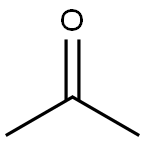
- 67-64-1
- C3H6O
- 58.08
- All (22)
- China (16)
- (22)
- 32449-00-6
- C3H5NaO
- 80.06100
- All (0)
- China (0)
- (0)
- 75560-45-1
- C7H16
- 101.21000
- All (17)
- China (13)
- (17)
- 3474-30-4
- C7H15
- 99.19400
- All (17)
- China (13)
- (17)

- 142-82-5
- C7H16
- 100.2
- All (17)
- China (13)
- (17)
- 126331-83-7
- C4H9DO2
- 91.12720
- All (17)
- China (13)
- (17)
- 3356-67-0
- C7H15
- 99.19400
- All (17)
- China (13)
- (17)

- 17104-38-0
- C3H7O+
- 59.08710
- All (0)
- China (0)
- (0)
- 84219-67-0
- C18H18N2O2
- 294.34800
- All (0)
- China (0)
- (0)
Related Products More >

- 96-26-4
- CNY Request For Quotation
- 96-26-4
- CNY Request For Quotation
- CNY Request For Quotation
- CNY Request For Quotation
- 112945-52-5
- Request For Quotation
- 4549-31-9
- Request For Quotation
- 111-16-0
- Request For Quotation
- 629-30-1
- Request For Quotation


One cool thing is that you can often peel it off cleanly if you make a mistake—so people use it for things like scrapbooking, art, or temporary sticking jobs. It’s not super strong like construction glue, but that’s kind of the point. It holds things in place without being permanent.
Just keep in mind, it has a strong smell because of the chemicals in it, so it’s best to use it in a well-ventilated space. For quick fixes or creative projects, rubber cement is a simple and useful tool to have around.
A key attribute of rubber cement is its temporary bonding capability. For instance, in graphic design or scrapbooking, artists apply it to attach photos or cutouts, knowing excess adhesive can be rubbed off once dry without damaging the substrate. The solvent-based formulation also enables easy cleanup, as fresh spills can be wiped away before evaporation. However, its volatility requires careful handling in well-ventilated spaces to avoid inhalation risks.
In practical use, rubber cement bridges hobbyist and industrial applications. Bookbinders rely on its flexibility to prevent spine cracking, while shoemakers use it to temporarily hold soles before permanent stitching. Its reversible nature contrasts with permanent adhesives, offering a balance between durability and adjustability. This duality underscores its niche as a tool for precision work where trial-and-error is inevitable, exemplifying how material properties align with real-world needs.
At the chemical level, rubber cement's effectiveness arises from the interaction between the rubber molecules and the solvent medium. The solvent acts as a carrier, dispersing the rubber into a liquid state for easy application. Once exposed to air, the solvent rapidly evaporates due to its high volatility, triggering a phase change in the rubber as it solidifies into a cohesive and elastic adhesive film. The rubber component imparts elasticity, resistance to cracking, and moderate tensile strength. Physically, the adhesive bond formed is non-crystalline and amorphous, allowing for flexibility and stress dispersion across the bonded surface.
Its uses are broad and extend far beyond arts and crafts. In industrial settings, rubber cement has been employed in the assembly of delicate components that require temporary fixation, such as during manufacturing, prototyping, or model assembly. In the medical field, while not directly applied to tissue due to the toxicity of solvents, the underlying principles of solvent-based adhesives have informed the development of biomedical adhesives with adjustable bonding times and reversible adhesion. Additionally, its role in education and creative fields supports cognitive and motor skill development in students through hands-on activities.
From an interdisciplinary perspective, rubber cement illustrates the convergence of materials science, chemistry, and design. Its formulation must consider polymer-solvent compatibility, volatility, and environmental safety. While convenient, rubber cement’s reliance on volatile organic compounds raises environmental and health concerns, prompting efforts to create low-VOC or solvent-free alternatives that retain the original adhesive properties.
Understanding rubber cement not only sheds light on the chemistry of adhesives but also reflects broader themes of material adaptability, sustainability, and design thinking. It’s a deceptively simple product with layers of complexity that bridge theoretical science and everyday utility.
A key attribute is its reversibility. Unlike permanent adhesives, rubber cement can be softened or removed by reapplying the solvent, making it ideal for temporary bonds. For instance, in art and craft projects, it is often used to attach paper cutouts to a surface because if adjustments are needed, a small amount of solvent on a cloth can lift the paper without damaging it. In office settings, it serves similarly for mounting photos or documents in scrapbooks, where repositioning is common.
Its mechanism relies on solvent evaporation: when applied, the solvent carries rubber particles, which coalesce into a continuous film as the solvent escapes, creating adhesion. This process makes it suitable for porous materials like paper, where the solvent can penetrate, though it is less effective on non-porous surfaces like metal. Musicians also use it to repair instrument pads, as its flexibility accommodates the movement of parts without failing, highlighting its practical value across diverse applications.