


 Home
Home
When people talk about connecting to the internet with an Ethernet cable, does that mean they’re using fiber optics? Or are Ethernet and fiber optic two different things? What kind of material is actually inside an Ethernet cable, and does it really affect how fast or stable your connection is? Can both types be used at home or are they only for businesses and big networks? What’s the real difference between them, and how do you know which one you’re using?
Is Ethernet Fiber Optic or Something Else?
Related Encyclopedia

- 7631-86-9
- O2Si
- 60.08
- All (126)
- China (40)
- (126)
- 83957-02-2
- O2Si
- 64.08380
- All (126)
- China (40)
- (126)
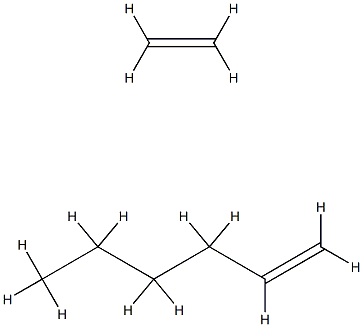
- 25213-02-9
- C8H16
- 112.21264
- All (24)
- China (2)
- (24)
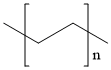
- 9002-88-4
- (C2H4)n
- 28.05316
- All (24)
- China (2)
- (24)
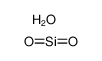
- 23382-09-4
- H2O3Si
- 78.09960
- All (1)
- China (0)
- (1)
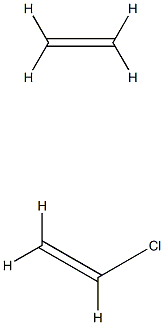
- 63231-66-3
- C4H7Cl
- 90.55138
- All (3)
- China (3)
- (3)
- 68131-73-7
- C12H5N7O12
- 0
- All (2)
- China (0)
- (2)
- 68441-17-8
- C51H102O21Si2
- 0
- All (29)
- China (28)
- (29)
- 64754-90-1
- 0
- All (3)
- China (3)
- (3)
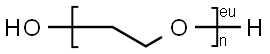
- 25322-68-3
- (C2H4O)nH2O
- 0
- All (65)
- China (33)
- (65)
Related Products More >

- 63231-66-3
- CNY Request For Quotation
- 13927-71-4
- CNY Request For Quotation
- CNY Request For Quotation
- CNY Request For Quotation
- CNY Request For Quotation
- 10402-15-2
- CNY Request For Quotation
- 10402-15-1
- CNY Request For Quotation
- 10402-15-0
- CNY Request For Quotation


Fiber optic cables are different—they use tiny glass or plastic strands to send data using light. Sounds fancy, right? And it is! These are super fast and great for long distances, like between cities or inside big office buildings. They’re also a lot thinner and often more expensive to install.
So, Ethernet is the name of the connection type, not the material. You can have fiber optic Ethernet, but most people at home are still using regular copper Ethernet cables. If your internet provider says you have “fiber internet,” the line coming into your house might be fiber, but the cable connecting your router to your devices is probably still the regular kind.
In fiber optic Ethernet, data is transmitted using pulses of light that travel through strands of glass or plastic, typically made from silica (silicon dioxide). This differs significantly from traditional copper Ethernet cables, where data is transmitted as electrical signals through metal conductors. The core physical mechanism at play in fiber optics is total internal reflection. Light beams bounce within the thin fiber core, guided with minimal loss, allowing signals to travel much farther and faster than electrical ones.
The distinction becomes more relevant when considering application demands. In medical imaging systems, for instance, fiber optic Ethernet offers the high bandwidth and low latency necessary for real-time transmission of large imaging data. In industrial automation, it enables communication over long distances in electrically noisy environments without signal degradation. Fiber is also immune to electromagnetic interference and does not conduct electricity, making it ideal in sensitive or hazardous areas such as chemical plants or power substations.
From a materials science and chemistry perspective, fiber cables incorporate polymer coatings and buffer layers to protect the fragile glass core, while advanced fabrication techniques ensure the precision needed to maintain optical integrity. The physical robustness and data integrity of fiber optics have also led to their increasing integration into consumer infrastructure—backbone networks for 5G, smart city grids, and cloud data centers rely heavily on this technology.
In essence, asking whether Ethernet is fiber optic opens up a conversation about how communication systems adapt to different physical media. The shift toward fiber optics in Ethernet deployments reflects not just a technological preference but a broader transformation across disciplines—melding physics, materials engineering, and information theory to meet growing global data demands.
The mechanism behind it involves encoding Ethernet frames into light signals via a transceiver, which converts electrical data from network devices into optical pulses. These pulses travel through the fiber, maintaining signal integrity over kilometers—far beyond the 100-meter limit of copper Ethernet—before being converted back to electrical signals at the receiving end. This efficiency supports gigabit and even terabit data rates, critical for applications like high-definition video streaming across campus networks or real-time data transfer between cloud data centers.
In practice, fiber optic Ethernet is widely used in backbone networks connecting cities, where its high capacity and low signal loss are essential. It also serves enterprise networks, linking multiple office buildings with reliable, high-speed connections. For example, a large hospital might use it to transmit medical imaging data between departments without degradation, ensuring quick access to critical information for patient care.
Fiber-optic Ethernet, such as 10G or 100G Ethernet, leverages the properties of light to achieve speeds unattainable with traditional copper. For instance, data centers deploy fiber-optic Ethernet to handle massive data flows between servers with low latency. The light pulses travel through the fiber’s core, reflecting off the cladding due to total internal reflection, which prevents signal degradation over miles. This makes fiber ideal for undersea cables or connecting distant offices, where copper would suffer from attenuation or electromagnetic interference.
In practice, fiber-optic Ethernet underpins high-speed internet backbones and cloud services. A typical example is ISPs using fiber to deliver gigabit internet to homes, where the "last mile" might still involve copper for cost reasons. Another case is industrial automation, where factories use fiber Ethernet to connect machinery immune to electrical noise. While Ethernet defines the protocol, fiber optics provides the physical pathway, combining to meet modern demands for speed and reliability. The choice between fiber and copper Ethernet depends on factors like distance, budget, and performance needs.