


 Home
Home
Many people turn to collagen supplements hoping to maintain youthful skin, but does it really work? We see ads and influencers promoting powders, gummies, and drinks, all claiming to smooth out wrinkles and improve skin texture. But can taking collagen actually reduce fine lines, or is it just a trend with no real effect? Is it absorbed well by the body? And how long does it take to notice any difference?
Does Taking Collagen Help with Wrinkles?
Related Encyclopedia
- 9007-34-5
- 0
- All (14)
- China (1)
- (14)
- 9064-67-9
- C4H6N2O3R2.(C7H9N2O2R)n
- 0
- All (14)
- China (1)
- (14)
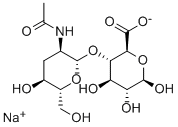
- 9004-61-9
- C14H22NNaO11
- 403.31
- All (106)
- China (43)
- (106)
- 92113-31-0
- CO(NH2)2,Fe+++
- 0
- All (3)
- China (0)
- (3)
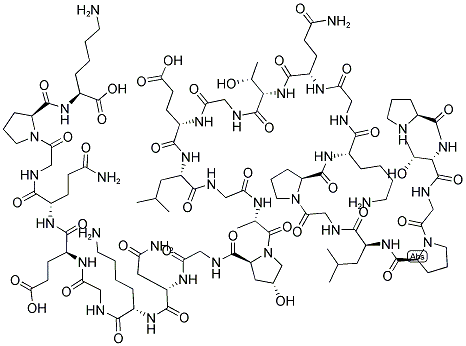
- 144703-90-2
- C106H174N32O37
- 2488.71
- All (0)
- China (0)
- (0)
Related Products More >
- CNY Request For Quotation
- CNY Request For Quotation
- 95507-66-7
- Request For Quotation
- 25kg/Drum
- 92113-31-0
- Request For Quotation
- 25kg/Cardboard Drum
- 92113-31-0
- Request For Quotation
- 1g,50g,100g,1000g
- 92113-31-0
- Request For Quotation
- 92113-31-0
- Request For Quotation
- 25kg/drum
- 92113-31-0
- Request For Quotation


The thing is, when you take collagen (as a pill or powder), your body breaks it down into smaller parts during digestion. These pieces can help your skin, but they don’t go straight to your wrinkles like some ads might make it sound. It’s more like giving your body the building blocks it needs to make more collagen on its own.
So, it’s not a quick fix, but it might give your skin a little boost—especially if you’re also taking care of it in other ways like eating well, sleeping enough, and using sunscreen.
When collagen is ingested through supplements, it is hydrolyzed into smaller peptides and amino acids in the digestive tract. These fragments can then be absorbed into the bloodstream and potentially stimulate fibroblast activity in the skin, encouraging the production of new collagen, elastin, and hyaluronic acid. From a biochemical standpoint, this process depends on several cofactors such as vitamin C, zinc, and copper, which act as enzymatic supports in collagen biosynthesis pathways. Collagen’s effectiveness is thus not just about intake but also about the metabolic environment in which it is processed.
From a physiological perspective, collagen supplementation has broader implications beyond cosmetic concerns. In orthopedics and sports medicine, it is used to support joint health and recovery, as it contributes to the integrity of cartilage and ligaments. In wound healing, collagen-based biomaterials are applied to promote tissue regeneration due to their biocompatibility and ability to modulate inflammatory responses. In the field of material science, collagen is engineered into scaffolds for regenerative medicine and drug delivery systems due to its structural properties and biodegradability.
What makes collagen especially relevant across disciplines is its dual role as both a structural and signaling molecule. It not only provides mechanical support but also influences cellular behavior, including migration, proliferation, and differentiation. This makes it a focal point in tissue engineering, aging research, and even oncology. Understanding collagen’s role in skin aging thus extends beyond aesthetics—it's a window into broader systemic processes like inflammation, cellular repair, and matrix remodeling.
For instance, a typical scenario involves someone in their 40s noticing fine lines around their eyes and mouth. After several months of consistent collagen supplementation, they might observe smoother skin texture and reduced wrinkle depth. This aligns with the idea that specific amino acids like glycine, proline, and hydroxyproline in collagen supplements act as building blocks for skin repair. Additionally, some formulations include vitamin C, which is crucial for collagen formation, further supporting the skin’s structural integrity.
However, results vary depending on factors like dosage, collagen source, and individual metabolism. Topical collagen, unlike oral supplements, often fails to penetrate deeply enough to be effective, highlighting the importance of delivery methods. While collagen isn’t a miracle cure, its potential to modestly improve skin appearance makes it a reasonable adjunct to other skincare practices like sun protection and retinoid use. The key is managing expectations—it’s more about gradual improvement than dramatic reversal.
The peptides from supplements may also stimulate fibroblasts, the cells responsible for producing collagen and elastin in the dermis. By enhancing fibroblast activity, they help maintain the skin’s structural integrity, reducing the depth and visibility of existing wrinkles over time. For instance, someone in their 40s who incorporates daily collagen intake might notice that fine lines around the eyes or mouth appear softer after several months, as the skin’s underlying support structure becomes more robust.
This connection between supplemental collagen and wrinkle reduction lies in its role as a nutrient source and stimulant for the skin’s repair and renewal systems. It works alongside other nutrients like vitamin C, which is essential for collagen formation, to enhance the skin’s ability to maintain elasticity and smoothness, making it a practical addition to routines aimed at addressing age-related changes.