


 Home
Home
Hello, I’d like to ask about CAO. What is it and what can it be used for?
What is CAO, also known as quicklime, and what are its properties and uses?
Related Encyclopedia
- 12323-41-0
- CaO
- 58.07720
- All (164)
- China (21)
- (164)
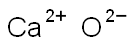
- 73018-51-6
- CaO
- 56.08
- All (164)
- China (21)
- (164)
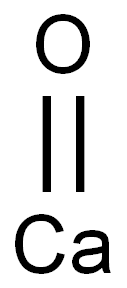
- 1305-78-8
- CaO
- 56.08
- All (164)
- China (21)
- (164)
- 188528-77-0
- Ca2O2
- 112.15500
- All (0)
- China (0)
- (0)
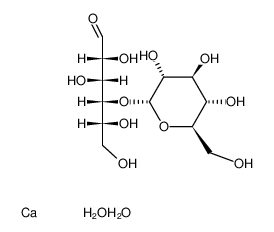
- 36570-80-6
- C12H26CaO13
- 422.43700
- All (0)
- China (0)
- (0)
Related Products More >
- 1305-78-8
- USD 135.0000
- 1ton
- 73018-51-6
- Request For Quotation
- 500g
- 73018-51-6
- Request For Quotation
- 100g
- 73018-51-6
- Request For Quotation
- 10g
- 73018-51-6
- Request For Quotation
- 10ton
- 73018-51-6
- Request For Quotation
- 495ton
- 73018-51-6
- Request For Quotation
- 1kg
- 73018-51-6
- Request For Quotation
- 25kg


This reaction, known as slaking, is reversible when calcium hydroxide is heated to high temperatures, releasing water and regenerating CaO .Production of Calcium OxideCalcium oxide is primarily produced by calcining limestone in a kiln at temperatures between 900–1200°C. The thermal decomposition reaction is:
The quality of the resulting quicklime depends on factors like the purity of the limestone, kiln design, and temperature control. Impurities in limestone, such as magnesium carbonate, can produce dolomitic lime , which has different properties and uses.Applications of Calcium OxideConstruction and Building Materials:Cement Production: CaO is a key component in Portland cement, a foundational material in concrete. It is combined with clay, silica, and other minerals, then heated to form clinker, which is ground into cement powder.Mortar and Plaster: When slaked with water, CaO forms calcium hydroxide, which is used in mortars to bind bricks and stones. Over time, calcium hydroxide reacts with carbon dioxide in the air to form calcium carbonate, hardening the mortar.Soil Stabilization: In civil engineering, quicklime is added to clay soils to improve their mechanical properties. The lime reacts with soil minerals and water, reducing plasticity and increasing strength, making it suitable for road bases and building foundations.Steel and Metal Production:
In the steel industry, CaO is used as a flux in blast furnaces and basic oxygen furnaces. It reacts with acidic impurities like silica and phosphorus oxides to form slag, which is separated from the molten metal. This process purifies the iron and improves the quality of the steel. Additionally, lime is used in non-ferrous metal refining, such as in the production of copper and aluminum, to remove impurities.Environmental and Waste Management:Water Treatment: CaO is used to adjust the pH of acidic wastewater, neutralizing contaminants like heavy metals. It precipitates metal ions as hydroxides, which can be filtered out. For example, in mining operations, lime is used to treat acidic mine drainage, reducing its environmental impact.Flue Gas Desulfurization: In power plants, CaO is injected into flue gases to remove sulfur dioxide , a major air pollutant. The reaction forms calcium sulfite and sulfate, which are captured as gypsum, a useful byproduct in construction.Waste Incineration: Lime is added to incinerators to neutralize acidic gases and trap heavy metals, preventing their release into the atmosphere.Agriculture and Food Industry:Soil Amendment: In agriculture, CaO is applied as lime to acidic soils to raise pH , improving nutrient availability for plants. It neutralizes soil acidity, enhances microbial activity, and promotes the growth of crops like cereals and vegetables.Animal Husbandry: Quicklime is used to disinfect livestock facilities and control pests. It is also added to animal feed as a source of calcium, essential for bone development in cattle, poultry, and fish.Food Processing: In the food industry, CaO is used as a drying agent in packaging to prevent moisture-related spoilage. It is also used in the production of certain foods, such as Chinese preserved eggs, where it helps create the characteristic ure and flavor.Other Industrial Uses:Glass Manufacturing: CaO is added to glass formulations to improve durability and reduce water solubility. It acts as a stabilizer in the molten glass, preventing the formation of cracks during cooling.Paper Industry: In pulp production, lime is used in the kraft process to recover cooking chemicals and regenerate sodium hydroxide, making the process more sustainable.Pharmaceuticals: Calcium oxide is used in the production of calcium supplements and antacids, though it is typically converted to calcium carbonate or hydroxide for safe consumption.Safety ConsiderationsCalcium oxide is highly caustic and reacts vigorously with water, generating heat and forming alkaline solutions. Direct contact with skin or eyes can cause severe burns, so proper personal protective equipment is essential when handling it. It should be stored in a dry environment to prevent spontaneous slaking, which can release significant heat and lead to fires in confined spaces.In summary, calcium oxide’s unique chemical properties and versatility make it a cornerstone of modern industry. From constructing skyscrapers to cleaning wastewater and sustaining agricultural systems, its applications are far-reaching and indispensable. As industries continue to prioritize sustainability, innovations in lime production—such as carbon capture during calcination—may further enhance its environmental profile, ensuring its relevance for years to come.
Calcium oxide is primarily produced by heating calcium carbonate , commonly found in limestone, in a process called calcination.
CAO stands for Calcium Oxide, a compound made up of calcium and oxygen.It's commonly known as quicklime.
The reason it's important is because it's a key ingredient in the production of cement.When you mix it with water, it forms calcium hydroxide, which then reacts with carbon dioxide to create cement.If you're working with CAO, it's crucial to handle it with care because it can be hazardous to inhale and can cause burns.
Calcium oxide, or CAO, is a chemical compound that's white or grayish in color and has a caustic nature.It's used in a variety of applications, including construction, where it's a primary component in making cement and mortar.
Another use is in the chemical industry for the production of calcium hydroxide.When dealing with CAO, it's important to store it properly and handle it with protective gear to prevent any accidents.
CAO, or calcium oxide, is an alkaline oxide that's formed when calcium carbonate is heated.It's used in the production of lime for agricultural purposes, as well as in the treatment of wastewater.
A case in point is its use in neutralizing acidic soil.The challenge with CAO is its reactivity with water, which can produce a lot of heat and cause the substance to splatter.The solution is to add water slowly and mix it in a controlled environment.
1. Calcium Oxide
Calcium oxide, often abbreviated as CAO, is also known as quicklime. It is a white, caustic, alkaline, crystalline solid at room temperature.
**Production**: It is typically produced by the thermal decomposition of materials such as limestone in a lime kiln at high temperatures (around 900