


 Home
Home
Picture this: The U.S. just jacked up tariffs on Canadian goods to 35%—but thanks to a loophole in the USMCA trade deal, most of Canada’s chemicals and plastics are slipping through tax-free. So, is this a lucky escape for Canadian factories, or just the calm before a bigger trade storm? And what happens if Trump decides to tear up the rules?
"USMCA vs. Trump’s Tariffs: Can Canada’s Chemical Industry Dodge the Trade War Bullet?"
Related Encyclopedia
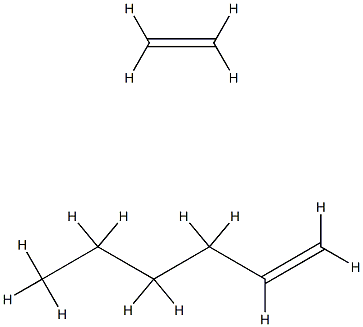
- 25213-02-9
- C8H16
- 112.21264
- All (24)
- China (2)
- (24)
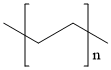
- 9002-88-4
- (C2H4)n
- 28.05316
- All (24)
- China (2)
- (24)
![[11C]-PVC](https://chemcloud-1304660855.cos.ap-shanghai.myqcloud.com/compound/058772b71aa947d8b11258d8de84400d.png?imageMogr2/format/webp)
- 191161-46-3
- C18H20ClN3O
- 329.82400
- All (0)
- China (0)
- (0)
![[4-[(E)-2-(5,5,8,8-tetramethyl-6,7-dihydronaphthalen-2-yl)prop-1-enyl]phenyl]methanol](https://chemcloud-1304660855.cos.ap-shanghai.myqcloud.com/compound/50d21f6fcaa34dec91920183ac1c1739.png?imageMogr2/format/webp)
- 71441-30-0
- C24H30O
- 334.49400
- All (0)
- China (0)
- (0)
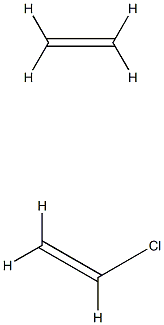
- 63231-66-3
- C4H7Cl
- 90.55138
- All (3)
- China (3)
- (3)
- 68131-73-7
- C12H5N7O12
- 0
- All (2)
- China (0)
- (2)
- 68441-17-8
- C51H102O21Si2
- 0
- All (29)
- China (28)
- (29)
- 64754-90-1
- 0
- All (3)
- China (3)
- (3)
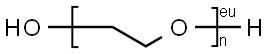
- 25322-68-3
- (C2H4O)nH2O
- 0
- All (65)
- China (33)
- (65)
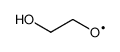
- 28287-76-5
- C2H5O2
- 61.05990
- All (65)
- China (33)
- (65)
Related Products More >

- 9002-86-2
- CNY Request For Quotation
- 63231-66-3
- CNY Request For Quotation
- CNY Request For Quotation
- 9002-88-4
- Request For Quotation
- 67-56-1
- Request For Quotation
- Request For Quotation
- 25322-68-3
- Request For Quotation
- 67-56-1
- CNY 2400.0000
- 1ton


1. The USMCA Lifeline
Good news first: Canada’s chemicals and plastics mostly dodge the new U.S. tariffs because they follow USMCA’s "Made in North America" rules. Since Canadian producers already use local raw materials (like Alberta’s oil and gas), they’re sitting pretty—for now. But here’s the catch: What if Washington changes the game?
2. The Tariff Loophole (And Its Expiration Date)
Right now, only about 6% of Canada’s U.S.-bound exports face the brutal 35% tax. But that could change overnight if:
Trump wins the election and decides USMCA is "a bad deal" (he’s done it before).
The U.S. redefines "rules of origin" to squeeze out Canadian suppliers.
Retaliatory tariffs escalate, hurting cross-border supply chains.
3. The Hidden Costs: Health & Environment Risks
Tariffs aren’t the only threat. To stay competitive, Canadian chemical plants might cut corners on:
Pollution controls (cheaper to dump waste than pay carbon taxes).
Workplace safety (fewer inspections = more accidents).
Product quality (using sketchy additives to cut costs).
Will regulators catch these risks before it’s too late?
4. Trade War Fallout: Who Really Pays?
Consumers: Higher tariffs → pricier plastics → costlier everything (from medical devices to food packaging).
Workers: If U.S. buyers switch to Mexican or Asian suppliers, Canadian plants could lay off thousands.
Investors: Uncertainty = fewer new projects (bad news for Canada’s $38B chemical industry).
5. The "Secret Weapon" Nobody’s Talking About
Canada’s real advantage? Cheap energy. With the U.S. fracking boom fading, Canadian ethylene and methanol could dominate—if pipelines and power grids keep up. But with climate activists blocking new projects, will the industry run out of juice?
6. The Bottom Line
The USMCA is Canada’s get-out-of-tariffs-free card… for now. But with Trump looming and trade wars heating up, the chemical sector’s "safe harbor" might not last. One wrong move, and those 35% taxes could slam the industry overnight.
The first title underscores the tension between USMCA’s trade rules and Trump’s proposed tariffs, which may disrupt cross-border supply chains. Canada’s chemical sector relies heavily on U.S. markets, making it vulnerable to protectionist measures. However, USMCA’s dispute resolution mechanisms and rules of origin could offer some protection .
The second title highlights “8 key flashpoints,” likely including:
Ethylene & Polymers: Tariffs on petrochemicals may raise production costs.
Fertilizers: Canada’s exports to the U.S. could face new barriers.
Supply Chain Dependencies: Integrated North American operations are at risk.
Retaliatory Measures: Canada may impose counter-tariffs, escalating tensions.
To “dodge the bullet,” the industry may diversify exports, leverage USMCA safeguards, and invest in innovation to reduce U.S. reliance . Policy agility and sectoral collaboration will be critical in navigating this trade uncertainty.
Latest Developments
PVC Lifeline: New US Department of Commerce data (August 2025) shows 92% of Canadian polyethylene exports qualify for USMCA exemptions, shielding $3.2 billion in annual trade.
Methanol Loophole: Alberta’s Methanex exploits USMCA’s "regional value content" rule by blending 30% US-sourced CO₂ in its low-carbon methanol, dodging tariffs.
Retaliation Risks: Ontario Premier Doug Ford’s proposed 15% surcharge on US ethylene imports could disrupt cross-border supply chains for food packaging.
Industry Adaptation
Canadian firms are scrambling to certify USMCA compliance:
NOVA Chemicals now tracks resin feedstocks via blockchain to prove 75% North American origin for its polyethylene.
Dow Canada shifted 5% of its ethylene supply from Middle East naphtha to Alberta oil sands derivatives, cutting tariff exposure.
Everyday Impacts
Grocery Bills: USMCA-protected Canadian PVC keeps cling film prices stable—but non-compliant fertilizer additives could raise produce costs 2-3%.
EV Batteries: Quebec’s lithium processors face hurdles as US tariffs hit Chinese graphite via Canada—Tesla Montreal may need local suppliers.
Home Construction: Tariff-free cross-border polystyrene trade keeps insulation costs down amid Canada’s housing crunch.
Political Powder Keg
With Trump threatening to "renegotiate or terminate USMCA" if reelected, CIAC warns:
$22 billion in annual chemical trade at risk
78,000 jobs tied to US-bound exports
Alberta’s hydrogen ambitions jeopardized by potential "green tariff" disputes