


 Home
Home
Hi, I'd like to ask—what are the steps to separate sugar from fruit juice through evaporation? Do you need to add any chemicals during the process, or can it be done by heating the juice alone? How do you determine when the sugar has been fully separated and crystallized? Thanks!
How Can Sugar Be Separated from Fruit Juice Using Evaporation?
Related Encyclopedia
- 27641-21-0
- C12H22O11
- 342.29600
- All (17)
- China (10)
- (17)
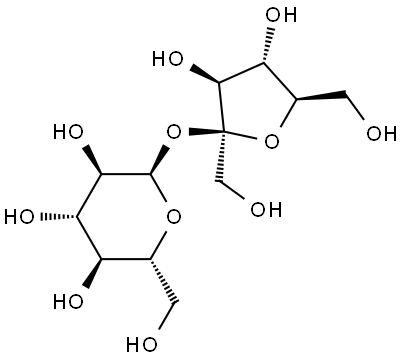
- 57-50-1
- C12H22O11
- 342.3
- All (17)
- China (10)
- (17)
- 95152-84-4
- C11H20O10
- 312.27100
- All (17)
- China (10)
- (17)
- 18304-13-7
- C36H46N8O11
- 766.80000
- All (0)
- China (0)
- (0)
- 37266-93-6
- C24H44O12
- 524.59896
- All (0)
- China (0)
- (0)
- 115094-71-8
- C13H24O10
- 340.32400
- All (0)
- China (0)
- (0)
- 31835-06-0
- C22H40O12
- 496.55
- All (0)
- China (0)
- (0)
- 875515-34-7
- C16H26O14
- 442.36900
- All (0)
- China (0)
- (0)
- 126-14-7
- C28H38O19
- 678.59
- All (5)
- China (0)
- (5)
- 758-65-6
- C28H38O19
- 678.59000
- All (5)
- China (0)
- (5)
Related Products More >

- 56038-13-2
- CNY 20.0000
- 25kg
- 34482-63-8
- Request For Quotation
- 1ton
- 34482-63-8
- Request For Quotation
- 25kg
- 25168-73-4
- Request For Quotation
- 25kg
- 25168-73-4
- Request For Quotation
- 500g
- 25168-73-4
- Request For Quotation
- 1kg
- 37318-31-3
- Request For Quotation
- 10kg
- 37318-31-3
- Request For Quotation
- 25kg


Next comes the crucial step of heating the juice. Place the pan over a stove set to low to medium heat. The objective here is to gently drive off the water content in the juice without subjecting the sugar and other components to excessive heat, which could lead to caramelization or burning. Caramelization occurs when sugar is heated to high temperatures, causing it to break down and form complex, brown - colored compounds with a distinct flavor. This is not desirable when the goal is to separate pure sugar. As the heating commences, you'll notice small bubbles starting to form on the surface of the juice. These bubbles are a sign that water is beginning to evaporate. Stir the juice regularly using a wooden or heat - resistant spoon. Stirring serves multiple purposes: it ensures that the heat is distributed evenly throughout the liquid, preventing hot spots at the bottom of the pan that could cause the sugar to burn, and it also helps in the efficient removal of water vapor.
As the evaporation process continues, keep a close eye on the changes in the juice. Over time, the volume of the liquid will gradually decrease, and the juice will transform from a relatively thin and runny consistency to a thicker, more syrupy state. Its color might also deepen slightly due to the concentration of various natural pigments present in the fruit juice. This is a slow process, and patience is key. Depending on the initial volume of the juice and the exact heat setting, it could take anywhere from half an hour to several hours.
Periodically, it's necessary to test the concentration of the sugar in the mixture. One simple and common method is the plate test. Take a small, clean, and cool plate or the back of a spoon. Drop a small amount of the concentrated liquid onto it. If the liquid spreads out thinly and remains liquid - like, it indicates that there is still a significant amount of water present. However, as the sugar concentration increases, the drop will start to form a thicker, more viscous layer. When it begins to set or form small, visible crystals upon cooling, it's a clear indication that the sugar content is rising. In more professional or scientific settings, tools like a hydrometer or a refractometer can be used. A hydrometer measures the density of the liquid, which is related to the sugar concentration, while a refractometer determines the sugar content by measuring the refraction of light through the liquid. These instruments provide more accurate readings but are not essential for a basic home - based separation.
Once the mixture has reached a highly concentrated state, similar to a thick syrup, you can choose to encourage sugar crystallization. After removing the pan from the heat, let it cool for a short while. Gentle stirring at this stage can help disrupt the supersaturated state of the sugar solution and initiate the formation of crystals. Another technique is to add a small amount of existing sugar crystals, often referred to as "seed crystals." These act as a nucleus around which new sugar crystals can form. Alternatively, pour the hot, concentrated syrup into a shallow tray and allow it to cool slowly at room temperature. The slower cooling process gives the sugar molecules more time to arrange themselves into an ordered crystalline structure, potentially resulting in larger and more distinct crystals.
If the aim is to obtain pure sugar crystals, after allowing the mixture to cool completely, you'll notice that the crystals have either settled at the bottom of the container or are dispersed throughout the remaining syrup. To separate the crystals from the liquid, which is often a dark, sticky molasses - like substance containing remaining impurities and a small amount of water, a filtration method can be employed. Use a fine - meshed cloth, such as cheesecloth, or a coffee filter. Pour the mixture through the filter, and the liquid will pass through, leaving the sugar crystals behind. To further purify the crystals, a gentle rinse with a small amount of ethanol can be done. Ethanol is a good choice because it evaporates quickly and has a lower solubility for sugar compared to water, so it can effectively remove any remaining impurities or color from the juice without dissolving too much of the precious sugar.
Determining when the sugar has been fully separated and crystallized can be a bit tricky and requires careful observation. One of the most obvious signs is the change in texture. When the sugar is fully separated, it will form distinct, solid crystals or a cohesive, granular mass. If, after cooling, the mixture remains a sticky, amorphous syrup, it means that there is still too much water present, and the evaporation process needs to continue. Visually, as the evaporation nears completion, the bubbling of the liquid will slow down and eventually stop. Instead of large, frothy bubbles, you might see small, slow - rising bubbles or even a thin, glassy - looking layer forming on the surface of the liquid. Crystals may also start to form around the edges of the pan, which is a clear indication that the sugar is beginning to solidify. Conducting a solubility test can also be helpful. Take a small sample of the cooled mixture and add a few drops of water. If the sample dissolves readily and completely, it suggests that there are still a significant number of dissolved sugars and other soluble substances. On the other hand, if the sample remains mostly solid or only partially dissolves, with distinct crystals visible, it's a strong indication that the sugar has been effectively separated.
It's important to remember that fruit juice is a complex mixture. Besides sugar, it contains organic acids, pectin, vitamins, and minerals. These components can influence the evaporation and crystallization process. For example, organic acids present in the juice can slightly lower the melting point of sugar. This means that the sugar is more likely to caramelize or undergo other chemical changes at relatively lower temperatures. To counteract this, maintaining a gentle and consistent heat throughout the process is crucial. Pectin, which is abundant in some fruits like apples and citrus, can cause the mixture to thicken into a gel - like consistency rather than forming pure sugar crystals. In such cases, the end product might be more like a fruit jam or a thick, sugary preserve rather than free - flowing sugar crystals. Understanding these potential complications and adjusting the process accordingly can lead to a more successful separation of sugar from fruit juice.
Begin by obtaining fresh fruit juice. The quality of the initial juice matters as it can affect the final product. For example, if the juice has been sitting for too long, it might start to ferment, introducing unwanted flavors and compounds that could impact the crystallization process. Strain the juice thoroughly using a fine - mesh sieve or cheesecloth. This step is crucial as any pulp or large particles left in the juice can act as nucleation sites for crystal growth in unexpected ways or cause the mixture to burn during heating. Even tiny bits of pulp can disrupt the uniformity of the evaporation and crystallization process.
Transfer the strained juice to a shallow, wide - mouthed container. A flat - bottomed saucepan or a shallow baking dish works well. The reason for choosing a shallow and wide container is based on the principle of surface area. The larger the surface area exposed to the heat source, the faster the evaporation rate. Think of it like this: if you pour the same amount of juice into a tall, narrow glass and a wide, shallow plate and leave them in the sun, the juice in the plate will dry up much faster. Place the container on a stovetop over low to medium heat. It's essential to avoid high heat at all costs. High heat causes the juice to boil vigorously, leading to splattering, which means you'll lose some of your mixture. More importantly, it can quickly caramelize or burn the sugar, ruining the whole separation process. Gentle heating allows the water in the juice to evaporate steadily without causing any unwanted chemical reactions to the sugar.
As the heating process starts, you'll notice small bubbles forming on the surface of the juice. These are the water molecules gaining enough energy to turn into vapor and escape. Stir the mixture regularly with a wooden or heat - resistant spoon. Stirring serves multiple purposes. It ensures that all parts of the juice are heated evenly, preventing hotspots at the bottom of the container that could lead to burning. It also helps to break up any surface foam that might form, which can impede evaporation. As time passes, you'll observe the volume of the liquid decreasing. The juice will start to change in color and consistency. Initially, it may be a thin, flowing liquid, but as more water evaporates, it will thicken into a syrupy texture.
To check the progress of the separation, you can perform a simple "spoon test." Dip a clean metal spoon into the mixture and then remove it from the heat. Let the spoon cool for a few seconds. If you see the liquid on the spoon start to thicken and form a sticky layer, or if small crystals begin to appear around the edges of the spoon as it cools, it's a sign that the sugar concentration is increasing. Another more accurate method is to use a candy thermometer. Different types of sugars have different crystallization temperatures. For common table sugar, which is mainly sucrose, when the temperature of the mixture reaches around 110 - 115°C (230 - 240°F), the mixture is approaching the stage where crystallization will occur upon cooling. However, keep in mind that the presence of other components in the fruit juice, such as acids or other sugars, can slightly affect this temperature.
Once the mixture has reached the desired consistency and temperature, remove it from the heat source. Let it cool slowly at room temperature. Avoid rushing the cooling process by placing it in the refrigerator, as rapid cooling can result in the formation of small, fine crystals or even an amorphous (non - crystalline) sugar mass. As the mixture cools, the sugar molecules, which are now in a supersaturated state (there's more sugar dissolved in the remaining liquid than it can normally hold at that temperature), will start to come out of the solution and form crystals. This process can take some time, depending on factors like the composition of the juice and the ambient temperature and humidity.