


 Home
Home
Hi, I’m curious about something—if I accidentally spill a strong acid at home or in a lab, can I safely use sodium bicarbonate to clean it up? How exactly does it work to neutralize the acid, and are there precautions I should follow to avoid making the situation worse? Is it suitable for all types of acids, or only certain ones? Could it produce dangerous reactions if used improperly, and what’s the safest way to apply it in a spill scenario?
Can You Safely Neutralize Acid Spills with Sodium Bicarbonate? Practical Tips and Uses
Related Encyclopedia

- 398507-55-6
- C47H62N12O11S2
- 1035.2
- All (0)
- China (0)
- (0)
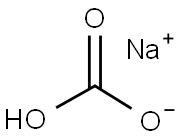
- 144-55-8
- CHNaO3
- 84.01
- All (83)
- China (59)
- (83)
![SODIUM BICARBONATE, [14C]](https://chemcloud-1304660855.cos.ap-shanghai.myqcloud.com/compound/4ca1cb1df0ef47f58653c7f46f805e3b.png?imageMogr2/format/webp)
- 7279-86-9
- CHNaO3
- 86.02000
- All (0)
- China (0)
- (0)
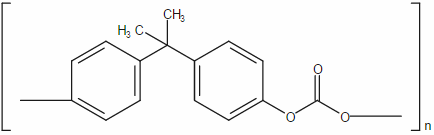
- 24936-68-3
- [-C6H4C(CH3)2C6H4OCO2-]n
- 0.00000
- All (3)
- China (0)
- (3)

- 3812-32-6
- CO3--
- 60.00890
- All (3)
- China (0)
- (3)
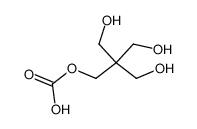
- 202523-98-6
- C6H12O6
- 180.15600
- All (0)
- China (0)
- (0)
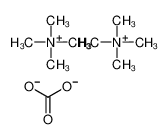
- 40105-52-0
- C9H24N2O3
- 208.29800
- All (0)
- China (0)
- (0)
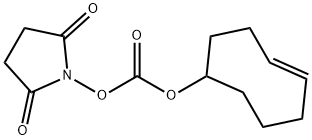
- 1191901-33-3
- C13H17NO5
- 267.28
- All (0)
- China (0)
- (0)
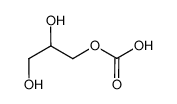
- 1026301-69-8
- C4H8O5
- 136.10300
- All (0)
- China (0)
- (0)
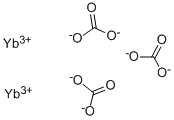
- 5895-52-3
- C3O9Yb2
- 526.11
- All (0)
- China (0)
- (0)
Related Products More >

- CNY Request For Quotation
- CNY Request For Quotation
- CNY Request For Quotation
- Request For Quotation
- 616-38-6
- CNY 3500.0000
- 1ton
- 105-58-8
- CNY 2000.0000
- 1ton
- 554-13-2
- CNY 60.0000
- 25kg
- 25037-45-0
- CNY 10.0000
- 25kg


Just keep in mind, the reaction can be a bit vigorous if the acid is strong, so don’t dump a huge amount all at once. Protective gloves and goggles are a smart idea. Also, it works best with common acids like vinegar, hydrochloric acid, or sulfuric acid, but very concentrated acids might need professional handling. It’s a simple way to make a messy situation safer without causing extra harm.
In practice, this method is not only convenient but also relatively safe for handling minor spills in households, classrooms, and laboratories. It’s commonly used with acids like vinegar, citric acid, or diluted hydrochloric acid. The fizzing and heat released are usually mild, but they signal that the reaction is actively taking place. One practical tip is to apply the powder gradually rather than dumping a large amount all at once, as sudden reactions can splash the acid.
Sodium bicarbonate’s accessibility and non-toxic nature make it ideal for emergency response, but for concentrated acids like concentrated sulfuric or nitric acid, professional guidance is recommended. In everyday life, this is why baking soda is often kept near chemistry setups or even kitchen areas—it provides a quick way to neutralize accidental acid contact without needing specialized chemicals. The same principle is used in industrial settings to safely handle minor acid leaks, highlighting the compound’s versatility in controlling acidity hazards.
In industrial safety and environmental engineering, sodium bicarbonate’s mild basicity makes it preferable for neutralizing corrosive acids such as hydrochloric (HCl) or sulfuric (H₂SO₄) acids in laboratories, manufacturing facilities, or transportation incidents. Its non-toxic, non-flammable nature allows for safe application on organic or inorganic acids without producing toxic byproducts, a critical advantage over lime (Ca(OH)₂), which can generate caustic slurries. However, sodium bicarbonate’s limited neutralizing capacity—requiring approximately 84 grams per liter of 1M HCl for complete neutralization—means it is unsuitable for large-scale or highly concentrated spills, where stronger agents like soda ash (Na₂CO₃) or commercial neutralizers may be necessary.
A common misconception is assuming sodium bicarbonate can replace specialized neutralizers for all acids; for instance, it reacts sluggishly with nitric acid (HNO₃) due to competitive oxidation reactions. Proper usage involves sprinkling the powder evenly over the spill, allowing effervescence to subside, and testing pH with litmus paper before disposal. This approach balances efficacy with safety, aligning with occupational health standards for minor acid incident response.
In practical applications, neutralizing acid spills with sodium bicarbonate follows a systematic process tailored to the spill’s size and type, ensuring safety and efficacy. For small household spills (e.g., vinegar, lemon juice, or dilute hydrochloric acid used for cleaning), the powder is sprinkled directly onto the acid—starting from the edges to contain the spill, then working toward the center—to avoid splashing. As the reaction occurs, fizzing (from CO₂ release) indicates the neutralization is active; once fizzing stops, the area is left to sit briefly before being wiped or rinsed with water. For larger industrial spills (e.g., dilute sulfuric acid in laboratories or manufacturing facilities), sodium bicarbonate may be applied as a slurry (mixed with water) to ensure better coverage and slower reaction, reducing heat buildup. After neutralization, the resulting mixture (a sodium salt solution) is collected and disposed of according to local regulations—since the salt is typically non-toxic, it can often be rinsed down drains (for small spills) or treated as non-hazardous waste. Critical precautions include wearing protective gear (gloves, goggles, a lab coat) to avoid contact with the acid or reaction byproducts, and never adding water to the acid first (which can cause splashing) or using sodium bicarbonate on concentrated acids like anhydrous sulfuric acid (which requires specialized neutralizers due to extreme heat generation).
The use of sodium bicarbonate for acid spill neutralization carries broader implications for safety, accessibility, and sustainability across household, industrial, and educational settings. Its low cost and widespread availability (found in most homes and easily sourced for industrial use) make it an inclusive solution, ensuring even small-scale operations or households can address minor acid spills without specialized equipment. Unlike toxic or corrosive neutralizers, sodium bicarbonate poses minimal risk to human health and the environment—its byproducts are harmless, reducing the likelihood of soil or water contamination when spills occur outdoors or near drains. In educational settings, it is often used to teach acid-base chemistry and spill response, as its visible fizzing reaction makes the neutralization process tangible, fostering safe handling practices among students. For industries, it supports compliance with occupational health regulations by providing a low-risk alternative to strong bases, lowering the incidence of chemical burns or accidents. Even in emergency situations, its stability (non-flammable, non-reactive under normal conditions) ensures it can be stored alongside other safety supplies without hazard. These attributes collectively make sodium bicarbonate a model of a practical, safe, and sustainable chemical for hazard mitigation, demonstrating how basic chemistry principles can be applied to solve real-world safety challenges.