


 Home
Home
Hi, I’m curious about managing pool water and keeping it balanced. I know that pH levels are important for swimmer comfort and for maintaining pool equipment, but I’m not sure how to adjust them correctly. Specifically, I want to know how much sodium bicarbonate I should add if my pool’s pH is too low. Is there a general guideline or calculation for determining the right amount without overdoing it and causing other issues? How do I make sure the pH rises to the correct level safely?
How Much Sodium Bicarbonate to Raise pH in Your Pool Safely
Related Encyclopedia

- 398507-55-6
- C47H62N12O11S2
- 1035.2
- All (0)
- China (0)
- (0)
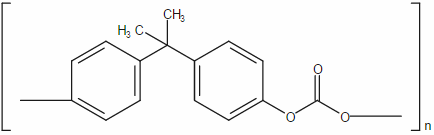
- 24936-68-3
- [-C6H4C(CH3)2C6H4OCO2-]n
- 0.00000
- All (3)
- China (0)
- (3)

- 3812-32-6
- CO3--
- 60.00890
- All (3)
- China (0)
- (3)
- 202523-98-6
- C6H12O6
- 180.15600
- All (0)
- China (0)
- (0)
- 40105-52-0
- C9H24N2O3
- 208.29800
- All (0)
- China (0)
- (0)
- 1191901-33-3
- C13H17NO5
- 267.28
- All (0)
- China (0)
- (0)
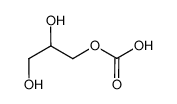
- 1026301-69-8
- C4H8O5
- 136.10300
- All (0)
- China (0)
- (0)
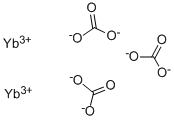
- 5895-52-3
- C3O9Yb2
- 526.11
- All (0)
- China (0)
- (0)
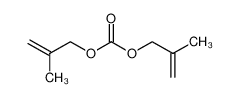
- 64057-79-0
- C9H14O3
- 170.21000
- All (0)
- China (0)
- (0)
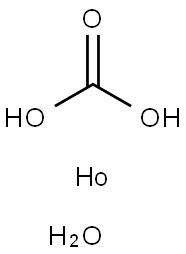
- 38245-34-0
- CH4HoO4
- 244.97
- All (0)
- China (0)
- (0)
Related Products More >

- CNY Request For Quotation
- CNY Request For Quotation
- CNY Request For Quotation
- Request For Quotation
- 616-38-6
- CNY 3500.0000
- 1ton
- 105-58-8
- CNY 2000.0000
- 1ton
- 554-13-2
- CNY 60.0000
- 25kg
- 25037-45-0
- CNY 10.0000
- 25kg


The amount needed to raise pH depends on both the size of the pool and the current alkalinity. For instance, adding roughly 1.5 pounds of sodium bicarbonate per 10,000 gallons of water will increase alkalinity by around 10 ppm, which in turn gently nudges the pH upward. This gradual approach is critical because overshooting the pH can create cloudy water or irritate swimmers’ eyes and skin. Pool operators typically sprinkle the bicarbonate evenly around the edges while the pump circulates, allowing it to dissolve fully before retesting and making further adjustments.
In real-life scenarios, sodium bicarbonate is not only used in swimming pools but also in hot tubs and aquarium systems to maintain stable water chemistry. By understanding the interplay between alkalinity and pH, users can keep the water safe, clear, and comfortable. Always add in measured increments, test frequently, and circulate the water well—this ensures that the intended pH increase occurs smoothly without causing additional chemical imbalances in the system.
For common applications like residential pools (the most frequent use case), a general reference is that 1.5 pounds (0.68 kg) of sodium bicarbonate per 10,000 gallons of water typically raises TA by 10 ppm, which in turn may lift pH by 0.1–0.2 units—assuming initial TA is within 60–80 ppm (the range where adjustment is most effective). If a pool’s pH is 7.0 (too low, ideal is 7.2–7.8) and TA is 70 ppm, raising TA to 80 ppm (a 10 ppm increase) with 1.5 pounds of sodium bicarbonate per 10,000 gallons would likely push pH to 7.1–7.2. For smaller volumes, like a 500-gallon aquarium (where pH stability is critical for aquatic life), 1 teaspoon of sodium bicarbonate may raise pH by 0.2–0.3 units if TA is moderate (100–120 ppm), but dosing must be slower—added in small increments (e.g., ¼ teaspoon at a time) with 30-minute intervals to avoid shocking fish. In industrial settings, such as food processing or water treatment, calculations scale with tank volume (e.g., 100 liters of process water may need 5–10 grams to raise pH from 5.5 to 6.0 if TA is 50 ppm), but these require pre-testing with a pH meter to avoid over-adjustment, as industrial solutions often contain other chemicals that interact with bicarbonate.
The distinction between sodium bicarbonate’s role in pH adjustment and TA buffering has broader implications for safety, efficiency, and system longevity across applications. In pools, over-reliance on sodium bicarbonate to raise pH (instead of addressing low TA first) wastes product and risks high TA (above 150 ppm), leading to cloudy water or reduced chlorine efficacy—costly for owners and harmful to swimmers. In aquariums, sudden pH jumps from excessive sodium bicarbonate can damage fish gills or disrupt beneficial bacteria, highlighting the need for gradual dosing tied to TA monitoring. In medicine, sodium bicarbonate is used intravenously to treat metabolic acidosis, but here dosing is based on blood pH and bicarbonate levels (measured via blood gas tests), with precise amounts (e.g., 1–2 mEq/kg of body weight) calculated to avoid alkalosis—underscoring how context (biological vs. aquatic vs. industrial) changes dosing logic. Environmentally, proper dosing reduces excess sodium bicarbonate runoff, which could alter natural water pH if drained, protecting aquatic ecosystems. Even for home bakers using sodium bicarbonate to adjust dough pH (for leavening or flavor), small amounts (¼ teaspoon per cup of flour) suffice because dough’s natural acidity (from buttermilk or vinegar) reacts with bicarbonate, limiting pH shifts to what is needed for texture. This range of use cases shows that while sodium bicarbonate can raise pH, its true value lies in balancing the underlying buffer system—TA—making dosing as much a matter of understanding solution chemistry as it is of volume and target pH.
In pool chemistry engineering, the relationship between TA and pH is critical: low TA (below 80 ppm) often correlates with unstable, acidic pH, while high TA (above 120 ppm) helps maintain a stable pH between 7.2–7.8. For every 10,000 gallons of water, adding approximately 1.5 pounds of sodium bicarbonate raises TA by 10 ppm, which may increase pH by 0.1–0.2 units, depending on initial conditions. This contrasts with sodium carbonate (Na₂CO₃), a stronger base that raises both pH and TA more aggressively, making it preferable for rapid pH correction.
A common misconception is assuming sodium bicarbonate can replace sodium carbonate for significant pH adjustments. While sodium bicarbonate is safer and less likely to overshoot pH targets, its limited basicity means large quantities may be needed for noticeable pH changes, potentially elevating TA beyond optimal levels (above 150 ppm). For targeted pH increases, use sodium carbonate or soda ash, then adjust TA with sodium bicarbonate if needed. This two-step approach ensures balanced water chemistry, protecting pool surfaces and optimizing sanitizer efficacy.