


 Home
Home
My chemistry teacher says all 'salts' are ionic, but we add table salt and sugar to tea. Does that mean sugar is ionic too?
Is Table Sugar (Sucrose) an Ionic Compound? The Sweet Truth
Related Encyclopedia
- 27641-21-0
- C12H22O11
- 342.29600
- All (17)
- China (10)
- (17)
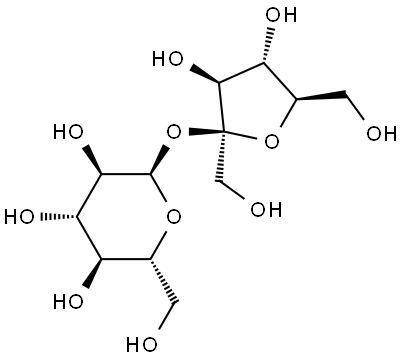
- 57-50-1
- C12H22O11
- 342.3
- All (17)
- China (10)
- (17)
- 95152-84-4
- C11H20O10
- 312.27100
- All (17)
- China (10)
- (17)
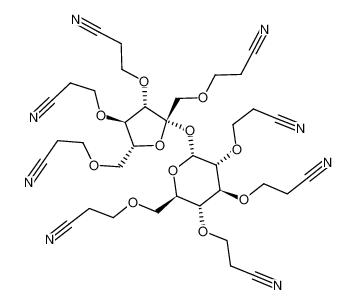
- 18304-13-7
- C36H46N8O11
- 766.80000
- All (0)
- China (0)
- (0)
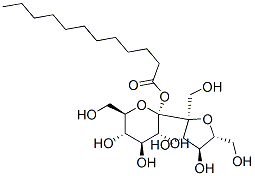
- 37266-93-6
- C24H44O12
- 524.59896
- All (0)
- China (0)
- (0)
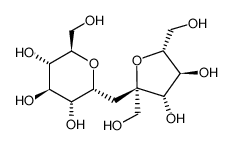
- 115094-71-8
- C13H24O10
- 340.32400
- All (0)
- China (0)
- (0)
- 31835-06-0
- C22H40O12
- 496.55
- All (0)
- China (0)
- (0)
- 875515-34-7
- C16H26O14
- 442.36900
- All (0)
- China (0)
- (0)
- 126-14-7
- C28H38O19
- 678.59
- All (5)
- China (0)
- (5)
- 758-65-6
- C28H38O19
- 678.59000
- All (5)
- China (0)
- (5)
Related Products More >

- 56038-13-2
- CNY 20.0000
- 25kg
- 34482-63-8
- Request For Quotation
- 1ton
- 34482-63-8
- Request For Quotation
- 25kg
- 25168-73-4
- Request For Quotation
- 25kg
- 25168-73-4
- Request For Quotation
- 500g
- 25168-73-4
- Request For Quotation
- 1kg
- 37318-31-3
- Request For Quotation
- 10kg
- 37318-31-3
- Request For Quotation
- 25kg


The atoms in sucrose are held together in a way that creates a neutral molecule. There are no distinct positive and negative ions like in an ionic compound. When sucrose dissolves in water, it doesn't break apart into ions. Instead, the water molecules surround the sucrose molecules through hydrogen bonding. This is a key difference from ionic compounds that dissociate into ions in water.
For those who are still unsure, a solution could be to study the chemical reactions of sucrose. Ionic compounds often participate in reactions where ions are exchanged or combined. But sucrose mainly undergoes reactions like hydrolysis, where the glycosidic bond is broken by water. Also, understanding the role of sucrose in food is helpful. Its solubility, sweetness, and ability to form crystals are all characteristics of a covalent compound. In the food industry, we rely on these properties for various applications, and it's clear that sucrose's behavior is not that of an ionic substance.
Carbon - carbon, carbon - hydrogen, and carbon - oxygen bonds in sucrose are covalent. The electronegativity differences between these atoms are not large enough to cause electron transfer. When we look at how sucrose behaves in different environments, we can see evidence of its covalent character. For instance, it doesn't react with metals in the way ionic compounds might.
To solve the confusion, one can study the historical discovery of sucrose. Early chemists analyzed its properties and found that it didn't fit the pattern of ionic compounds known at the time. Another approach is to compare it with well - known ionic and covalent substances. By observing the differences in their solubility, melting points, and chemical reactivity, it becomes clear that sucrose belongs to the covalent family. In our daily lives, when we use sugar in cooking or baking, its behavior is consistent with that of a covalent compound, further confirming that it's not ionic.