


 Home
Home
Hi, I'd like to ask—how does the production process of white sugar and brown sugar affect their composition? Do they differ in molasses content and sucrose purity? How do their taste, texture, and sweetness levels vary? Can brown sugar be substituted for white sugar in baking, and what impact does it have on recipes? Are there health considerations when choosing between the two, like mineral content differences? Thanks!
What Is the Difference Between White Sugar and Brown Sugar in Composition and Uses?
Related Encyclopedia
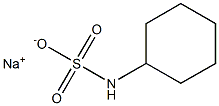
- 68476-78-8
- C6H12NNaO3S
- 201.21915
- All (11)
- China (3)
- (11)
- 27641-21-0
- C12H22O11
- 342.29600
- All (17)
- China (10)
- (17)
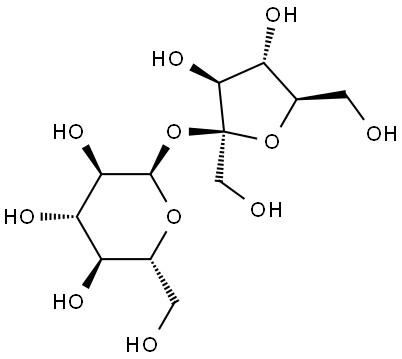
- 57-50-1
- C12H22O11
- 342.3
- All (17)
- China (10)
- (17)
- 95152-84-4
- C11H20O10
- 312.27100
- All (17)
- China (10)
- (17)
- 18304-13-7
- C36H46N8O11
- 766.80000
- All (0)
- China (0)
- (0)
- 37266-93-6
- C24H44O12
- 524.59896
- All (0)
- China (0)
- (0)
- 115094-71-8
- C13H24O10
- 340.32400
- All (0)
- China (0)
- (0)
- 31835-06-0
- C22H40O12
- 496.55
- All (0)
- China (0)
- (0)
- 875515-34-7
- C16H26O14
- 442.36900
- All (0)
- China (0)
- (0)
- 126-14-7
- C28H38O19
- 678.59
- All (5)
- China (0)
- (5)
Related Products More >

- 60343-69-3
- USD 18.0000
- 25kg
- 56038-13-2
- CNY 20.0000
- 25kg
- 657-27-2
- USD 3.1000
- 25kg
- 34482-63-8
- Request For Quotation
- 1ton
- 34482-63-8
- Request For Quotation
- 25kg
- 25168-73-4
- Request For Quotation
- 25kg
- 25168-73-4
- Request For Quotation
- 500g


Molasses content dictates their differences in taste, texture, and sweetness. White sugar has a clean, neutral sweetness with a dry, granular texture. Brown sugar, rich in molasses, tastes caramel-like and slightly fruity, with a moist, sticky texture due to molasses’ hygroscopic nature. While their sweetness levels are similar gram for gram, brown sugar’s molasses imparts deeper flavors.
In baking, brown sugar can substitute for white sugar, but it affects recipes. Its moisture content can make baked goods moister and denser, while the molasses adds color, flavor, and tenderness. For example, replacing white sugar with brown sugar in cookies can yield chewier textures. However, adjustments may be needed: reduce liquid slightly and expect darker browning.
Nutritionally, brown sugar contains trace minerals like calcium, iron, and potassium from molasses, though amounts are minimal (e.g., 1 tsp has ~1 mg iron). White sugar lacks these minerals but is pure sucrose. Health-wise, both are high in calories and should be consumed in moderation.
In contrast brown sugar production either stops short of complete molasses removal or deliberately adds molasses back to refined white sugar. Natural brown sugar retains some molasses during initial processing while commercial brown sugar usually combines white sugar with 3% to 10% molasses depending on whether it's classified as light or dark varieties. This molasses component significantly alters the sugar's physical properties and chemical composition. The molasses content typically ranges between 1% to 10% by weight in commercial products creating variations in color intensity and flavor strength.
The presence of molasses directly affects moisture retention with brown sugar containing about 3% to 5% water compared to white sugar's nearly 0% moisture level. This higher moisture content contributes to brown sugar's softer texture and tendency to clump together. From a chemical perspective the molasses introduces trace minerals including calcium potassium iron and magnesium though these remain in negligible amounts per typical serving size.
Taste differences arise from molasses compounds that impart caramelized and slightly smoky notes to brown sugar while white sugar delivers pure sweetness without additional flavor dimensions. Texture variations become particularly relevant in baking applications where brown sugar's moisture content affects dough consistency and final product density.
When substituting brown sugar for white sugar in recipes the 1:1 weight ratio generally maintains equivalent sweetness levels. However bakers should anticipate changes in moisture absorption and leavening dynamics. The additional moisture may require adjustments to liquid ingredients or baking times particularly in delicate pastries. The molasses flavor profile becomes pronounced in recipes with prolonged mixing or high baking temperatures potentially altering intended taste balances.
Health considerations focus on the minimal mineral content difference between the two sugars. While brown sugar contains trace elements from molasses the quantities remain insufficient to provide significant nutritional benefits. Daily consumption of either sugar type contributes comparable calorie intake without meaningful vitamin or mineral contributions. The refining process eliminates most natural nutrients regardless of the final product's color or molasses content.
White sugar production begins with the extraction of juice from sugarcane or sugar beets. Once the juice is obtained, it goes through a clarification process to remove impurities such as dirt, fibers, and non - sugar substances. This is typically done by adding substances like lime and using filtration methods. After clarification, the juice is boiled in large vats to concentrate the sucrose content. As the water evaporates, the solution becomes more concentrated, and eventually, sugar crystals start to form. These crystals are then separated from the remaining liquid, called molasses, through a process of centrifugation. In many cases, the sugar crystals are further refined and may even be bleached using activated carbon to remove any remaining color, resulting in a product with a sucrose purity often exceeding 99%.
On the other hand, brown sugar production either halts the refining process earlier than white sugar production or adds molasses back to refined white sugar. When the process is stopped earlier, some molasses naturally remains mixed with the sugar crystals. Molasses is a thick, dark liquid that contains not only sucrose but also other sugars like fructose and glucose, as well as minerals such as calcium, iron, potassium, and various organic acids. This gives brown sugar a molasses content typically ranging from 3% to 10%, which in turn reduces its sucrose purity to around 90% to 97%.
The disparity in molasses content is what sets the two sugars apart in terms of taste, texture, and sweetness. White sugar offers a clean, straightforward sweetness, as it is mostly pure sucrose. This makes it ideal for applications where a simple, unadulterated sweet flavor is desired, such as in making clear syrups, meringues, or sweetening beverages where you don't want any additional flavors to interfere. Brown sugar, with its molasses, has a more complex, rich flavor. The molasses imparts a caramel - like, almost buttery or toffee - like taste, which can add depth to baked goods. In terms of texture, white sugar consists of dry, free - flowing crystals, while brown sugar is moist and often clumps together. This is because molasses is hygroscopic, meaning it attracts and holds onto water.
When it comes to baking, brown sugar can indeed be substituted for white sugar, but it requires some adjustments. Since brown sugar contains moisture from the molasses, substituting it directly in equal amounts can make batters and doughs stickier. To counter this, one might need to reduce the amount of liquid in the recipe slightly or increase the amount of flour. Additionally, the molasses in brown sugar promotes caramelization, which can give baked goods a darker color and a more intense flavor. For example, using brown sugar in a chocolate chip cookie recipe can result in cookies that are chewier, darker in color, and have a more complex, rich taste compared to using white sugar. However, in recipes for delicate pastries where a light color and a simple sweetness are preferred, white sugar is usually the better choice.
In terms of health, while brown sugar does contain small amounts of minerals that white sugar lacks - for instance, a tablespoon of brown sugar might contain around 2 mg of calcium and 0.2 mg of iron, compared to white sugar's negligible amounts - these quantities are relatively insignificant in the context of a balanced diet. Both white sugar and brown sugar are high in calories and, when consumed in excess, can contribute to issues like weight gain, tooth decay, and an increased risk of certain chronic diseases. So, although some people might consider brown sugar to be a "healthier" alternative, nutritionally, the differences between the two are not substantial enough to make a significant impact on overall health.