


 Home
Home
Hi, I'd like to ask—can I use silica gel to dry flowers for resin embedding? How long does it take to dry roses with desiccant for resin use? Will air-drying flowers cause them to lose too much color for resin projects? Should I spray flowers with preservatives after drying before putting them in resin? What's the best way to store dried flowers before using them in resin? Thanks!
How to dry flowers properly to keep their shape and color for resin crafts?
Related Encyclopedia
- 112926-00-8
- O2Si
- 60.0800018310547
- All (27)
- China (5)
- (27)
![3-[(E)-4,6-dimethylhept-2-enyl]oxolane-2,5-dione,2-[3-(oxiran-2-ylmethoxy)propoxymethyl]oxirane,4-(oxiran-2-yl)-7-oxabicyclo[4.1.0]heptane](https://chemcloud-1304660855.cos.ap-shanghai.myqcloud.com/compound/bbb16ce2863d42899585d90674283a10.png?imageMogr2/format/webp)
- 52368-54-4
- C30H48O9
- 552.69700
- All (0)
- China (0)
- (0)
- (C14H13NO)n
- 211.26000
- All (0)
- China (0)
- (0)
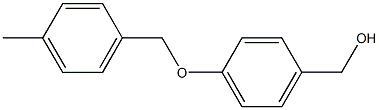
- 201058-08-4
- C15H16O2
- 228.28634
- All (0)
- China (0)
- (0)
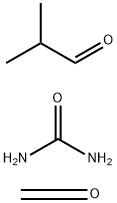
- 28931-47-7
- C6H14N2O3
- 162.19
- All (0)
- China (0)
- (0)

- 11041-12-6
- C27H47N
- 385.66878
- All (0)
- China (0)
- (0)
- 9003-74-1
- C10H18
- 0
- All (7)
- China (4)
- (7)
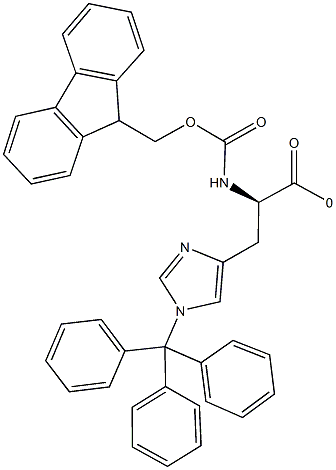
- 55844-94-5
- C40H32N3O3R
- 602.70038
- All (3)
- China (0)
- (3)

- 39319-11-4
- C18H15P
- 262.285461
- All (1)
- China (0)
- (1)
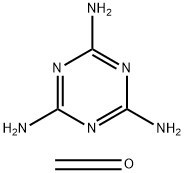
- 9003-08-1
- C4H8N6O
- 156.15
- All (1)
- China (1)
- (1)
Related Products More >

- 9002-86-2
- CNY Request For Quotation
- CNY Request For Quotation
- CNY Request For Quotation
- CNY Request For Quotation
- 465-42-11
- CNY Request For Quotation
- 465-42-10
- CNY Request For Quotation
- 465-42-9
- CNY Request For Quotation
- Request For Quotation


Drying roses with desiccant like silica gel usually takes 3 to 7 days. Smaller roses with thinner petals may be ready in 3 to 5 days, while larger, fuller ones might need 5 to 7 days. They’re done when they feel dry and brittle to the touch.
Air-drying flowers can lead to significant color loss, especially for vibrant blooms. The slow drying process causes pigments to break down, leaving flowers looking dull—this is noticeable in red, pink, or yellow flowers, which may fade too much for resin projects where color matters.
Spraying dried flowers with a preservative before putting them in resin is a good idea. A light coat of clear acrylic or floral preservative spray creates a protective layer, reducing color bleeding and preventing petals from crumbling. It also seals in remaining moisture, which helps avoid bubbles during resin curing. Let the spray dry fully before embedding.
To store dried flowers before using them in resin, keep them in an airtight container in a cool, dry place, away from direct sunlight and heat. Adding a small silica gel packet to the container helps absorb any excess moisture, preventing mold or rehydration. Be careful not to crush or press the flowers to maintain their shape until you’re ready to use them.
When using silica gel to dry roses the process typically requires 3 to 7 days for complete dehydration depending on factors such as flower size ambient humidity and silica gel freshness. Larger rose blooms with thick petals may need the full week to dry thoroughly while smaller or thinner varieties might finish in just three days. To begin place the rose carefully in a container filled with fresh silica gel ensuring the stem and petals are fully submerged but not crushed. Seal the container tightly to create an airtight environment which accelerates moisture absorption and prevents contamination. Check the flower periodically after the third day gently testing petal firmness until they feel completely dry and crisp. Over drying can make petals brittle so removing them at the right moment is crucial for successful resin embedding.
Air drying flowers remains a common alternative but it often results in undesirable changes for resin projects. As flowers dry slowly in open air they frequently lose significant color intensity turning dull or brownish and their petals tend to wrinkle or curl. These textural alterations can detract from the smooth polished finish resin projects require. Silica gel drying addresses these issues by locking in the flower s natural pigments and maintaining structural integrity throughout the dehydration process.
Applying preservative sprays to dried flowers before resin embedding is generally unnecessary and potentially counterproductive. Many commercial sprays contain chemicals that might interfere with resin curing or leave visible residues on the petals. If the flowers have been properly dried using silica gel they should already be stable and dry enough for resin use. Instead focus on cleaning the dried petals gently with a soft brush or compressed air to remove any dust or debris before placing them in the resin.
For storing dried flowers prior to resin work keep them in an airtight container in a cool dry location away from sunlight and moisture. Exposure to humidity can rehydrate the petals while light exposure may cause gradual fading. Place the dried flowers between layers of acid free tissue paper or parchment paper to prevent physical damage and maintain their shape. Avoid compressing the flowers tightly which could cause bending or breakage.
These proteins act as channels or carriers. For example, glucose transporters change shape to move the sugar into cells, a process that doesn’t require energy. In contrast, sodium-potassium pumps use energy from ATP to move ions against their concentration gradients, maintaining the cell’s electrical balance.
Temperature affects membrane fluidity. Cold conditions make phospholipids pack tightly, reducing movement, while heat increases fluidity. Cells adjust by altering the ratio of saturated to unsaturated fatty acids in the bilayer, ensuring the membrane remains functional across different environments. This balance is vital for cells to survive and interact with their surroundings.
Air-drying flowers is an alternative method, but it often results in significant color loss and structural changes. The natural drying process exposes flowers to environmental factors such as sunlight and humidity, which can lead to fading and wilting. In contrast, silica gel provides a controlled environment that minimizes these issues. The preservation of color is particularly important for resin projects, as vibrant flowers can enhance the aesthetic appeal of the final product.
After drying the flowers with silica gel, it is generally not necessary to apply preservatives. However, ensuring that the flowers are completely dry is essential. If moisture remains, it can lead to mold or mildew formation within the resin. To check for complete drying, gently press the petals; they should feel dry and brittle. If any flexibility remains, additional drying time may be required.
Proper storage of dried flowers is essential for maintaining their condition before embedding them in resin. The best practice involves placing the flowers in an airtight container to prevent moisture absorption. A cool, dry environment is ideal, as fluctuations in temperature and humidity can degrade the flowers' quality over time. By following these steps, you can ensure that the flowers remain in optimal condition for your resin projects, allowing you to create beautiful and long-lasting pieces.