


 Home
Home
Hello, I'd like to ask a few questions:
What does hydrochloric acid do? Could you explain and suggest a catchy question-style title that includes the keyword? Also, what's the role of hydrochloric acid in stomach acid?
What are some common industrial uses of hydrochloric acid?
How should we handle a hydrochloric acid leak in an emergency?
Hydrochloric Acid: Digestive Hero or Industrial Hazard?
Related Encyclopedia
- 9001-75-6
- n.a.
- 0
- All (9)
- China (0)
- (9)
- 144-55-8
- CHNaO3
- 84.01
- All (83)
- China (59)
- (83)
![SODIUM BICARBONATE, [14C]](https://chemcloud-1304660855.cos.ap-shanghai.myqcloud.com/compound/4ca1cb1df0ef47f58653c7f46f805e3b.png?imageMogr2/format/webp)
- 7279-86-9
- CHNaO3
- 86.02000
- All (0)
- China (0)
- (0)

- 7647-01-0
- ClH
- 36.46
- All (25)
- China (20)
- (25)

- 101752-05-0
- CH5ClO
- 68.50280
- All (0)
- China (0)
- (0)

- 12015-40-6
- Cl2H2
- 71.91390
- All (0)
- China (0)
- (0)
- 19400-49-8
- ClH8O3
- 90.50680
- All (0)
- China (0)
- (0)
- 42348-42-5
- ClH2+
- 38.98180
- All (0)
- China (0)
- (0)
- 64990-51-8
- C4H9ClO2
- 124.56600
- All (0)
- China (0)
- (0)
- 160208-71-9
- CH3Cl3
- 121.39400
- All (0)
- China (0)
- (0)
Related Products More >

- CNY Request For Quotation
- CNY Request For Quotation
- CNY Request For Quotation
- 7647-01-0
- CNY 2000.0000
- 1ton
- 144-55-8
- CNY 100.0000
- 25kg
- 144-55-8
- USD 225.0000
- 25kg
- 144-55-8
- USD 7.5000
- 25kg
- 7647-01-0
- Request For Quotation
- 1ton


Why Is HCl Important?
Digestive Agent – Breaks down food in the stomach.
Industrial Reactant – Used in metal cleaning, pH adjustment, and chemical synthesis.
Versatile & Cheap – Produced in bulk for widespread applications.
Role of HCl in Stomach Acid
Digestion:
Activates pepsinogen → pepsin (enzyme for protein breakdown).
Kills pathogens in food (bacteria, viruses).
pH Balance:
Maintains stomach pH at 1.5–3.5, optimal for digestion.
Deficiency Risks:
Hypochlorhydria (low HCl) causes bloating, nutrient malabsorption (iron, B12).
Note: Proton pump inhibitors (PPIs) like omeprazole reduce HCl production to treat acid reflux.
Industrial Uses of Hydrochloric Acid
Steel Pickling:
Removes rust/scale from metals before galvanization.
PVC Production:
Catalyzes ethylene dichloride → vinyl chloride (PVC precursor).
Water Treatment:
Adjusts pH in pools/wastewater.
Food Industry:
pH control in corn syrup, gelatin processing.
Example: ~5 million tons of HCl are used annually in steel cleaning.
Emergency Response to HCl Spills
Protection:
Wear acid-resistant gloves (neoprene), goggles, and a respirator.
Containment:
Use inert absorbents (vermiculite, sand).
Neutralization:
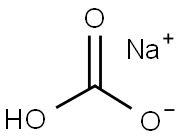
Slowly add sodium bicarbonate (baking soda) until fizzing stops.
Disposal:
Collect neutralized waste as hazardous material.
First Aid:
Skin/eyes: Rinse with water for 15+ mins.
Inhalation: Move to fresh air; seek medical help if coughing persists.
In industry, HCl is used for metal treatments, such as pickling steel to remove rust and prepare surfaces for further processing. This ensures that metals are clean and ready for fabrication or coating, preventing corrosion. Another application is in the production of oil and gas, where it is used in well stimulation processes like acidizing to dissolve carbonate rock formations and increase flow rates.
The chemical industry utilizes HCl in the synthesis of numerous compounds, including polyvinyl chloride (PVC) for plastics, and in the purification of common table salt. Additionally, it serves in water treatment processes to adjust pH levels and neutralize alkaline substances, ensuring water safety and efficiency in industrial processes.
A practical scenario could involve a manufacturing plant using hydrochloric acid in the maintenance of metal machinery and parts. By periodically treating these components with HCl, they prevent rust accumulation and extend equipment lifespan, reducing maintenance costs and downtime. Understanding the multifaceted uses of hydrochloric acid underscores its importance in both biological functions and industrial applications, highlighting its role in enhancing productivity, safety, and product quality across different sectors. However, handling HCl requires caution due to its corrosive nature, emphasizing the need for appropriate safety measures.
What is hydrochloric acid's role in stomach acid?
Enzyme activation: Low pH (1–3) converts pepsinogen to pepsin, breaking down proteins.
Pathogen killing: Denatures microbes in ingested food, reducing infection risk.
Mineral absorption: Dissolves calcium and iron salts for better intestinal uptake.
What are common industrial uses of hydrochloric acid?
Metal pickling: Removes rust (Fe₂O₃) from steel via:
Fe₂O₃ + 6HCl → 2FeCl₃ + 3H₂O
pH regulation: Adjusts acidity in wastewater treatment and chemical synthesis.
Oil well : Injects HCl to dissolve rock formations, enhancing oil flow.
PVC production: Converts ethylene to ethylene dichloride, a precursor to polyvinyl chloride.
How to handle hydrochloric acid spills?
Personal protection: Wear acid - resistant gloves and respirators to avoid skin/respiratory burns.
Containment: Use sodium bicarbonate (NaHCO₃) to neutralize spills:
HCl + NaHCO₃ → NaCl + CO₂ + H₂O
Ventilation: Evacuate areas to disperse toxic fumes, then rinse residues with copious water.