


 Home
Home
Hello, may I ask about the techniques and longevity of preserving insects in resin?
What pretreatment steps (e.g., dehydration, positioning, or sealing) are necessary before embedding insects in resin, and how do they prevent decay or discoloration?
Why do bubbles or distortions occur around insects in resin? Could you explain how degassing techniques or slow layering minimizes these artifacts?
How long can resin-encased insects remain intact? Are there environmental factors (UV exposure, temperature) that accelerate degradation over decades?
How to Preserve Insects in Resin? Pre-Treatment Steps, Bubble Prevention & Longevity Secrets
Related Encyclopedia
- 112926-00-8
- O2Si
- 60.0800018310547
- All (27)
- China (5)
- (27)
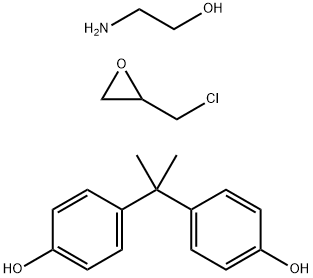
- 38891-59-7
- C20H28ClNO4
- 381.9
- All (2)
- China (0)
- (2)
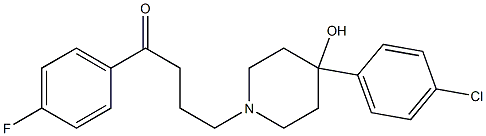
- 61788-97-4
- C21H23ClFNO2
- 375.8642232
- All (1)
- China (0)
- (1)
- 19848-60-3
- C18H16N4
- 288.34600
- All (0)
- China (0)
- (0)
Related Products More >

- CNY Request For Quotation
- CNY Request For Quotation
- CNY Request For Quotation
- 25085-99-8
- USD 490.0000
- 240kg
- 9003-05-8
- USD 1.0000
- 25kg
- 63231-67-4
- Request For Quotation
- 20kg
- 63231-67-4
- Request For Quotation
- 2kg


1. Essential Pre-Treatment for Insect Preservation
Cleaning & Drying:
Brush insects with a soft microfiber cloth to remove debris; use compressed air (<0.5MPa) for hard-to-reach areas.
Dehydrate in silica gel (200–300 mesh) for 72h at 25°C; moisture content must drop below 3% to prevent resin clouding.
Fixing Posture:
Use entomology pins (0.1mm diameter) to adjust wings and legs; let dry for 24h before encasing to maintain position.
2. Preventing Bubbles & Deformation in Resin
Mold Design:
Create two-part silicone molds (Shore A 20) with 1mm overhangs; pour 0.5mm resin layers around the insect, curing 12h between each to avoid heat damage.
Degassing Techniques:
Vacuum degas mixed epoxy (viscosity <500cP) at -90kPa for 5 minutes; pre-coat insects with a 0.1mm resin layer to seal air pockets.
Temperature Control:
Cure at 20–25°C (max 30°C); excessive heat (>40°C) causes insect tissues to shrink by 10–15%, distorting morphology.
3. Long-Term Preservation Stability in Resin
Microbiological Resistance:
Resin-encased insects remain viable for 10+ years if:
Cured resin has <0.1% residual monomers (tested by GC-MS)
UV stabilizers (benzophenone-3, 2%) are added to prevent photodegradation
Environmental Factors:
Store in dark, dry conditions (RH <40%, temp 15–25°C); sunlight exposure (>500 hours) may cause resin yellowing and insect pigment fading.
Chemical Stability:
Epoxy resin provides better long-term protection than polyester; its cross-linked structure resists hydrolysis, maintaining insect integrity for decades.
1. **Select Your Insect:** Choose an insect that is intact and clean. For artistic purposes, the choice might be based on visual appeal, while for educational displays, species identification may be more critical.
2. **Prepare the Mold:** Use a silicone mold suitable for your project's size and shape. Silicone molds are ideal because they easily release the resin once cured.
3. **Position the Insect:** Carefully place the insect into the mold in the desired position. You may pour a thin layer of resin into the mold first and partially cure it to secure the insect in place before adding more resin.
4. **Mix the Resin:** Follow the manufacturer's instructions to mix the resin and hardener thoroughly. Ensure the mixture is well combined to avoid cloudiness in the final product.
5. **Pour the Resin:** Slowly pour the mixed resin into the mold, covering the insect completely. Pouring slowly helps to minimize air bubbles. Consider pouring in layers, allowing partial curing between layers if needed, especially for larger projects.
6. **Remove Air Bubbles:** To remove any air bubbles trapped around the insect or in the resin, use a heat gun or torch lightly over the surface or place the mold in a pressure chamber if available.
7. **Curing:** Allow the resin to cure fully as per the instructions. Curing times vary depending on the type of resin used and environmental conditions.
**Applications and Examples:**
In life, preserving insects in resin finds applications in education, art, and personal interest. Schools and museums may use these preserved specimens for teaching entomology or showcasing biodiversity. Artists create jewelry, paperweights, or decorative items featuring insects, appealing to nature enthusiasts. Collectors preserve rare or beautiful insects in resin for display, maintaining their beauty indefinitely.
Understanding the technique of embedding insects in resin opens up creative possibilities while preserving natural beauty for study or admiration. Always handle insects and chemicals responsibly, ensuring ethical sourcing and safe practices.
Scientific Basis:
Moisture content must be reduced to prevent resin clouding
Chitinous exoskeleton requires strengthening agents
Internal organs need chemical stabilization
Three Critical Compound Tags:
Ethanol (70% solution) - Primary fixative and dehydration agent
Glycerin (C3H8O3) - Maintains tissue flexibility during curing
Acetone (CH3COCH3) - Rapid dehydration for delicate specimens
Preparation Protocol:
Initial Fixation: Soak in 70% ethanol for 48-72 hours (larger specimens require longer)
Gradual Dehydration:
Day 1-2: 70% ethanol
Day 3-4: 95% ethanol
Day 5-6: 100% anhydrous ethanol
Clearing Agent: Transfer to xylene or clove oil for 24 hours to remove fatty tissues
Final Stabilization: Immerse in glycerin solution (10%) for 12 hours before resin embedding
2. Techniques to Eliminate Bubbles and Deformation
Critical Methods:
Pre-Curing Degassing: Place specimen in vacuum chamber (29inHg) for 5-10 minutes
Layered Pouring:
Base layer: Thin resin coat (1-2mm) to secure specimen
Secondary layers: 3-5mm pours with 2-hour intervals
Temperature Control: Cure at 20-25°C (68-77°F) to minimize thermal expansion
Bubble Prevention Additives:
Surfactants (e.g., BYK-052) - Reduces surface tension by 15-20%
Heating Elements: Pre-warm resin to 30°C before mixing (reduces viscosity)
Pressure Pot Curing: 60psi pressure eliminates microbubbles
Deformation Solutions:
Wire Armature: Stainless steel pins for large specimens
Support Mesh: Nylon netting for fragile wings
Flexible Molds: Silicone molds with 5% platinum catalyst
3. Long-Term Preservation and Durability
Factors Affecting Preservation Lifespan:
UV Protection: Add 2% UV stabilizer (Tinuvin 234) to prevent yellowing
Moisture Barrier: Epoxy resins with <0.1% water absorption rate
Chemical Stability: Aliphatic epoxy systems resist yellowing better than aromatic types
Expected Preservation Timeline:
Storage Condition Expected Lifespan
Room temperature (dark) 50+ years
Direct sunlight 10-15 years
High humidity (>60%) 5-10 years
Degradation Prevention:
Oxygen Scavengers: Iron-based packets reduce oxidative degradation
Desiccants: Silica gel maintains <40% RH in display cases
Periodic Inspection: Check for resin cracking every 5 years
Professional Standards:
Smithsonian Institution recommends aliphatic polyurethane for insect preservation
American Entomological Society approves epoxy resins with <1% shrinkage rate
ISO 1817 specifies resin permeability standards for biological specimens