


 Home
Home
How can a material that is lighter than air and once known for its fragility now withstand extreme compression and still spring back to its original form? What role does the unique micro-dome structure play in giving aerogels both elasticity and heat resistance above 2000°C? Could this innovation open the door to safer spacecraft, faster aircraft, or even protective gear for exploring extreme environments on Earth and beyond?
How Did Micro-Dome Aerogels Turn “Frozen Smoke” Into a Bouncy, Heat-Resistant Material?
Related Encyclopedia
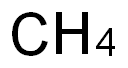
- 1034343-98-0
- CH4
- 16.04246
- All (14)
- China (12)
- (14)
- 1177013-41-0
- C16H23NO4
- 293.35800
- All (0)
- China (0)
- (0)
Related Products More >

- 1034343-98-0
- Request For Quotation
- 10ml
- 1034343-98-0
- Request For Quotation
- 5g
- 1034343-98-0
- Request For Quotation
- 25kg
- 1034343-98-0
- Request For Quotation
- 200g
- 1034343-98-0
- Request For Quotation
- 1kg
- 1034343-98-0
- Request For Quotation
- 50g
- 1034343-98-0
- Request For Quotation
- 250g
- 1034343-98-0
- 1600.0000
- 1g


In terms of chemical structure and engineering principles, the micro - dome's non - developable curved surface characteristic forms abundant recoverable folds. Computer simulations show it can store at least 10 times more elastic strain energy than traditional structures, enabling the aerogel to withstand extreme compression and spring back. This represents a new curvature design concept in porous materials, distinct from traditional angular - structured aerogels.
Regarding heat resistance, the "en - ceramic" aerogel, a hybrid of graphene and ceramic at the atomic level, is a breakthrough. Graphene inhibits the high - temperature recrystallization of 2D ceramics, and ceramics prevent the high - temperature slippage of graphene sheets. This allows it to maintain 99% elastic strain from deep cold (-268.8°C) to ultra - high temperatures (2000°C).
In professional fields, this innovation is crucial. For spacecraft, it can improve heat shields, enabling closer solar exploration. In aircraft, it may lead to faster and safer designs. For protective gear, it offers reliable thermal protection in extreme environments on Earth and beyond. A potential misunderstanding could be that all aerogels have similar properties. However, this new micro - dome - structured aerogel stands out due to its unique combination of elasticity and high - temperature resistance, opening up new application possibilities.
Aerogel, once fragile despite being lighter than air, now withstands extreme compression and rebounds due to a unique micro-dome structure. Traditional aerogels have angular pores, but the new design features micron-scale dome-shaped pores. These curved surfaces, inspired by biological and architectural dome structures, create recoverable folds that store over 10 times more elastic strain energy than conventional structures, enabling resilience even after 99% compression repeated tens of thousands of times.
The micro-dome structure, formed via a 2D channel-confined foaming method using graphene oxide, enhances both elasticity and heat resistance above 2000°C. The graphene-ceramic hybrid "Xitao" aerogel inhibits high-temperature recrystallization of ceramics and prevents graphene sheet sliding at ultra-high temperatures. With thermal conductivity as low as half that of air, it maintains stability under repeated thermal shocks up to 2273K.
This innovation holds great potential for safer spacecraft, supersonic aircraft, and protective gear for extreme environments, from deep-space probes to nuclear fusion devices and even exploration of Earth's harshest regions.