


 Home
Home
Hello, please. The answer is that carbon calcium (calcium carbonate) is commonly produced via chemical precipitation, like reacting calcium hydroxide with carbon dioxide, as it's a cost-effective and controllable method. Could you explain why this approach is widely used, what are the lab-scale production methods, what equipment is needed for industrial production, and what raw materials are essential for making calcium carbonate?
How Is Calcium Carbonate Produced? From Lab to Industry – The Complete Manufacturing Guide
Related Encyclopedia
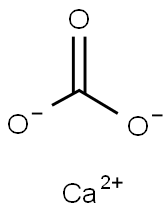
- 1317-65-3
- CCaO3
- 100.09
- All (868)
- China (56)
- (868)
- 792848-15-8
- CCaO3
- 100.08700
- All (868)
- China (56)
- (868)
- 471-34-1
- CCaO3
- 100.0869
- All (868)
- China (56)
- (868)
- 15634-14-7
- CH2O3.Ca.6H20
- 208.17900
- All (0)
- China (0)
- (0)
Related Products More >

- 471-34-1
- CNY 50.0000
- 25kg
- 471-34-1
- Request For Quotation
- 1ton
- 471-34-1
- Request For Quotation
- 25kg
- 471-34-1
- Request For Quotation
- 1ton
- 471-34-1
- Request For Quotation
- 25kg
- 471-34-1
- Request For Quotation
- 1kg
- 471-34-1
- Request For Quotation
- 1ton
- 471-34-1
- Request For Quotation
- 25kg


Lab-scale methods include reacting calcium chloride with sodium carbonate solutions, forming insoluble CaCO₃ precipitates, which are filtered and dried. Another way is bubbling CO₂ through calcium hydroxide solution (lime water) until precipitation completes.
Industrial equipment includes crushers (for mining), reactors (for precipitation), filters, dryers, and mills. These enable large-scale processing, from ore crushing to refining precipitated carbonate into fine powders.
Raw materials vary: mined carbonate uses limestone or marble; precipitated forms use calcium oxide (lime) or calcium chloride, paired with carbon dioxide or sodium carbonate.
1. Laboratory-Scale Production Methods
A. Precipitation Method (Most Common)
1.
Reagents: Calcium chloride (CaCl₂) + Sodium carbonate (Na₂CO₃)
CaCl
2
+Na
2
CO
3
→CaCO
3
↓+2NaCl
2.
Procedure:
•
Mix equimolar solutions at room temperature
•
Filter/centrifuge the white precipitate
•
Dry at 60-80°C
Yield: ~90% pure CaCO₃ (amorphous or calcite form)
B. Carbonation Process
1.
Reagents: Calcium hydroxide (Ca(OH)₂) + CO₂ gas
Ca(OH)
2
+CO
2
→CaCO
3
↓+H
2
O
2.
Procedure:
•
Bubble CO₂ through limewater until pH drops to 7
•
Forms ultrafine (<1 μm) particles
Best for: High-purity nano-CaCO₃ research
C. Biological Route (Experimental)
•
Use urea-hydrolyzing bacteria (e.g., Sporosarcina pasteurii) to precipitate CaCO₃ from calcium salts
2. Industrial Production Equipment
Process Stage
Key Machinery
Function
Quarrying
Rotary drills, crushers
Extract limestone (CaCO₃ ore)
Calcination
Rotary kilns (900-1200°C)
Convert CaCO₃ → CaO + CO₂
Slaking
Hydration reactors
CaO + H₂O → Ca(OH)₂
Carbonation
Bubble column reactors
Ca(OH)₂ + CO₂ → CaCO₃
Classification
Air separators, cyclones
Sort particles by size (1-100 μm)
Annual Capacity: Modern plants produce 500,000+ tons/year
3. Raw Materials Overview
Natural Sources
•
Limestone: 90-98% CaCO₃ (mined from sedimentary deposits)
•
Marble: High-purity crystalline CaCO₃ (crushed/ground)
•
Chalk: Soft, porous CaCO₃ (for food/pharma grades)
Synthetic Inputs
•
Quicklime (CaO): Derived from limestone calcination
•
Carbon dioxide: Byproduct of fermentation/combustion
•
Salt brines: Provide CaCl₂ for precipitation methods
Purity Standards:
•
Food-grade: >99% CaCO₃, <5 ppm heavy metals
•
Industrial-grade: >95% CaCO₃
The reason for using different production methods depends on the desired particle size, purity, and application. PCC offers better control over crystal shape and size, making it suitable for high-value applications, while ground calcium carbonate (GCC) is more cost-effective for bulk uses.
Calcium carbonate is widely used across industries. In construction, it serves as a key ingredient in cement and building materials. In paper manufacturing, it improves brightness and opacity. It is also used as a dietary calcium supplement and antacid in pharmaceuticals, and as a filler in plastics, paints, and coatings to enhance durability and texture.
Despite its abundance and low toxicity, sustainable sourcing and CO₂ emissions during calcination are environmental concerns. Therefore, energy efficiency and carbon capture are increasingly important. Keywords like production, purity, and sustainability highlight the balance between industrial demand and responsible manufacturing practices in the production of calcium carbonate.