


 Home
Home
Hello, please. The answer is yes, calcium carbonate is a mineral. It's because it naturally occurs in the Earth's crust and has a defined chemical composition and crystal structure. Could you explain why it meets the mineral criteria, what its mineralogical classification is, what are its natural mineral forms, and what are its key physical properties as a mineral?
Is Calcium Carbonate a Mineral? Delving Into Its Geologic Identity
Related Encyclopedia
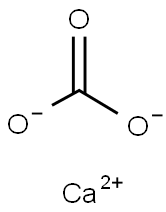
- 1317-65-3
- CCaO3
- 100.09
- All (868)
- China (56)
- (868)
- 792848-15-8
- CCaO3
- 100.08700
- All (868)
- China (56)
- (868)
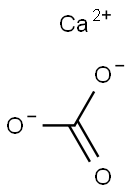
- 471-34-1
- CCaO3
- 100.0869
- All (868)
- China (56)
- (868)
- 15634-14-7
- CH2O3.Ca.6H20
- 208.17900
- All (0)
- China (0)
- (0)
Related Products More >

- 471-34-1
- CNY 50.0000
- 25kg
- 471-34-1
- Request For Quotation
- 1ton
- 471-34-1
- Request For Quotation
- 25kg
- 471-34-1
- Request For Quotation
- 1ton
- 471-34-1
- Request For Quotation
- 25kg
- 471-34-1
- Request For Quotation
- 1kg
- 471-34-1
- Request For Quotation
- 1ton
- 471-34-1
- Request For Quotation
- 25kg


In mineralogy, it is classified under the carbonate group, specifically as a carbonate mineral, characterized by the presence of the carbonate ion (CO₃²⁻) bonded to a metal cation (here, Ca²⁺).
Natural mineral forms of calcium carbonate include calcite (most common, trigonal crystal system), aragonite (orthorhombic), and vaterite (rare, hexagonal, metastable).
Its physical properties include a hardness of 3 on the Mohs scale, white to colorless appearance, perfect cleavage in three directions, and a specific gravity of 2.71. It reacts with acids, releasing CO₂, a key identifying trait.
1. Why Calcium Carbonate Qualifies as a Mineral
Calcium carbonate meets all five standard mineral definitions:
1.
Naturally Occurring: Forms through geological/biogenic processes
2.
Inorganic: Despite being produced by organisms (e.g., shells)
3.
Solid: Crystalline at standard conditions
4.
Definite Chemical Formula: CaCO₃
5.
Ordered Atomic Structure: Hexagonal (calcite) or orthorhombic (aragonite) lattices
Mineralogical Classification:
•
Class: Carbonates
•
Group: Calcite group (rhombohedral) / Aragonite group (orthorhombic)
•
Mohs Hardness: 3 (calcite) to 3.5-4 (aragonite)
2. Natural Mineral Forms of CaCO₃
A. Calcite
•
Crystal System: Trigonal
•
Habitus: Rhombohedral, scalenohedral
•
Geological Settings: Limestone, marble, travertine
B. Aragonite
•
Crystal System: Orthorhombic
•
Habitus: Needle-like, columnar
•
Special Locations: Hot springs, mollusk shells
C. Vaterite
•
Crystal System: Hexagonal
•
Rarity: Metastable, forms in biological systems
Biogenic Variants:
•
Coccoliths: Microscopic plates from algae
•
Foraminifera tests: Shells of marine protists
3. Physical Properties of Mineral CaCO₃
Property
Calcite
Aragonite
Luster
Vitreous to pearly
Resinous
Cleavage
Perfect (3 directions)
Poor (2 directions)
Density
2.71 g/cm³
2.93 g/cm³
Birefringence
Extreme (double refraction)
Weak
Solubility
0.0014 g/100mL (25°C)
0.0015 g/100mL (25°C)
Unique Behaviors:
•
Effervescence: Reacts violently with dilute HCl (diagnostic test)
•
Thermal Decomposition: Breaks down to CaO + CO₂ at 900°C
3 Key Compound Tags
•
Rock-forming mineral
•
Biogenic carbonate
•
Industrial raw material
The reason calcium carbonate is considered a mineral lies in its defined chemical composition and crystalline structure. It exists in several polymorphic forms, the most common being calcite and aragonite, both composed of calcium, carbon, and oxygen but differing in crystal arrangement. These natural deposits are mined or quarried for industrial and commercial use.
In daily life, calcium carbonate has a wide range of applications. A major use is in the construction industry, where it serves as a key ingredient in cement, concrete, and building stones. It is also used as a dietary supplement to support bone health and as an antacid to relieve indigestion. In manufacturing, it functions as a filler in paper, plastics, paints, and coatings, improving texture and brightness. Additionally, it plays a role in environmental protection by neutralizing acidic soils and waters in agriculture and flue gas desulfurization.
Despite its widespread use, safety and environmental impact should be considered, especially in mining and dust exposure. Keywords such as mineral, natural source, safety, and versatility highlight the importance of understanding calcium carbonate’s role in both nature and human applications.