


 Home
Home
Have you ever wondered about the tiny building blocks that make up everything around us? Hydrogen is one of the simplest and most common atoms in the universe, but what about its electrical charge? Does it have a positive or negative charge, or is it neutral? How does its charge affect the way it interacts with other atoms, like in water or in fuels? Why do scientists often talk about hydrogen’s charge when explaining chemical reactions or electricity? Can understanding hydrogen’s charge really help us make sense of everyday things like water, batteries, or even our bodies?
What Is Hydrogen’s Charge and Why Does It Matter?
Related Encyclopedia

- 12408-02-5
- H2
- 2.01588
- All (0)
- China (0)
- (0)
- 108703-53-3
- C34H34N2O6+
- 567.65100
- All (0)
- China (0)
- (0)
- 12501-73-4
- H12O4+
- 73.06910
- All (0)
- China (0)
- (0)
- 1333-74-0
- H2
- 2.02
- All (5)
- China (5)
- (5)
- 103733-28-4
- C34H35ClN2O10
- 667.10200
- All (0)
- China (0)
- (0)
- 144336-63-0
- FH
- 22.02220
- All (0)
- China (0)
- (0)
- 16844-87-4
- AsHO4
- 139.92700
- All (0)
- China (0)
- (0)
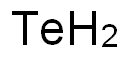
- 7783-09-7
- H2Te
- 129.61588
- All (0)
- China (0)
- (0)

- 6914-07-4
- CHN
- 27.02530
- All (0)
- China (0)
- (0)
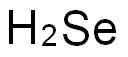
- 7783-07-5
- H2Se
- 80.98
- All (0)
- China (0)
- (0)
Related Products More >

- 7757-93-11
- CNY Request For Quotation
- 7757-93-10
- CNY Request For Quotation
- 7757-93-9
- CNY Request For Quotation
- 92128-87-5
- CNY Request For Quotation
- 92128-87-5
- CNY Request For Quotation
- 1341-49-7
- Request For Quotation
- 13472-35-0
- USD 22.0000
- 25kg
- 13530-50-2
- USD 240.0000
- 300kg


In chemical and physical contexts, hydrogen’s partial charges influence molecular structures and interactions. For example, in a water molecule, the electron density tends to cluster closer to the oxygen atom, rendering the hydrogen nuclei slightly positively charged. This polarization creates hydrogen bonding, a weak but significant force that shapes the properties of liquids, determines boiling and melting points, and stabilizes biological macromolecules like proteins and DNA. Beyond chemistry, hydrogen’s charge dynamics are central to electrochemistry and energy applications. Proton exchange in fuel cells and the behavior of hydrogen ions in batteries rely directly on its capacity to exist in charged forms and migrate through conductive media.
Hydrogen’s charged nature also plays a vital role in biology and medicine. The movement of hydrogen ions across cell membranes governs pH balance, enzyme activity, and energy production in the form of ATP. In industrial processes, its charged states enable catalysis, metal hydride formation, and the production of ammonia through the Haber process. The dual identity of hydrogen, both as neutral atoms and as charged ions, underpins its versatility in technological and natural systems, influencing everything from clean energy solutions to the chemistry of life itself.
Understanding hydrogen’s charge gives insight not only into the atom itself but also into the broader mechanisms that govern molecular interactions, energy transfer, and biological function. Its presence and behavior in charged forms are foundational to disciplines as varied as materials science, environmental chemistry, and physiological regulation.
When hydrogen participates in chemical bonding, its charge can shift dramatically. In ionic compounds such as hydrochloric acid (HCl) dissolved in water, hydrogen loses its electron to the more electronegative chlorine atom, resulting in a positively charged hydrogen ion (H⁺). This ion, often referred to as a proton in aqueous solutions, plays a central role in acid-base chemistry, influencing pH levels and driving reactions like neutralization. Conversely, in hydrides like sodium hydride (NaH), hydrogen gains an electron from sodium, forming a negatively charged hydride ion (H⁻), which acts as a strong base in organic synthesis.
A common misunderstanding is conflating hydrogen's charge with its oxidation state, though the two are related. Oxidation state reflects the hypothetical charge an atom would have if all bonds were ionic, whereas actual charge depends on the bond type. For example, in water (H₂O), hydrogen has an oxidation state of +1, but due to the polar covalent bond, it carries only a partial positive charge rather than a full +1 charge. This distinction matters in fields like biochemistry, where the partial charges on hydrogen in molecules like DNA influence intermolecular interactions and structural stability.
In industrial processes, such as hydrogen fuel cells, the movement of hydrogen ions (H⁺) across membranes is foundational to generating electricity. Here, the positive charge of these ions drives the electrochemical reaction, highlighting how hydrogen's charge properties are harnessed for practical energy applications. Unlike elements with fixed ionic charges, hydrogen's ability to adopt both positive and negative charges makes it uniquely versatile across chemical and physical systems.
The charge of hydrogen is not static but dynamic, influenced by its environment. In water, for example, hydrogen bonds form between molecules, creating a network where partial charges play a critical role. The oxygen atom in water attracts electrons more strongly than hydrogen, leaving the hydrogen atoms with a partial positive charge (δ⁺). This polarity enables hydrogen bonding, which is essential for the unique properties of water, such as high surface tension and the ability to dissolve many substances.
In practical applications, hydrogen’s charge variability is exploited in technologies like fuel cells, where H⁺ ions facilitate energy conversion. The movement of these ions through a membrane generates an electric current, powering vehicles and devices. Another example is biochemistry, where the transfer of H⁺ ions drives cellular processes like ATP synthesis. The interplay of hydrogen’s charge with other elements underpins both natural phenomena and human-engineered systems, making it a cornerstone of chemistry and physics.