


 Home
Home
I’ve been wondering about natural ways to ease a cough without relying too much on medicines. Essential oils are often mentioned as a home remedy, but I’m not sure which ones actually work for coughs. Are there specific essential oils that can help calm or reduce coughing? How do they work, and is it safe to use them? Could essential oils be a good option for people who want gentle, natural relief for a cough? What should I know before trying them at home?
What Essential Oils Help with a Cough? Exploring Natural Relief Options
Related Encyclopedia
- 1214906-07-6
- C10H20O
- 156.26500
- All (28)
- China (25)
- (28)

- 15356-70-4
- C10H20O
- 156.27
- All (25)
- China (10)
- (25)

- 1181819-05-5
- C10H20O
- 156.26500
- All (25)
- China (10)
- (25)
- 566916-97-0
- C17H23NO4
- 305.36900
- All (25)
- China (10)
- (25)
- 15356-60-2
- C10H20O
- 156.27
- All (6)
- China (2)
- (6)
- 1375952-47-8
- C12H16O6
- 256.25200
- All (0)
- China (0)
- (0)
- 5989-54-8
- C10H16
- 136.23
- All (0)
- China (0)
- (0)
- 138-86-3
- C10H16
- 136.23
- All (0)
- China (0)
- (0)
- 121153-32-0
- C12H24O2
- 200.31800
- All (0)
- China (0)
- (0)
- 64282-88-8
- C10H20O
- 156.26500
- All (0)
- China (0)
- (0)
Related Products More >

- CNY Request For Quotation
- CNY Request For Quotation
- 89-78-1
- USD 285.0000
- 25kg
- 97-53-0
- Request For Quotation
- 96-08-2
- Request For Quotation
- 25kg drum
- 91770-81-9
- Request For Quotation
- 25kg/Drum
- 89-78-1
- Request For Quotation
- 25kg/Cardboard Drum
- 89-78-1
- Request For Quotation
- 25kg/Cardboard Drum


These oils aren’t magic cures but can be a nice, gentle way to ease coughing, especially when you want to avoid too many medicines. Just be careful—don’t put essential oils directly on your skin without mixing them, and don’t use them around babies or very young kids without checking first. So yeah, essential oils can be a handy tool to help with coughs, especially when used safely at home.
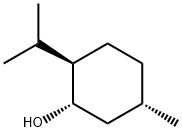
Another essential oil with notable benefits is peppermint oil, primarily due to its high menthol content. Menthol acts as a natural cooling agent and local anesthetic, providing temporary relief from throat irritation and cough reflex sensitivity. The physiological response to menthol involves the activation of transient receptor potential (TRP) channels, specifically TRPM8, which are sensitive to cold temperatures. This activation leads to a sensation of coolness and numbness, which can be soothing for individuals experiencing a dry, irritating cough. However, it is important to differentiate between the soothing effects of menthol and its potential to cause bronchoconstriction in sensitive individuals, particularly those with asthma or chronic obstructive pulmonary disease (COPD).
Tea tree oil, derived from Melaleuca alternifolia, is another essential oil that has been explored for its antimicrobial and anti-inflammatory properties. The primary active components, terpinen-4-ol and α-terpineol, exhibit broad-spectrum antimicrobial activity, which can be beneficial in cases where a cough is associated with a bacterial or viral infection. Additionally, tea tree oil's anti-inflammatory effects can help reduce airway inflammation, contributing to a decrease in cough severity. It is essential to note that while tea tree oil has these potential benefits, its use should be approached with caution due to the risk of skin irritation and allergic reactions, especially when applied topically or inhaled in high concentrations.
In contrast to these essential oils, lavender oil is more commonly associated with its calming and sedative effects, which can indirectly benefit individuals experiencing cough-related sleep disturbances. The primary constituents of lavender oil, linalool and linalyl acetate, interact with the gamma-aminobutyric acid (GABA) neurotransmitter system, promoting relaxation and reducing anxiety. While lavender oil does not directly address the physiological mechanisms of cough, its ability to improve sleep quality can be valuable in supporting overall respiratory health and recovery.
A common misunderstanding is that all essential oils have the same mechanism of action or are equally effective in treating cough. This is not the case, as each essential oil has a unique chemical profile that determines its specific effects on the body. For example, while eucalyptus oil and peppermint oil both have bronchodilatory effects, they achieve this through different chemical pathways and may be more suitable for different types of cough. Eucalyptus oil is generally preferred for productive cough due to its mucolytic properties, whereas peppermint oil may be more effective for dry, irritating cough due to its cooling and anesthetic effects.
Furthermore, it is important to recognize that essential oils should not be viewed as a replacement for conventional medical treatment, especially in cases of severe or chronic cough. Instead, they can be used as a complementary approach to support respiratory health and alleviate symptoms. The use of essential oils should always be discussed with a healthcare professional, particularly for individuals with pre-existing respiratory conditions or those taking medications, as there may be potential interactions or contraindications.
In summary, the selection of essential oils for cough relief should be based on their specific chemical composition and the underlying physiological mechanisms they influence. Eucalyptus oil, peppermint oil, and tea tree oil each offer distinct benefits related to mucus clearance, airway sensitivity, and antimicrobial activity, respectively. Lavender oil, while not directly addressing cough, can contribute to improved sleep quality, which is essential for overall respiratory health. Understanding these differences and potential interactions is crucial for making informed decisions about the use of essential oils in managing cough symptoms.
From a physiological perspective, inhaling essential oils or applying them topically allows these compounds to interact with the mucous membranes and sensory nerve endings in the respiratory system. This interaction can modulate neural pathways associated with coughing, reduce inflammation in bronchial tissues, and promote easier breathing. The volatile nature of essential oils enables rapid absorption through the nasal and oral mucosa, facilitating prompt symptom relief.
In practical terms, essential oils such as eucalyptus, peppermint, tea tree, and thyme have been widely used in both traditional and complementary medicine to alleviate coughs. Their application spans steam inhalation, topical chest rubs with carrier oils, and diffusion in living spaces to improve air quality. Beyond personal health, these oils also find roles in industrial formulations, such as natural flavoring agents and disinfectants, leveraging their antimicrobial characteristics.
Understanding the chemical makeup and mechanism of action of these oils enriches their application scope. For example, the ability of eucalyptus oil to act as an expectorant and antiseptic makes it valuable not only in treating cough but also in respiratory infections where mucus accumulation and microbial presence are concerns. However, safe usage guidelines are critical, as undiluted essential oils can cause irritation or sensitization, and certain populations, like young children or those with respiratory conditions, require cautious use.
The interdisciplinary insights combining chemistry, physiology, and clinical practice underscore the relevance of essential oils in respiratory care. Their integration into everyday health routines highlights a balance between traditional knowledge and modern understanding, offering natural adjuncts in managing cough symptoms with a foundation in bioactive chemistry and physiological response.
Peppermint oil works differently, leveraging menthol to relax the muscles in the respiratory tract. This relaxation reduces spasms that trigger dry, hacking coughs, providing a cooling sensation that also eases throat discomfort. It pairs well with steam inhalation, as the warmth helps the oil’s properties penetrate more effectively.
Tea tree oil, known for its antimicrobial properties, can be beneficial when a cough stems from a bacterial or viral infection. While it doesn’t directly suppress coughing, it supports the body’s defense against pathogens, potentially shortening the duration of the illness that’s causing the cough. Diluting it in a carrier oil and applying it to the chest may enhance this effect through skin absorption.
Using these oils requires caution: always dilute them to avoid skin irritation, and keep them away from children’s faces. For someone with a mild cough from a cold, adding a few drops of eucalyptus to a bowl of hot water, then inhaling the steam, can provide noticeable relief within minutes, reducing both the frequency and intensity of coughing fits.