


 Home
Home
Many people going through menopause experience hot flashes, which can be uncomfortable and disruptive. Some have heard that taking vitamin E might help reduce these sudden feelings of heat and sweating. But is there any truth to this? How exactly might vitamin E work to ease hot flashes, and is it safe to use for this purpose? Could vitamin E be a simple natural option to manage menopause symptoms, or is it just a myth? What does the science say about using vitamin E for hot flashes?
Can Vitamin E Help with Hot Flashes During Menopause?
Related Encyclopedia
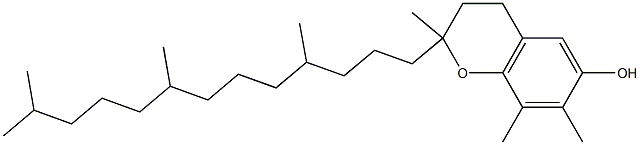
- 1406-66-2
- C28H48O2
- 416.67952
- All (0)
- China (0)
- (0)
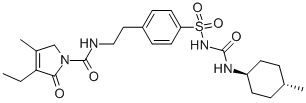
- 1406-18-4
- C29H50O2
- 430.71
- All (0)
- China (0)
- (0)
![α-Tocopherol-[D6] (Vitamin E-[D6])](https://chemcloud-1304660855.cos.ap-shanghai.myqcloud.com/compound/202502120400270246.gif?imageMogr2/format/webp)
- 113892-08-3
- C29H50O2
- 430.72
- All (0)
- China (0)
- (0)
- 67629-40-7
- C30H49ClO3
- 493.16100
- All (38)
- China (12)
- (38)

- 59-02-9
- C29H50O2
- 430.71
- All (38)
- China (12)
- (38)

- 79434-83-6
- C29H50O2
- 430.70600
- All (38)
- China (12)
- (38)

- 2074-53-5
- C29H50O2
- 430.71
- All (38)
- China (12)
- (38)
- 142386-74-1
- C38H67N2O3P
- 630.92400
- All (38)
- China (12)
- (38)
- 90498-90-1
- C43H64O10
- 740.98
- All (0)
- China (0)
- (0)

- 110675-26-8
- C33H60OS2
- 536.96
- All (0)
- China (0)
- (0)
Related Products More >

- CNY Request For Quotation
- CNY Request For Quotation
- CNY Request For Quotation
- CNY Request For Quotation
- CNY Request For Quotation
- CNY Request For Quotation
- CNY Request For Quotation
- CNY Request For Quotation


A few studies have shown that taking vitamin E supplements might reduce how often or how strong hot flashes feel for some women. It’s thought that vitamin E could gently ease symptoms by helping balance your body a bit, but it’s not a guaranteed fix for everyone. Plus, vitamin E is generally safe when taken in recommended amounts, but it’s good to check with a doctor before starting any supplement, especially if you’re on other medications.
In everyday life, some women find that adding vitamin E to their routine helps them feel a bit better during menopause, but others don’t notice much change. So, it might be worth trying, but keep in mind it’s just one of many options to manage hot flashes.
In the context of hormonal changes, declining estrogen levels can reduce the body’s natural antioxidant defenses, making tissues more vulnerable to oxidative stress. By supplementing with vitamin E, individuals may support these defenses, potentially stabilizing the hypothalamus’s response to temperature signals. For instance, someone experiencing frequent nightly hot flashes might find that consistent vitamin E intake, alongside other lifestyle adjustments, leads to fewer disruptions, as the nutrient aids in maintaining cellular balance in the areas responsible for regulating body temperature.
It’s important to note that the effects can vary; while some people notice a reduction in hot flash severity, others may experience minimal change, as responses depend on individual physiology, overall health, and the presence of other contributing factors like stress or diet. Integrating vitamin E into a broader approach—such as staying hydrated, managing stress, and avoiding triggers like spicy foods—can create a more comprehensive strategy to address these symptoms, leveraging the nutrient’s role in supporting cellular health and reducing oxidative stress.
However, it is essential to distinguish vitamin E's mechanism from that of hormones like estrogen, which directly bind to estrogen receptors in the hypothalamus to regulate thermoregulation. Estrogen deficiency, particularly during menopause, is a well-established trigger for hot flashes, whereas vitamin E does not exhibit hormonal activity. Another point of differentiation is with selective serotonin reuptake inhibitors (SSRIs), which are sometimes used off-label to manage hot flashes by altering serotonin levels in the brain. Vitamin E, by contrast, does not interact with neurotransmitter systems in this manner.
A common misunderstanding is that vitamin E's antioxidant effects are a panacea for all oxidative stress-related conditions, including hot flashes. While its ability to scavenge free radicals is beneficial, the direct link between vitamin E supplementation and significant reduction in hot flash frequency or severity remains nuanced, as the etiology of hot flashes involves complex neuroendocrine interactions that are not solely driven by oxidative stress. Furthermore, high-dose vitamin E supplementation can pose risks, such as increased bleeding tendency due to its antiplatelet effects, which underscores the importance of moderation and medical supervision when considering its use for symptomatic relief.
In engineering terms, if we consider the body as a system where oxidative stress is a form of "noise" disrupting normal signaling, vitamin E can be viewed as a filter that reduces this noise, potentially allowing for clearer communication between the hypothalamus and peripheral vasculature. Nonetheless, this analogy simplifies the intricate biological processes at play and highlights the need for a holistic approach to managing hot flashes, incorporating lifestyle modifications, hormone therapy when appropriate, and, possibly, adjunctive agents like vitamin E within a carefully evaluated framework.
The mechanism by which vitamin E may influence hot flashes is thought to be multifactorial. On a cellular level, vitamin E’s antioxidative action could help mitigate oxidative stress associated with menopausal hormonal changes, potentially stabilizing vascular endothelial function. This stabilization might reduce abnormal vasodilation and the resulting sudden heat sensations. Moreover, vitamin E interacts with lipid membranes and modulates signaling pathways that regulate vascular tone and inflammatory mediators, which are implicated in the pathophysiology of hot flashes. From a biochemical standpoint, vitamin E's role in maintaining membrane integrity and modulating prostaglandin synthesis may indirectly influence the frequency and severity of vasomotor symptoms.
In daily life and clinical settings, vitamin E’s application extends beyond dietary supplementation; it is incorporated into various formulations aimed at supporting menopausal health. While not a primary treatment, vitamin E is often considered a complementary approach due to its relative safety profile and potential vascular benefits. Industrially, vitamin E is utilized in nutraceutical products targeting women’s health, leveraging its antioxidative and cell-protective effects. Its relevance spans the biochemical, physiological, and therapeutic realms, providing a bridge between molecular actions and symptom management.
The broader significance of vitamin E’s role in alleviating hot flashes lies in its capacity to influence the interplay between oxidative stress and neurovascular regulation. This intersection highlights the importance of antioxidants in managing symptoms related to hormonal transitions and vascular reactivity. Understanding this connection offers insight into how nutritional and biochemical factors may contribute to non-hormonal strategies for symptom relief during menopause.