


 Home
Home
Have you ever wondered if vitamin E can expire or lose its effectiveness over time? Many people keep bottles of vitamin E capsules or oil for months or even years, but do they actually go bad after a while? Does temperature, sunlight, or air exposure make vitamin E spoil faster? And if it does, is it harmful to use old vitamin E products on your skin or to take them as supplements?
Can Vitamin E Go Bad? Understanding Its Shelf Life and Safety
Related Encyclopedia
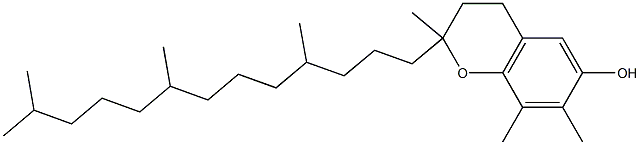
- 1406-66-2
- C28H48O2
- 416.67952
- All (0)
- China (0)
- (0)
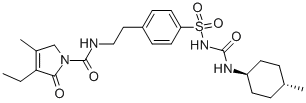
- 1406-18-4
- C29H50O2
- 430.71
- All (0)
- China (0)
- (0)
![α-Tocopherol-[D6] (Vitamin E-[D6])](https://chemcloud-1304660855.cos.ap-shanghai.myqcloud.com/compound/202502120400270246.gif?imageMogr2/format/webp)
- 113892-08-3
- C29H50O2
- 430.72
- All (0)
- China (0)
- (0)
- 67629-40-7
- C30H49ClO3
- 493.16100
- All (38)
- China (12)
- (38)

- 59-02-9
- C29H50O2
- 430.71
- All (38)
- China (12)
- (38)

- 79434-83-6
- C29H50O2
- 430.70600
- All (38)
- China (12)
- (38)

- 2074-53-5
- C29H50O2
- 430.71
- All (38)
- China (12)
- (38)
- 142386-74-1
- C38H67N2O3P
- 630.92400
- All (38)
- China (12)
- (38)
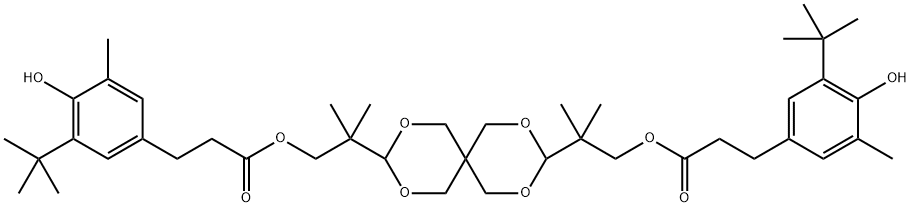
- 90498-90-1
- C43H64O10
- 740.98
- All (0)
- China (0)
- (0)

- 110675-26-8
- C33H60OS2
- 536.96
- All (0)
- China (0)
- (0)
Related Products More >

- CNY Request For Quotation
- CNY Request For Quotation
- CNY Request For Quotation
- CNY Request For Quotation
- CNY Request For Quotation
- CNY Request For Quotation
- CNY Request For Quotation
- CNY Request For Quotation


If you have vitamin E capsules, they usually last for about two years if kept in a cool, dark place. The same goes for vitamin E oil, but because it’s exposed to air when you open the bottle, it can go bad sooner. Using expired vitamin E isn’t usually dangerous, but it might not give you the skin or health benefits you expect. Always check the smell and look for any changes in color or texture. If it smells rancid, it’s time to toss it.
In practical terms, vitamin E’s stability is challenged by its unsaturated hydrocarbon tail, which is susceptible to oxidation. When stored improperly—such as in clear containers under direct sunlight or in warm conditions—the molecule can break down into inactive or potentially rancid byproducts. This not only affects its nutritional value in supplements or fortified foods but also alters sensory properties like odor and color, which can be critical in industries such as cosmetics and food manufacturing.
From a physiological perspective, the loss of vitamin E activity compromises its ability to neutralize free radicals, which are implicated in cellular aging, inflammation, and chronic diseases. Therefore, the integrity of vitamin E supplements and topical formulations is essential to ensure their protective roles are maintained. In medical applications, degraded vitamin E might fail to deliver expected therapeutic benefits, especially in conditions requiring antioxidant support.
Beyond individual health, the stability of vitamin E impacts industrial formulations where it serves as a preservative to extend shelf life of oils and fats by preventing rancidity. Its breakdown not only undermines this preservative function but can also contribute to off-flavors and reduced product quality, affecting consumer acceptance and safety.
Understanding the chemical kinetics behind vitamin E degradation underscores the importance of optimal storage and formulation strategies, such as using opaque packaging, adding stabilizing agents, or maintaining low temperatures. These measures mitigate oxidative damage and prolong shelf life, enhancing both consumer safety and product performance.
The broader implications of vitamin E’s stability extend into food science, pharmacology, and dermatology, where its role as an antioxidant is harnessed. Ensuring its potency requires interdisciplinary knowledge spanning chemistry, biology, and material science, highlighting how molecular stability can influence effectiveness across multiple domains.
The degradation of vitamin E, often perceived as "going bad," stems from its oxidation under environmental stressors like light, heat, or exposure to metals. When vitamin E neutralizes free radicals, it forms a tocopheryl radical, which, in the presence of other antioxidants like vitamin C, can be regenerated to its active form. However, prolonged exposure to oxidative conditions depletes its antioxidant capacity, rendering it ineffective. This degradation differs from spoilage in perishable foods, where microbial activity or enzymatic breakdown occurs; vitamin E’s loss of potency is purely chemical, involving structural alterations that prevent its interaction with free radicals.
A common misunderstanding is equating vitamin E’s expiration date with microbial spoilage. In reality, the date indicates the period during which the compound retains its antioxidant activity under proper storage conditions. For instance, alpha-tocopherol, the most biologically active form, degrades faster when exposed to UV light compared to gamma- or delta-tocopherols due to differences in side-chain structure. This variability highlights the importance of formulation in supplements and fortified foods, where stabilizers or encapsulation techniques may be employed to extend shelf life.
In industrial applications, such as food preservation or cosmetic formulations, vitamin E’s stability is engineered through controlled environments. For example, storing oils containing vitamin E in opaque containers minimizes photodegradation, while refrigeration slows thermal-induced oxidation. These principles are distinct from those governing synthetic preservatives, which may inhibit microbial growth but do not directly scavenge free radicals. Understanding these nuances is essential for professionals in nutrition, pharmacology, and material science, as it informs decisions on storage, dosage, and compatibility with other compounds in complex formulations.
Another layer of complexity arises when comparing natural and synthetic vitamin E. Natural sources, typically derived from vegetable oils, contain a mix of tocopherols and tocotrienols, each with varying antioxidant efficacies. Synthetic vitamin E, often labeled as dl-alpha-tocopheryl acetate, consists of a single isomer and may exhibit lower bioavailability. This distinction is crucial when addressing degradation, as natural mixtures may have compensatory mechanisms where less active isomers protect the more vulnerable ones, potentially prolonging overall stability. Such interactions underscore the importance of contextualizing vitamin E’s behavior within its specific matrix, whether biological or manufactured.
When vitamin E goes bad, it loses its ability to neutralize free radicals in the body, which are molecules that can damage cells and contribute to aging and disease. This change isn’t just about reduced potency; in some cases, oxidized vitamin E can produce compounds that might have mild pro-oxidant effects, though these are generally not harmful in small amounts. A person using expired vitamin E capsules on their skin might notice that the product doesn’t absorb as well or fails to soothe dryness as it once did, reflecting this loss of function.
Practical storage habits directly impact how long vitamin E remains viable. Keeping it in a cool, dark place—such as a medicine cabinet away from the stove—can slow oxidation. For example, a bottle of liquid vitamin E stored in the refrigerator, where temperatures are stable and light is minimal, may retain its efficacy for up to two years past its labeled expiration date, whereas one stored near a warm oven might degrade significantly within six months.
Even unopened vitamin E products have a shelf life, as the packaging can’t completely block all oxygen diffusion over time. A sealed tube of vitamin E cream stored in a bathroom, where humidity fluctuates, might show signs of separation—oil rising to the top—sooner than one kept in a dry pantry. This physical change is a visible indicator that the vitamin’s structure has shifted, making it less reliable for its intended uses, whether in skincare or as a dietary supplement.