


 Home
Home
Many people wonder if using vitamin E oil can actually promote hair growth. Is it true that vitamin E oil can help strengthen hair and reduce hair loss? How does it work when applied to the scalp or hair? Are there any real benefits, or is it just a myth? Can using vitamin E oil regularly make your hair thicker or grow faster? What do everyday users say about it?
Can Vitamin E Oil Really Help with Hair Growth?
Related Encyclopedia
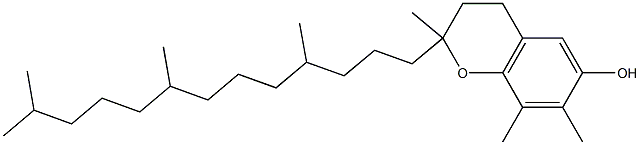
- 1406-66-2
- C28H48O2
- 416.67952
- All (0)
- China (0)
- (0)
- 1406-18-4
- C29H50O2
- 430.71
- All (0)
- China (0)
- (0)
![α-Tocopherol-[D6] (Vitamin E-[D6])](https://chemcloud-1304660855.cos.ap-shanghai.myqcloud.com/compound/202502120400270246.gif?imageMogr2/format/webp)
- 113892-08-3
- C29H50O2
- 430.72
- All (0)
- China (0)
- (0)
- 67629-40-7
- C30H49ClO3
- 493.16100
- All (38)
- China (12)
- (38)

- 59-02-9
- C29H50O2
- 430.71
- All (38)
- China (12)
- (38)

- 79434-83-6
- C29H50O2
- 430.70600
- All (38)
- China (12)
- (38)

- 2074-53-5
- C29H50O2
- 430.71
- All (38)
- China (12)
- (38)
- 142386-74-1
- C38H67N2O3P
- 630.92400
- All (38)
- China (12)
- (38)

- 83376-94-7
- C29H49O2
- 429.69800
- All (0)
- China (0)
- (0)
- 1261156-27-7
- C30H52O4S
- 508.79600
- All (0)
- China (0)
- (0)
Related Products More >

- CNY Request For Quotation
- CNY Request For Quotation
- CNY Request For Quotation
- 2074-53-5
- CNY 30.0000
- 25kg
- 30999-06-5
- Request For Quotation
- 50kg
- 30999-06-5
- Request For Quotation
- 1kg
- 991-84-4
- Request For Quotation
- 991-84-4
- Request For Quotation


People often rub a little vitamin E oil onto their scalp or mix it with other oils for a nourishing hair treatment. It can help with dryness and might reduce inflammation that could block hair growth. But it’s not like a magic potion—results can vary from person to person. Some notice their hair feels softer or looks shinier, but the actual speed of hair growth might not change drastically.
If you’re dealing with hair loss or thinning, vitamin E oil might be a gentle way to support your scalp health alongside other treatments. Just remember, it’s best to do a patch test first, since some people might get a bit of irritation. Overall, vitamin E oil is a popular, natural option to try if you want to care for your hair a little extra.
From a physiological perspective, hair growth depends on the well-functioning of hair follicles embedded in the dermis. Follicles are sensitive to oxidative damage and inflammatory processes, which can lead to miniaturization and eventual hair thinning or loss. Vitamin E oil's antioxidative properties counteract lipid peroxidation in follicular membranes, potentially slowing down these degenerative changes. Moreover, vitamin E can influence the lipid bilayer fluidity of skin cells, improving barrier function and moisture retention, factors that indirectly promote an optimal environment for hair growth.
Chemically, tocopherols in vitamin E oil have a high affinity for lipid-rich environments, making them particularly effective in penetrating the scalp’s sebum and hair shaft lipids. This penetration can help in mitigating dryness and brittleness in hair fibers, thus reducing breakage and improving overall hair quality. In addition, vitamin E's anti-inflammatory effects may inhibit pro-inflammatory cytokines that otherwise impair hair follicle cycling, contributing to healthier hair growth phases.
Cross-disciplinary insights connect dermatology, biochemistry, and cosmetic science to illuminate how vitamin E oil functions not only as a protective agent but also as a conditioning and therapeutic compound. In industrial applications, vitamin E derivatives are frequently incorporated into hair care formulations aimed at improving scalp health and hair resilience. Medically, while vitamin E oil is not a standalone treatment for severe alopecia or underlying systemic conditions, its role as a complementary topical agent is recognized for improving scalp conditions that hinder hair growth.
Overall, the interplay between vitamin E oil's antioxidative capacity, its interaction with skin and hair lipid structures, and its anti-inflammatory effects constructs a plausible biological basis for its use in hair care regimens. This makes it an intriguing option in both everyday personal care and clinical adjunctive therapy for maintaining scalp health and potentially supporting hair growth.
The oil’s role extends beyond protection; it also aids in improving blood circulation to the scalp. Massaging it into the skin stimulates capillaries, increasing the delivery of oxygen and nutrients to hair follicles. This enhanced blood flow can revitalize dormant follicles, which may be why some people with thinning hair report thicker regrowth over time. Consider someone with a history of tight hairstyles that strain the scalp—over time, this tension can restrict blood flow, leading to hair loss. Incorporating vitamin E oil into their routine, paired with gentle massage, can help counteract this effect, creating a more nurturing environment for follicles to thrive.
While its benefits are linked to follicle health and reduced breakage, it’s important to note that vitamin E oil does not create new follicles. For those with genetic hair loss, its impact is more about preserving existing hair rather than regrowing large areas. A person with androgenetic alopecia might use it alongside other treatments, finding that it reduces the brittleness of remaining hair, making it appear fuller. This synergy highlights how the oil functions as a supportive element in broader hair care strategies, working with the body’s natural processes rather than overriding them.
Vitamin E oil's antioxidant properties are crucial in this regard. By neutralizing ROS, it helps maintain the integrity of the hair follicle cells, ensuring proper cell function and division. This is different from other vitamins involved in hair health, such as biotin. Biotin is a water - soluble B - vitamin that plays a key role in the synthesis of keratin, the main structural protein of hair. While biotin directly contributes to the building blocks of hair, vitamin E focuses on protecting the cellular environment in which hair growth occurs. Another related concept is minoxidil, a topical drug used for hair loss treatment. Minoxidil works by dilating blood vessels in the scalp, increasing blood flow and nutrient delivery to the hair follicles. In contrast, vitamin E does not have a direct vasodilatory effect but rather acts on a cellular level to prevent oxidative damage.
There are some potential misunderstandings surrounding the use of vitamin E oil for hair growth. One common misconception is that applying large amounts of vitamin E oil directly to the scalp will lead to rapid and significant hair growth. However, the absorption of vitamin E through the skin is limited, and excessive application may not provide additional benefits. Moreover, the effectiveness of vitamin E oil also depends on an individual's overall nutritional status and the underlying cause of hair problems. If hair loss is due to genetic factors or hormonal imbalances, vitamin E oil alone may not be sufficient to reverse the condition. Additionally, some people may experience skin irritation or allergic reactions when using vitamin E oil, especially if they have sensitive skin. It is important to perform a patch test before widespread application.
In the field of hair care engineering, the formulation of vitamin E - containing products is also a significant aspect. The stability of vitamin E in a product formulation is a challenge because it is susceptible to degradation by light, heat, and oxygen. To ensure the long - term effectiveness of vitamin E oil - based hair care products, engineers use various techniques such as microencapsulation. This process involves enclosing vitamin E molecules in tiny capsules, protecting them from external factors and allowing for a controlled release of the active ingredient over time. This is different from simple blending of vitamin E into a product, as microencapsulation can enhance the bioavailability and stability of vitamin E, making it more effective in promoting hair health.