


 Home
Home
I was chatting with a friend who’s just getting into chemistry, and they asked, “Hey, is Na a small molecule?” I get where that question’s coming from—it’s short, just two letters, right? But is sodium (Na) really a molecule?
Is Na a Small Molecule – Or Something Else Entirely?
Related Encyclopedia
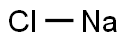
- 7647-14-5
- ClNa
- 58.44
- All (45)
- China (29)
- (45)
- 1173022-42-8
- CO2
- 43.98980
- All (4)
- China (4)
- (4)

- 138832-57-2
- CO2
- 44.00950
- All (4)
- China (4)
- (4)
- 1031883-92-7
- C2O
- 40.02080
- All (4)
- China (4)
- (4)
- 75042-80-7
- CO2
- 47.00160
- All (4)
- China (4)
- (4)
- 75042-81-8
- CO2
- 48.00160
- All (4)
- China (4)
- (4)

- 124-38-9
- CO2
- 44.01
- All (4)
- China (4)
- (4)
- 20273-06-7
- CO2
- 50.00160
- All (4)
- China (4)
- (4)
- 1173022-38-2
- CO2
- 47.99830
- All (4)
- China (4)
- (4)

- 20510-56-9
- ClNa
- 60.46000
- All (0)
- China (0)
- (0)
Related Products More >

- 7757-82-6
- CNY Request For Quotation
- 10124-56-8
- CNY Request For Quotation
- 7758-19-2
- CNY Request For Quotation
- 2893-78-9
- CNY Request For Quotation
- 63231-66-3
- CNY Request For Quotation
- CNY Request For Quotation
- CNY Request For Quotation
- CNY Request For Quotation


The term "small molecule" typically refers to low-molecular-weight compounds (usually <900 daltons) formed by covalent bonding between atoms, such as water (H₂O) or glucose (C₆H₁₂O₆). Sodium, as a metal, does not form molecules; instead, it readily loses its valence electron to become a sodium ion (Na⁺), which exists in ionic compounds like NaCl. Thus, Na is an element, not a molecule, and the concept of "small molecule" does not apply to it.
Sodium (Na) is a SINGLE ATOM in pure form, not a molecule. It forms giant metallic lattices—like a Bollywood dance group clinging together!
Why NOT a Molecule?
Atomic Structure:
Pure Na = isolated atoms (11 protons + electrons).
No covalent bonds → can’t be a molecule!
Metallic Madness:
Solid sodium = 10²³ atoms linked by delocalized electrons → ∞ network (not discrete units).
Size Wars:
Species Size (nm) Type
Sodium atom (Na) 0.19 Single atom
H₂O molecule 0.28 Small molecule
Protein (haemoglobin) 6.5 Macro-molecule
When Na Becomes Molecular?
☁️ Gaseous Sodium:
Forms Na₂ dimers (weak bonds, like friends in shared auto)—only at 800°C+!
🧪 Ionic Compounds:
Loses electron → Na⁺ ions (e.g., NaCl → crystal, not molecule).
Why Lab Freaks Out?
🌊 Water Reaction:
2Na + 2H₂O → 2NaOH + H₂↑ + 🔥
(Explodes like firecrackers!)
⚠️ Safety Alert:
Store under kerosene → isolates lone Na atoms.
Never touch—sweat alone can ignite it!
Industry Tricks with Na:
Use Case Role
Coolant Liquid Na in nuclear reactors (transfers heat)
Streetlights Na vapor emits bright yellow light
Organic Synthesis Reduces alkyl halides → fuels
Final Verdict: Na = maverick solo atom. Forms molecules only under extreme conditions!
Sodium is renowned for its reactivity, especially when encountering water, where it vigorously reacts to form sodium hydroxide (NaOH) and hydrogen gas (H₂), releasing significant heat in the process. This reaction underscores sodium's tendency to lose one electron, attaining a stable electron configuration akin to that of neon. From a physical perspective, sodium exhibits metallic properties, including luster, ductility, and conductivity, further distinguishing it from molecular substances.
The concept of a "small molecule" typically refers to simple compounds composed of a few atoms, such as water (H₂O), carbon dioxide (CO₂), methane (CH₄), ammonia (NH₃), or oxygen (O₂). These molecules have distinct chemical formulas and exhibit unique properties based on their atomic composition and bonding.
Given sodium's status as an elemental atom rather than a compound, it doesn't fit the classification of a small molecule. However, this distinction sparks intriguing questions about the nature of elements versus molecules and encourages deeper exploration into the fundamental building blocks of matter.
Now, sodium can be part of a compound—like NaCl (table salt)—and that’s when it starts playing a more familiar role in everyday life. Sodium ions (Na⁺) are super important for nerve function, muscle movement, and even fluid balance in the body. But too much sodium? That’s linked to high blood pressure and heart disease.
In the lab, sodium’s used in a bunch of inorganic reactions. But be careful—pure sodium metal reacts violently with water, releasing hydrogen gas and heat. Definitely not something to play with in your kitchen.