


 Home
Home
Hi, I'd like to ask—does calcium chloride erode paver surfaces over time? Will it cause color fading or structural cracks? How does its de-icing effect interact with paver materials? Are there alternative de-icers safer for concrete pavers? What application methods can prevent damage to pavers? Thanks!
Is Calcium Chloride Safe for Pavers Long-Term? Effects & Precautions
Related Encyclopedia
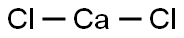
- 10043-52-4
- CaCl2
- 110.98
- All (479)
- China (34)
- (479)
- 99886-95-0
- CaClI
- 202.43500
- All (0)
- China (0)
- (0)
- 14031-58-4
- CaClHO
- 92.53830
- All (0)
- China (0)
- (0)
- 127886-77-5
- CaClHO
- 92.53830
- All (0)
- China (0)
- (0)
- 22691-02-7
- CaCl2H2O
- 128.99900
- All (0)
- China (0)
- (0)
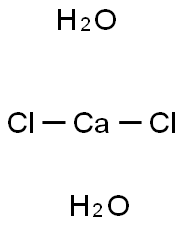
- 10035-04-8
- CaCl2H4O2
- 147.01
- All (116)
- China (17)
- (116)
- 7774-34-7
- CaCl2H12O6
- 219.08
- All (16)
- China (1)
- (16)
- 75535-31-8
- CaClFH4O4P-3
- 193.53000
- All (0)
- China (0)
- (0)
- 135732-52-4
- C4H12CaCl2O
- 187.12100
- All (0)
- China (0)
- (0)
- 20280-08-4
- C12H24CaCl2N8
- 391.35700
- All (0)
- China (0)
- (0)
Related Products More >

- 10035-04-8
- CNY 110.0000
- 25kg
- 10043-52-4
- USD 4.8000
- 25kg
- USD 35.0000
- 25kg
- 7774-34-7
- Request For Quotation
- 25kg
- 7774-34-7
- Request For Quotation
- 1ton
- 10035-04-8
- Request For Quotation
- 10g
- 10035-04-8
- Request For Quotation
- 500g
- 10035-04-8
- Request For Quotation
- 100g


The de-icing effect of calcium chloride works by lowering water’s freezing point, but its corrosive properties interact harmfully with porous paver materials. Safer alternatives for concrete pavers include calcium magnesium acetate (CMA), a biodegradable option with reduced corrosiveness, and potassium chloride, which has a lower chloride concentration. Organic de-icers like sugar beet molasses are gentler on pavers but less effective in extremely cold conditions.
To minimize damage, apply calcium chloride sparingly—no more than 0.5 pounds per 100 square feet—and sweep away excess after use. Pre-treating pavers with a penetrating sealer creates a protective barrier against salt infiltration. Avoid applying de-icers to wet surfaces, as moisture enhances chemical absorption. Post-winter, rinsing pavers with water helps remove residual salts, reducing long-term corrosion risks and preserving the pavers’ structural integrity and appearance.
The de - icing effect of calcium chloride is due to its ability to form a brine solution when mixed with water. This brine has a lower freezing point than pure water, which helps to melt ice and snow on surfaces. However, this same property can be detrimental to pavers. The brine can seep into the pores of the paver material, leading to internal pressure as it freezes. Over time, this internal pressure can cause the paver to crack and deteriorate.
There are alternative de - icers that are considered safer for concrete pavers. Sodium chloride, or rock salt, is a common alternative that is less likely to cause chemical damage to pavers. However, it is less effective at lower temperatures compared to calcium chloride. Another alternative is calcium magnesium acetate, which is less corrosive and more environmentally friendly. It is also less likely to cause damage to concrete surfaces.
To prevent damage to pavers when using de - icers, several application methods can be employed. One approach is to use a pre - wetting technique, where the de - icer is applied to the surface before snowfall. This can help to reduce the amount of de - icer needed and minimize its contact with the paver surface. Another method is to use a mechanical means of snow removal, such as shoveling or plowing, before applying any de - icers. This can help to reduce the amount of de - icer needed and minimize its contact with the paver surface.
Pavers made from concrete, cement-based materials, or natural stone are particularly vulnerable. Calcium chloride increases water absorption into the paver structure, which then freezes and expands when temperatures drop. This repeated expansion and contraction can cause surface scaling, where the top layer of the paver begins to flake off. Over time, this weakens the structural integrity of the paver and may lead to visible cracks or spalling. The problem is exacerbated in porous materials that absorb more water, as they retain moisture longer and experience greater freeze-thaw stress.
Color fading is another concern, especially for dyed or stained pavers. Calcium chloride can react with the pigments or surface sealants, leading to gradual discoloration. The moisture retained by the compound also creates an environment conducive to mold and mildew growth, which can stain paver surfaces if not regularly cleaned. Structural cracks may develop as the freeze-thaw cycles weaken the bond between pavers and the joint sand, causing shifting and separation over time.
When comparing de-icing alternatives, magnesium chloride is often considered a milder option, though it still poses similar risks of moisture retention and freeze-thaw damage. Calcium magnesium acetate (CMA) presents a non-corrosive, biodegradable solution that is significantly less damaging to pavers and concrete, though it is less effective at very low temperatures. Potassium acetate offers another environmentally friendly option but is typically more expensive and used in specialized applications.
Application methods play a crucial role in minimizing damage. Pre-treating surfaces before ice forms reduces the amount of de-icer needed, while using sand or traction aids eliminates chemical exposure entirely. Sealing pavers with a penetrating sealer creates a protective barrier against moisture and salt penetration. Diluting calcium chloride solutions and applying them sparingly can also mitigate its impact. Regular springtime rinsing removes residual salts that accumulate over winter, preventing long-term damage from salt buildup.
For paver maintenance, combining preventative measures with selective de-icer use provides the best protection. While calcium chloride remains effective for ice removal, its long-term effects on paver surfaces necessitate careful application and alternative methods to preserve material integrity.
Safer alternatives for concrete pavers include calcium magnesium acetate (CMA), which is less corrosive, or organic de-icers like beet molasses. Sodium chloride is milder but still risky in high amounts, while sand offers traction without chemicals.
To prevent damage, apply de-icers sparingly (under 0.5 lb per 100 sq ft), focus on busy areas, and rinse pavers afterward. Avoid use below -15°C, as calcium chloride is less effective then, leading to higher, more harmful doses. A sealant can also help reduce chemical penetration into pavers.